


Using a technique called gravitational lensing and NASAThrough the Chandra X-ray Observatory telescope, astronomers caught a glimpse of two supermassive black holes that existed in the universe 2 billion years ago.
This process allows astronomers to examine distant and faint X-ray objects like these black holes in unprecedented detail, and go back in time to the time when the age of the universe was only a fraction of its current age of about 14 billion years. X-ray objects It is a cosmic object that emits strongly in the X-ray region of the electromagnetic spectrum. These include areas around stars, supernovae, and black holes.
According to a forthcoming study, the X-ray-emitting object in question is 12 billion light-years away from the Earth. It is likely to be a double-growth supermassive black hole, with a distance of only 650 light-years between them. Astrophysical Journal.
NASA/CXC/M. Weiss/SAO/D. Schwartz et al./NASA
Although Chandra has previously observed a growing number of supermassive black holes in pairs and trios, they are usually closer to the Earth or farther apart. This is the first time the observatory has been able to distinguish such a pair from such a long distance and such a close distance.
These objects exist as part of the MG B2016+112 system and were originally discovered during the radio wave emission of the system. Radio data indicate that there are two supermassive black holes, each of which seems to be emitting a jet of matter.
This highlights the areas for follow-up research by Dan Schwartz and his team at the Harvard and Smithsonian (CfA) Center for Astrophysics. However, if you want to examine the area in more detail and distinguish suspicious black holes, you need to use X-ray emission. Since the X-rays emitted by the MG B2016+112 system are very weak, the only way to do this effectively is to use the phenomenon of gravitational lensing and natural X-ray lenses—a huge mass object—that can enhance the light.
Gravitational lensing is a phenomenon predicted by Albert Einstein in his general theory of relativity.This shows that the mass of the object is like galaxy, Black holeAnd the stars “distort” space. This causes the light to bend as it passes through the object, so the emission is usually amplified or enhanced.
This means that when a galaxy It exists between us and the light emitting source, and it can almost function like a cosmic magnifying glass-greatly enhancing the field of view of objects behind it.
By using such an intermediate galaxy as a lens, Schwartz and his team were able to distinguish three independent X-ray sources from two very closely spaced supermassive black holes.
The light from a black hole is distorted to produce two beams of light, while the light from a darker object forms a single light source. This discovery is a true proof of concept using gravitational lensing to enhance X-ray source detection, because the X-ray emission from the weaker of the two sources is magnified about 300 times, which means it will not be magnified and visible with another technique .
In addition, this research can help astronomers discover how supermassive black holes developed to such a huge size in the early universe.
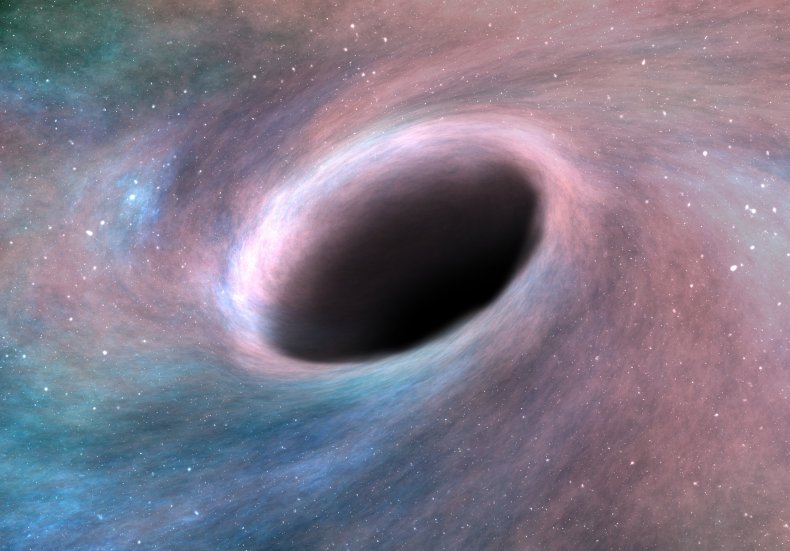
Getty Images


