


Mugwort uses abound! This self-seeding perennial is easy to grow and has many valuable benefits as food and medicine.
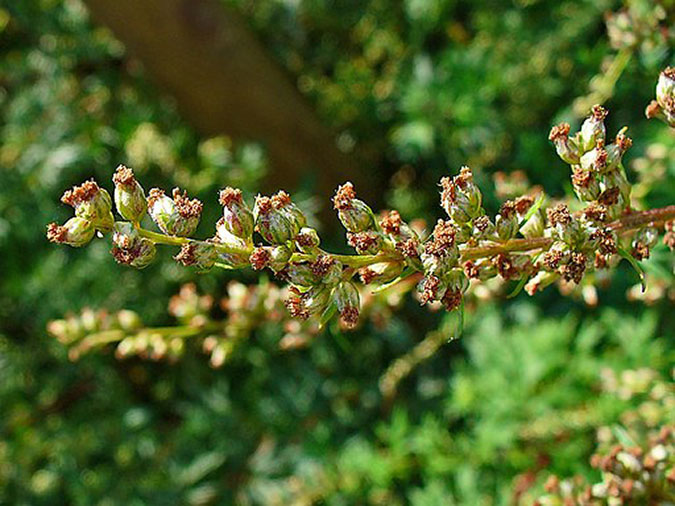
H. Zell, CC BY-SA 3.0, via Wikimedia Commons
For the Love of Mugwort: 7 Mugwort Uses You Need to Know
Mugwort (Artemisia vulgaris) is a divine lady who goes by several names, including wild wormwood, chrysanthemum weed, artemis, Old Uncle Henry, St. John’s plant, and cronewort.
As a simple-to-grow perennial that self-seeds readily, mugwort easily grows to 4 ft. and more. She can grow in all types of soils, including poor and alkaline, but she does prefer good drainage. She can tolerate drought and likes full to part sun.
Identifying Mugwort in the Wild
Her central stem is purplish like the color of a deep Bordeaux wine, while her feathery, deeply divided pinnate leaves are dark green on the upper surface and covered with downy hairs reminiscent of the moon’s silvery sheen on the underside.
Her reddish or pale yellow flowers bloom from July to October. Although nondescript, mugwort flowers are delicate to behold.
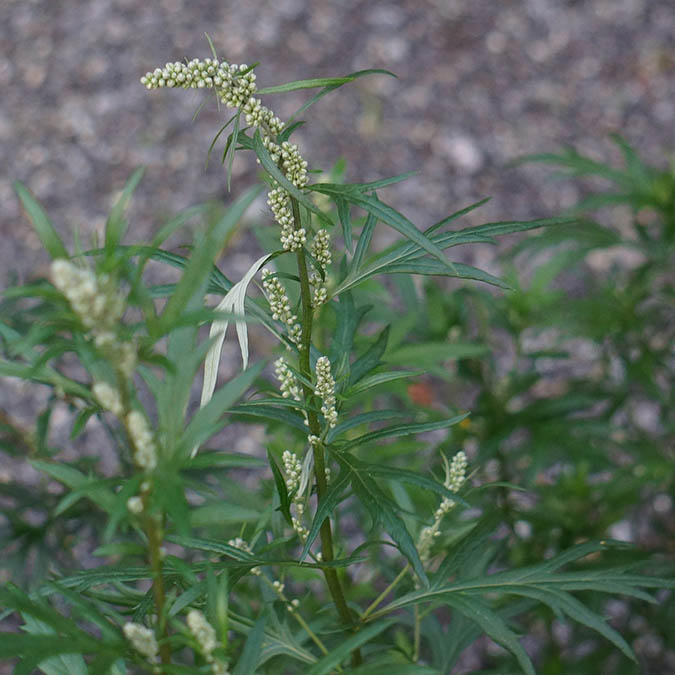
Image by Merja Partanen from Pixabay
You can easily purchase mugwort seeds and grow her yourself to take advantage of her benefits. But chances are that she might be growing in your backyard already. Truth is, she grows all over temperate Europe, Asia, Africa, and even some parts of Alaska.
You’ll find the mugwort flower growing in fields, in uncultivated soils, and along waysides and waste lands. Although she is considered an invasive weed in some parts of North America, you really want to get to know this tall lady a lot better considering all of her interesting properties.
Poison Hemlock Look-Alike?
Wait a minute. Doesn’t mugwort look a lot like poison hemlock? Not really. However, as with any plant, you should be 100% sure of identification. Here are 5 major differences:
- Hemlock plants can grow as much as 10–12 ft. high, while mugwort only grows to 4 ft. While I’ve met some mugworts as tall as 5–6 ft., I’ve certainly not seen any that were 12 ft. tall.
- Hemlock has white flowers with 5 petals that are arranged in umbrella-shaped clusters, while the mugwort flower is smaller, pale yellow or reddish, and arranged in groups on a raceme.
- Hemlock’s central stem is green with purple splotches, while mugwort’s stem is all purplish in color.
- Hemlock has toothed, fern-like leaves, while mugwort’s leaves are pinnately lobed with the underside of the leaves featuring a downy, silvery sheen.
- When crushed, hemlock leaves have a musky odor reminiscent of mouse urine, while mugwort’s leaves have a pleasant smell reminiscent of sage and chrysanthemum.
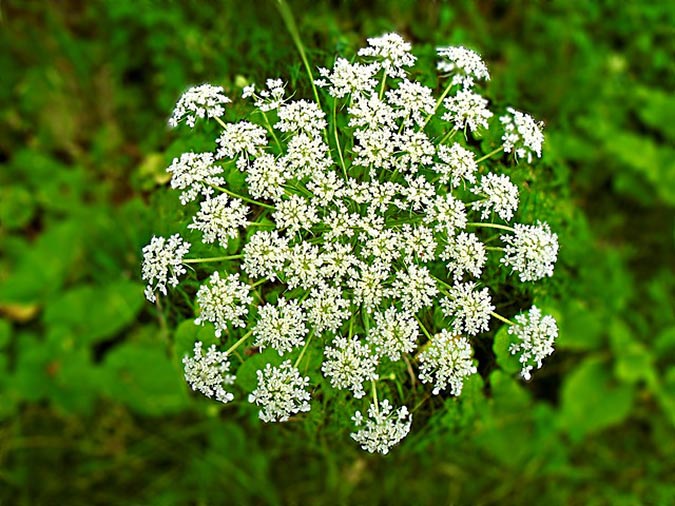
Hemlock (Conium maculatum) flowers are white and grow in umbrella-shaped clusters.
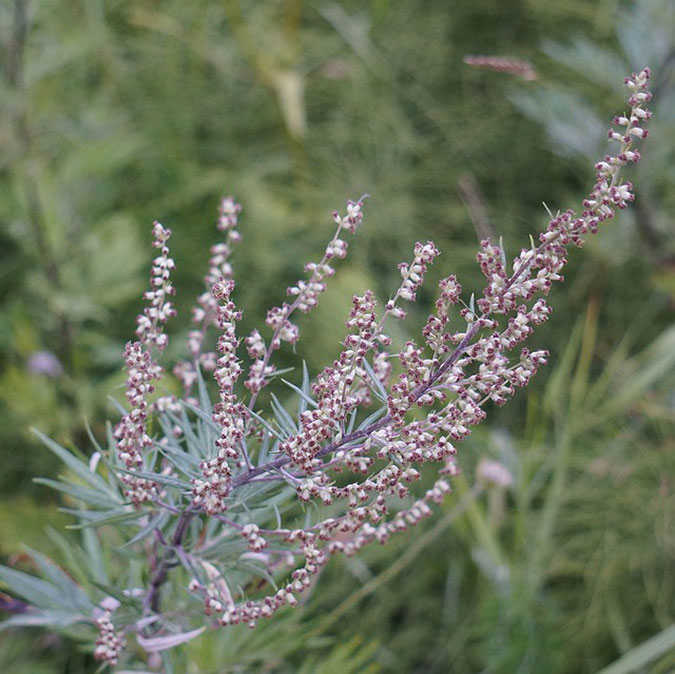
Mugwort (Artemisia vulgaris) flowers are pale yellow or reddish in color and grow in racemes.
7 Edible and Medicinal Mugwort Uses
Now let’s look at the many interesting edible and medicinal uses of mugwort—the reasons why this wonderful lady is a sure keeper.
#1: Flavorful as a Bitter Aromatic
On the edibility scale, she’s considered a bitter aromatic, which means she helps to get the liver juices flowing. Some don’t mind her raw, so if you are keen on her taste, you can add a few of her leaves and flowers to salads. Others prefer her leaves and flowers in soups and stews, much as you would use flavorful herbs like cilantro, dill, or parsley.
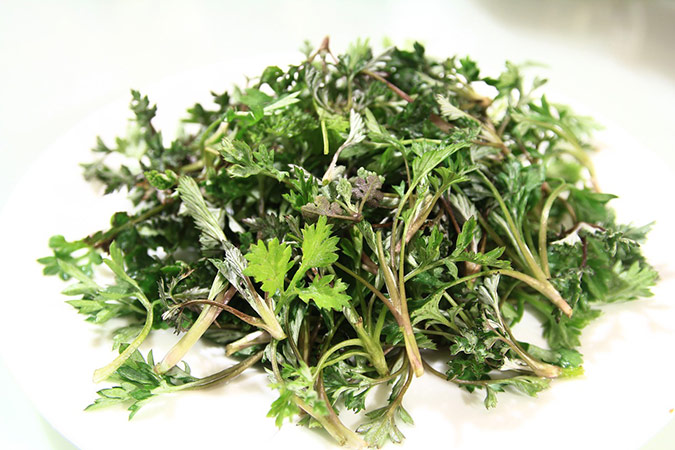
Image by cheolhan jo from Pixabay
Don’t Miss This —> In TGN’s exclusive Bitters eCourse, learn about these beneficial staples in your home apothecary. Though they are commonly known to be found in drinks, bitters are also an essential first aid tool for gut health, immunity, and inflammation. In this short eCourse, you will learn what it takes to create your own bitters, allowing you to stock your cabinet full of medicinal goodness.
Along a similar vein, you can add some of her leaves and flowers as you would other herbs to flavor rice and grain dishes, fish, meat, and poultry—and even deviled eggs. If you’re into green juices and green smoothies, you can add in a small handful of leaves and flowers along with other greens and fruits.
#2: Tea Substitute? Tea Medicine!
Interesting tidbit: Back in WWII, when tea became a pricey luxury, mugwort was used as a tea substitute in some parts of England. Nowadays, we know that a pot of mugwort tea holds several cups of medicinal mugwort benefits to help with gas, stomach acid, bile production, and overall digestion. Her root is considered a supreme stomachic.

Image by Myriams-Fotos from Pixabay
That same cup of tea can be enjoyed as a nightcap before bedtime since mugwort also has nerve-soothing properties. She might even bring you some lucid dreams.
Mugwort uses also include star status as an emmenagogue, antispasmodic, and hemostatic, which means 1–3 cups of tea a day will help women with menstrual cramps or those who have heavy, prolonged bleeding.
How to Harvest Mugwort
Cut off the top 1/3 of the plant when mugwort is in flower. You can hang the plant upside down to dry (such as from an indoor clothesline), or chop her into small pieces and spread her onto newspaper or on mesh sheets in a dehydrator.
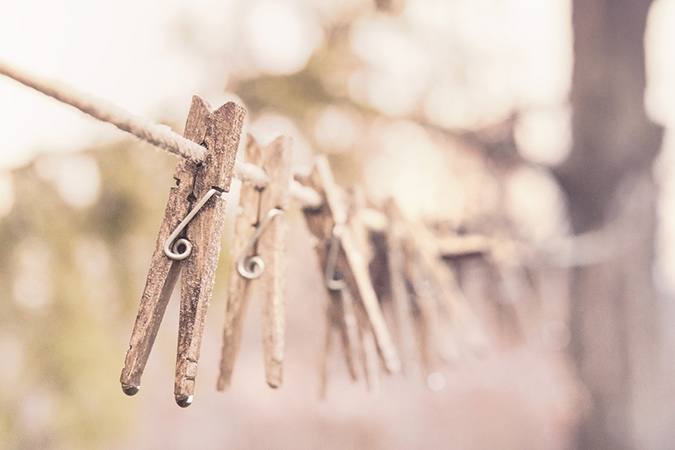
Image by Ryan McGuire from Pixabay
Roots are dug up and collected in the fall. Use a scrub brush and a bit of water to clean the roots, then spread them out on newspaper or on mesh sheets in the dehydrator and let them dry completely. All parts of the plant should be stored away from light (e.g., in paper bags).
You May Also Enjoy:
“How to Make Herbal Infusions”
“Oatstraw Benefits: Stress Reliever, Love Potion, Brain Booster, and More”
“Calendula: Lymph Mover, Detoxifier, Cancer Fighter, and Skin Beautifier”
To Make Mugwort Tea:
Place 1 oz. dried mugwort in 4 cups of boiling water and let steep 5–10 minutes, then strain. If you let it sit for longer and make a standard infusion in a mason jar for 4 hours, the tea will be quite bitter.
Feel free to halve this recipe if you want to make less tea. Keep any unused tea in the fridge for up to 2–3 days.
To Make Mugwort Root Tea:
Place 1 oz. chopped roots with 4 cups water in a glass or ceramic pot. Bring to a boil, then continue to simmer, covered, until reduced by half, about 20–30 minutes. Strain and drink.
To Make Tincture of Mugwort:
If you’d like a taste of mugwort benefits, but you want to skimp on the bitter, consider taking her as a mugwort tincture instead. It’s easy to make your own.
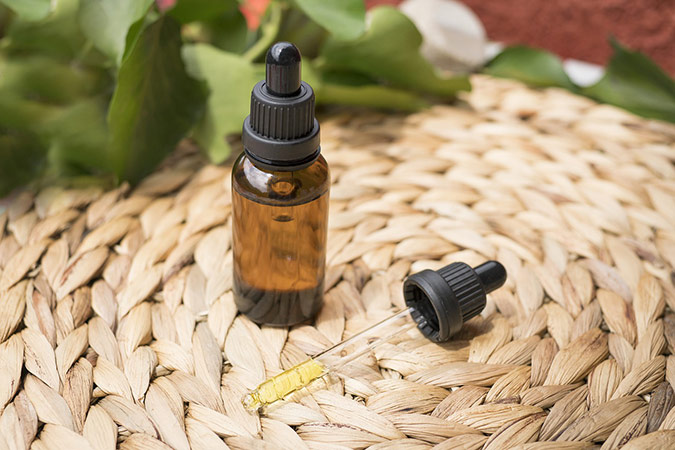
Image by Erin Stone from Pixabay
Cut off the top 1/3 of flowering mugwort plants, and chop the stems, leaves, and flowers into small pieces using scissors or pruners. Place slightly packed in a mason jar. What size mason jar you use depends on how much herb you have.
Fill the jar with alcohol, screw the lid on, and let sit for 6 weeks in a cool, dry place. Strain, and store in dark, amber-colored bottles.
Standard dosage is 5–20 drops. Use this tincture before meals to help with stomach acid and liver bile production or after meals to help with gas, bloating, and distension.
#3: Parasites, Be Gone!
Mugwort is in the same family as wormwood (Artemisia absinthium), and both are great at ridding the body of parasites and candida, including Staphylococcus aureus, Bacillus typhi, B. dysenteriae, streptococci, E. coli, B. subtilis, and pseudomonads. While you can drink the tea for this purpose, you can also try a mugwort retention enema in combination with other naturopathic treatments.

Image by Arek Socha from Pixabay
Yes, folks, you read about mugwort enemas first on The Grow Network!
To Make a Mugwort Enema:
Put 1 liter of slightly warm, finger-hot mugwort infusion* in a 2-liter enema bag. Lie on your right side, making sure that the nozzle has been well lubed, and hold in the mugwort infusion for 10–15 minutes. Candida/parasite cleanses work well on 10-days-on/5-days-off cycles, so use the mugwort enema for 10 days on, then take 5 days off. You can then repeat for another 10 days using the mugwort enema, or do a rotation and opt for other parasitic herbs used for retention enemas.
Commonly used herbs include pau d’arco, wormwood, and black walnut hulls. Since mugwort is in the daisy (Asteraceae) family, this would not be a suitable option for those with ragweed allergies.
*To Make a Mugwort Infusion:
Place 1 oz. of dried mugwort and 4 cups boiling water in a 1-liter mason jar. Screw on the lid, let steep for 4 hours, and then strain.
#4: Dream a Little Third-Eye Dream
Mugwort is said to open the third eye and to spark vivid dreaming, so let’s get to making a dream pillow! Yours can be as simple as filling a sock with dried mugwort leaves or as fancy as stuffing the dried leaves into an embroidered silk sachet. A cotton or organza bag works just fine too.
Simply place your dream pillow underneath your head pillow, and dream away! You can add some dried lavender in with the mugwort leaves to help ease you into peaceful slumber.
#5: Mugwort Clears the Bad Air
Science has officially recognized what folk medicine has known for centuries. Burning herbs to “clear the energy” does just that: It kills bad bacteria lingering around.
Mugwort benefits include its antimicrobial properties, so whether you happen to be a health practitioner about to give a healing session (such as massage, Reiki, reflexology, etc.), or you just want to purge your house of nasty bacteria, consider using a mugwort smudge or incense.

Image by Hanjörg Scherzer from Pixabay
To Make a Mugwort Smudge:
Working with the fresh herb is best for this. You can use dried branches instead, but be aware that the dried leaves will create a fine mess when you go about twining them together with string.
Chop off the top 1/3 of the flowering plant. Take off the smaller branches, and lay them with the flowers at the top and the cut ends at the bottom. Trim the cut ends so that the pieces are about the same length.
Take some cotton string and wrap the ends together, winding several times. Make a knot to secure the string in place. Then continue wrapping the branches together, working up toward the flowery end. The string might have a zigzag look, but don’t worry! Finish by wrapping the flower end several times, then cut the string and secure it with a knot.
Now let the smudge dry—drying will take some time.
You May Also Enjoy:
“A No-Nonsense, Illustrated Guide to 49 Botanical Terms”
To Use a Mugwort Smudge:
While holding the cut-stems end, light the opposite (mugwort flower) end. Hold the smudge over an ashtray or other non-flammable object to collect the ashes, and walk around the room, letting the mugwort smoke bring her clean, grounding energy. Do keep an eye on the smudge while you are doing this!
To put out the smudge completely, douse the lit end in a mason jar filled with baking soda. You can reuse the smudge if you like. You can also burn mugwort as an incense by placing a small bit of a dried branch in a nonflammable object like an incense holder and lighting the branch at the flowering tip.
Smudge rooms seasonally or as needed. Try smudging before meditation or burning mugwort as incense during meditation.
#6: Remineralize With “Strong Bones Vinegar”
A great way to get some of the calcium and magnesium required for strong, healthy bones is by using mugwort vinegar. You can make “strong bones vinegar” at home by lightly packing a mason jar of any size with fresh mugwort leaves and adding apple cider vinegar to fill the jar. Screw the lid on, and let it sit for 6 weeks before straining.
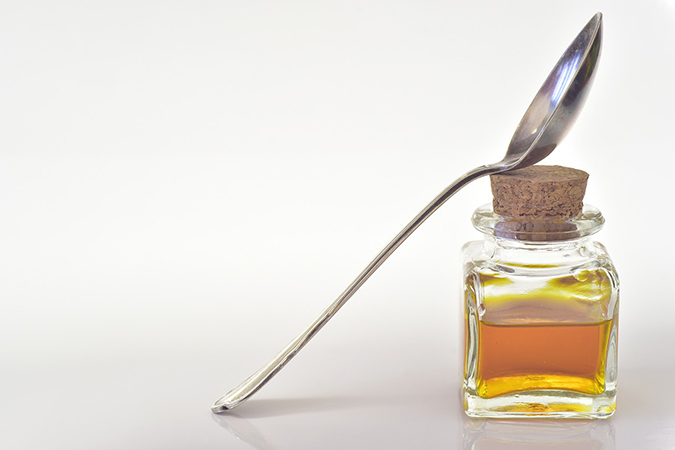
Image by Ulrike Leone from Pixabay
As the leaves soak up the vinegar, you can add in more vinegar as needed. You can use plastic wrap or parchment paper to keep the metal lid from coming in contact with the vinegar and rusting. The apple cider vinegar will leach out the calcium and magnesium from the mugwort’s leaves. Some people like to shake the bottle on a daily basis, checking to see if any more vinegar is needed.
You May Also Enjoy:
“19 Remarkable Benefits of Stinging Nettle”
If you’re like me (too busy or too lazy) and only check it occasionally, your vinegar will turn out just fine anyway so long as you leave it in a cool, dry place out of direct light.
Pour this vinegar over salads or add it to vinaigrettes. (See, mugwort benefits can taste good too!) If you use an apple cider vinegar “with the mother,” you will get the benefits of gut-friendly probiotics as well. And if you like this “strong bones vinegar,” try pairing the mugwort with chickweed (Stellaria media) or nettles (Urtica dioica), or use all three together to make a potent herbal bone vinegar.
#7: Natural Insecticide Help
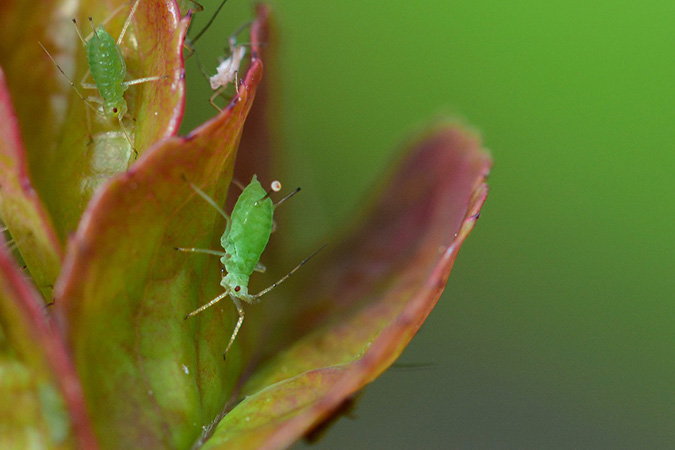
You can grow mugwort as a companion plant to dissuade aphids and other bothersome insects in the garden. However, since she can inhibit the growth of nearby plants, consider keeping her in a pot. She grows very well in containers and can easily attain 2 ft. in height. Another idea you can try is to use a weak mugwort tea to spray on infected plants as a natural insecticide.
You May Also Enjoy:
“This Natural Bug Repellent Is As Effective As DEET!”
A Few More Ways With Mugwort
Still not sold on how mugwort benefits can improve your life? You might be when you consider these other mugwort uses that you can research further on your own (especially that last one):
- Use mugwort stalks or leaves for kindling.
- Add dried mugwort to a fire to help keep it smoldering.
- Rub mugwort leaves on skin as an antidote to poison oak.
- Since mugwort is an insect repellent, try adding essential oil of mugwort with other essential oils (such as neem, thyme, fennel, lemon eucalyptus, and others) to a carrier oil (such as coconut oil) to make your own natural insect repellent. Try using 20 drops total essential oils to 1 oz. carrier oil.
- Infused mugwort oil can be used to aid in circulation, such as on varicose veins.
- If you’re an acupuncturist/acupressurist, consider making your own moxa sticks from mugwort (how-to instructions can be found on the Internet).
- Make mugwort beer. Mugwort was used in beer recipes before hops became the standard. Look for recipes for “gruit ale” on the Internet.
Note: Large amounts and prolonged use of mugwort can cause nervous system and liver damage. While some midwives might use mugwort to help induce labor, mugwort is not suitable for pregnant or lactating women. Mugwort’s flowers contain pollen, which can trigger hay fever symptoms in those susceptible. Contact dermatitis has been reported by some.
What Do You Think?
What are your favorite mugwort uses? If you are privvy to any mugwort benefits not listed above, let us know in the comments below!
_____________________________
This is an updated version of an article that was originally published on October 5, 2015. The author may not currently be available to respond to comments; however, we encourage our Community members to chime in to share their experiences and answer questions!
Psst! Our Lawyer Wants You to Read This Big, Bad Medical Disclaimer –> The contents of this article, made available via The Grow Network (TGN), are for informational purposes only and do not constitute medical advice; the content is not intended to be a substitute for professional medical advice, diagnosis, or treatment. Always seek the advice of a qualified health care provider with any questions you may have regarding a medical condition. If you think you may be suffering from any medical condition, you should seek immediate medical attention. You should never delay seeking medical advice, disregard medical advice, or discontinue medical treatment because of information provided by TGN. Reliance on any information provided by this article is solely at your own risk. And, of course, never eat a wild plant without first checking with a local expert.
The Grow Network is a participant in the Amazon Services LLC Associates Program, an affiliate program designed to provide a means for our team to earn fees for recommending our favorite products! We may earn a small commission, at no additional cost to you, should you purchase an item after clicking one of our links. Thanks for supporting TGN!
(Visited 71,811 times, 1 visits today)


