


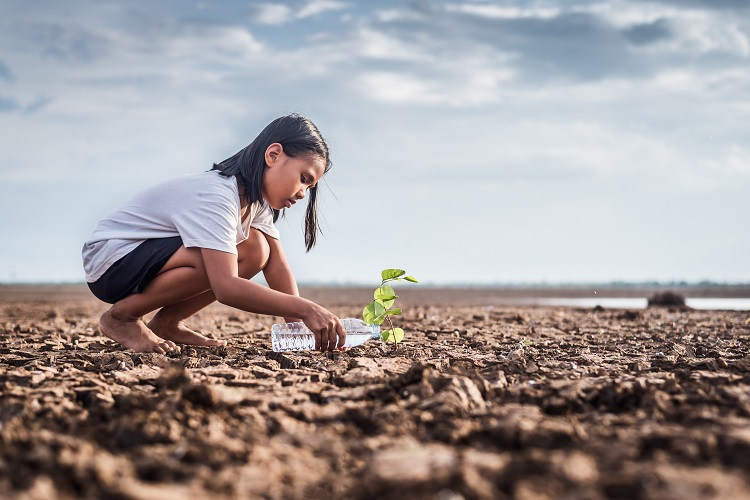
Asian girl watering green plants in dry land, cracked dry soil in drought, and climate change caused by global warming.
With the dramatic increase in population and increased economic activity, the climate has also presented its fair share of problems. This is especially evident in the context of rising greenhouse gas emissions that contribute to global warming. Failure to act will continue to pose a huge threat to the environment. (1)
With this in mind, everyone should do their part to protect the environment, and this starts with understanding climate change dynamics. With this in mind, you can educate yourself about climate change by:
- Read articles, books and watch documentaries
There are countless documentaries on environmental issues. You can find some of them on paid-only video streaming platforms or on free platforms like YouTube and Vimeo. You can also watch them on TV as they air. Visual learning is often attractive, especially if the video is professionally shot and of high quality. Beyond that, there is the entertainment value associated with it. As long as you have stable internet access, there is no limit to the number of climate change documentaries you can watch.
Alternatively, articles and climate change books This is a great option if you like to read. They are real and backed up by deep and extensive research. They cover every aspect of climate change in depth. By reading such books, you can learn about floods, droughts, and other climate changes from an academic perspective. You can find them at local bookstores and libraries, or online as ebooks.
- Attend class
Some community colleges offer short-term environmental courses. Consider signing up for such events and studying climate change in a classroom setting. This enables you to collaborate with other like-minded students and continue to have meaningful conversations around climate change. The good news is that classes are very flexible, so even if your current schedule is tight, you can still take classes. In addition, you can earn certificates and certifications that prepare you to work in organizations that advocate for environmental sustainability. Despite the politicization surrounding environmental science courses in schools, you can still learn a lot. (2)
Here are some more advantages of taking a climate change course:
- You can conduct research and provide useful data on extreme weather events that authorities can use to help advocate for climate protection.
- You’ll learn about ecosystems and how people’s actions affect wildlife, natural forests and the water cycle.
- It changes the attitude of you and your community towards land and water pollution
- It inspires you to find solutions to climate change, perhaps through innovative ways to recycle used products and release cleaner energy
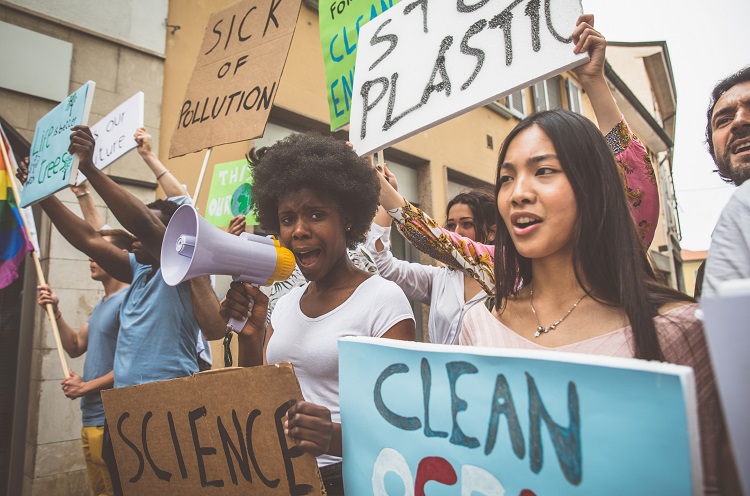
Public demonstrations in the streets against global warming and pollution.Multiethnic group protesting climate change and ocean plastic
- Join the conversation on social media
Social media has become an essential part of communication today, creating awareness and delivering information. Furthermore, climate change has been a key topic of discussion on these platforms.To increase your knowledge, you can join these conversations to see what experts have to say about droughts, floods, ice loss and other issues Environmental issues The world is facing.
Plus, social media brings like-minded people together; it becomes easy to connect with people who share the same vision for sustainability, green technology, recycling, and other areas of interest to you.
- volunteer service
Another way to learn about climate change is to volunteer with local organizations working on environmental issues. This is the perfect way to gain hands-on experience with typical climate change mitigation measures. These include:
- tree planting
- solar panel installation
- clean water
- Reduce vehicle CO2 emissions through regular maintenance
- Change consumption patterns, such as buying more durable products instead of disposables
- Build sustainable buildings with minimal environmental impact
- Liaise with government to develop national policy Reduce carbon footprint. (3) (4)
- Participate in protests and rallies
Time and again, environmental enthusiasts have staged protests and rallies to pressure leaders to implement appropriate policies to curb global warming. If there are such people in your area, please join the protest. Along the way, you’ll learn about key climate change issues and what you can do about it. You can also connect with like-minded people and exchange ideas.
Just recently, more than 1,000 scientists from 25 different countries met in the wake of the latest report from the Intergovernmental Panel on Climate Change. The report warns of the need to cut greenhouse gas emissions by 2025. Failure could leave the world staring at catastrophic climate impacts. Attending such gatherings will significantly keep you informed of current climate change developments. (5)
in conclusion
Understanding climate change is the first step in your involvement in environmental protection. You can do this formally by taking classes, or more casually by reading climate change books, attending protests, or following and participating in social media conversations. Whichever approach you take, your passion for environmental protection will allow you to get as much information about climate change as possible. This goes a long way towards making the planet a better place.
refer to
- “Changing Climate Data” Source: https://www.nytimes.com/2009/02/21/opinion/21sat3.html?searchResultPosition=7
- “Should Schools Teach Climate Change?” Source: https://www.nytimes.com/2018/02/08/learning/should-schools-teach-about-climate-change.html?searchResultPosition=3
- “Climate Change Mitigation: Practical Measures to Limit Global Warming IPCC Report 2014 Working Group III” Source: https://www.greenfacts.org/en/climate-mitigation-limiting-warming/index.htm
- “Climate Change Mitigation: Solutions for a Carbon Neutral World,” Source: https://www.unep.org/gef/index.php/focal-areas/climate-change-mitigation
- “Scientists Hold Global Climate Change Protest After IPCC Report”, https://www.smithsonianmag.com/smart-news/scientists-stage-worldwide-climate-protests-after-ipcc-report-180979913/

