


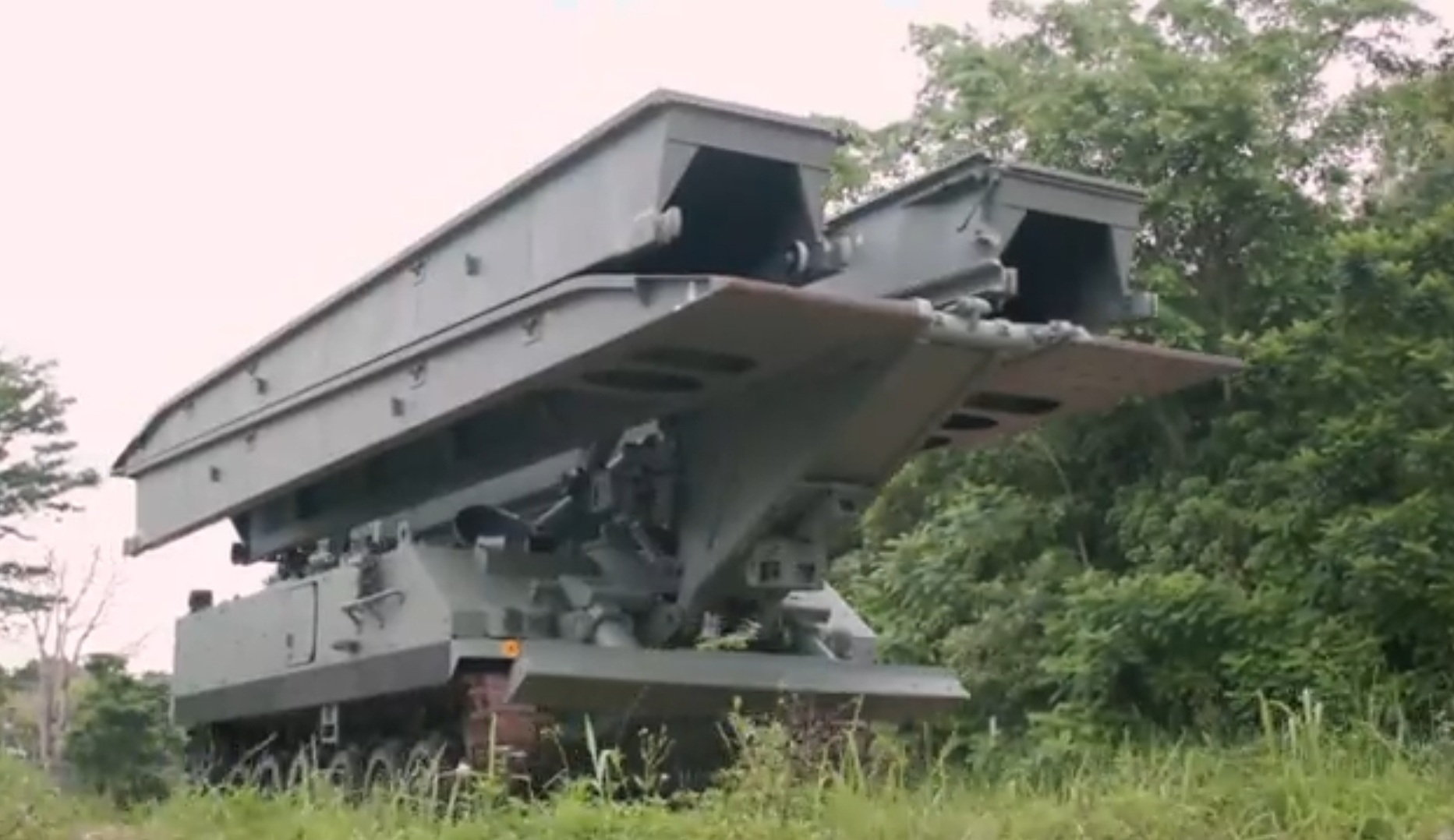
The Singapore Army revealed in a social media post in mid-October that a new combat bridge variant of its tracked Hunter armored vehicle platform had entered service.
Dubbed the Hunter Armored Vehicle Launch Bridge (HT-AVLB), the new vehicle made its debut during the Army Combat Engineers’ 55day The anniversary is celebrated on the same day as the commission.
The HT-AVLB was jointly designed by the Army and the Defense Science and Technology Agency (DSTA) and produced by local defense and engineering firm ST Engineering. A mixed reality simulator has also been developed to improve training efficiency and safety, as well as operator competency.
Specifications for the HT-AVLB have not been made public, but the baseline Hunter Armored Fighting Vehicle (AFV) is known to be 6.9 meters long, 3.4 meters wide and has a combat weight of approximately 29 tonnes. Like the AFV variant, the HT-AVLB is equipped with an all-round camera suite that provides a high level of situational awareness and enables the crew to fully maneuver and operate its bridge system while under armor protection, increasing their survivability.

According to the RSAR, the HT-AVLB – which will eventually replace the aging SM-1 launch bridge in service – can be deployed within seven minutes and networked with other hunter vehicles. The AFV variant of the Hunter platform, the service’s first combat vehicle, incorporates an indigenously developed battlefield C2 system called the Army Tactical Engagement and Information System (ARTEMIS), which is not only a Its operating system — including its weapons, sensors and communications systems — but also serves as a real-time mission planning tool and can wirelessly exchange information between friendly vehicles over low-latency network radios and wide-area communications networks.
The service also commissioned an armored recovery vehicle variant of the Hunter platform, called the Hunter Recovery Vehicle (HRV), on February 18, 2022. The HRV was first shown to the public in July 2017 as the Next Generation Armored Rescue Vehicle (NGARV), with a crew of three, including a vehicle commander, a driver and an automotive specialist technician.
The main equipment of the vehicle is a telescoping knuckle boom crane capable of traversing 360° and a recovery winch with a nominal maximum pulling force of 25,500 kg. DSTA also claims it has a “first-of-its-kind mechanism” that facilitates quick and easy towbar attachment and removal. When performing heavy-duty recovery or winching operations, the HRV deploys a front-mounted dozer-style blade and a pair of outriggers on its rear to stabilize itself.
by Jr Ng


