


Green shipping is the practice of transporting goods by ship using as few resources and energy as possible to protect the environment from pollution. Green shipping promotes greener procedures to provide pollution control, effective port management, sustainable supply chains and proper equipment maintenance.
In 2012, the shipping industry burned about 300 million tons of fuel oil and emitted 949 million tons of carbon dioxide. Without concerted action, these emissions are expected to more than double by 2050.
World freight and container companies vital to global supply networks with little success Decarbonization Progress Until recently. This must change if the world is to achieve zero emissions by 2050.
Green supply chain management is gaining more and more attention in organizations environmental issue. Main rationale for implementation Supply Chain Sustainability The method is to prevent pollution from industrial waste. Clearly, logistics activities significantly increase air pollution, impacting both the environment and the economy.
To make the supply chain more sustainable, here are some shipping plans currently being developed:
- Explore future fuels
Hydrogen is gaining momentum internationally as the greenest of all future fuel sources. In this sense, many shipping industry stakeholders have written to the European Commission to encourage the use of green hydrogen on ships as part of the upcoming regulation of marine fuels.
The advantages of using hydrogen as fuel include zero emission And there is less vibration and noise in the fuel cell. However, there are also disadvantages, including:
- The need for cryogenic storage
- difficult to extract
- can cause metal embrittlement
Meanwhile, liquefied natural gas (LNG) is a marine fuel alternative, but this option is not safe. Remember, safety is paramount and zero emissions shouldn’t mean you take it for granted. Using gas as a fuel is not suitable for many ships and requires modifications to the ship’s structure and equipment.
Using LNG as a fuel reduces carbon dioxide (CO2) by 20% and sulfur oxides (SO2) and nitric oxide (NO) by 80%. While LNG fuel is environmentally friendly, here are some major disadvantages when you use it as a marine fuel:
- Requires installation of an engine capable of running on LNG fuel
- Additional capital is required for non-engine equipment, such as gasoline tanks and reliquefaction equipment that are two to three times the size of normal tanks.
The International Maritime Organization (IMO) is working to reduce sulphur levels in marine fuels. That said, the shipping industry is starting to look at low-sulfur fuel oil (LSFO), marine gas oil (MGO), liquefied natural gas, and even fuels that currently have scrubbers on their exhaust stacks.
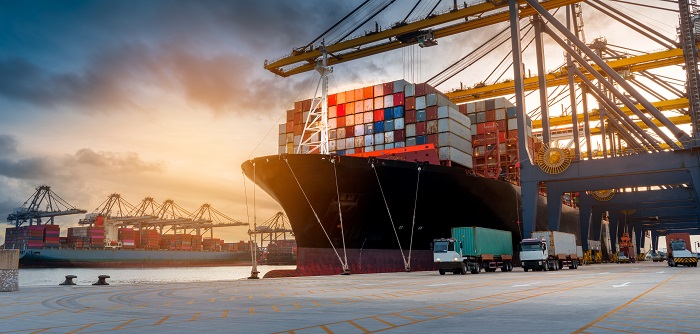
Crane loads cargo container from truck to container ship in international terminal logistics sea port concept freight
- slow steaming
slow steaming is the practice of reducing the speed of the boat to between 12 and 19 knots. This can result in a speed reduction of up to 50%. A slower driving speed generally saves fuel. In the case of a container ship, a slow sailing of 21 knots per day can reduce fuel usage to 200 tons.
This strategy has benefited several shipping companies. Maersk has been sailing slowly since 2007, reducing engine load by 35% without any mechanical problems. Maersk is also working on ultra-slow steam, which can reduce engine power by 90 percent.
- container management
Empty containers account for a large portion of ocean emissions. Unlike full containers, empty containers must meet the shipping company’s internal requirements, allowing for more integrated emissions planning techniques.
If you want to improve the efficiency and security of your shipping supply chain, you can do it with smart containers. Using a sensor-equipped container, any data from the container’s temperature to its precise location can be collected in real-time.
Supply chains can benefit from the collection of such data. By using precise sensor data, the number of relocations and the amount of fuel used in container transport can be reduced. Empty container shipping and relocation cost up to $20 billion a year in fuel and are a major source of energy loss.
- ballast water
When large container ships are empty of any cargo, they use water as ballast to keep them stable. While ballast water is necessary for the safe and efficient operation of modern shipping, the different species carried in ships’ ballast water can cause significant ecological difficulties. These include many species of bacteria, microorganisms, microscopic invertebrates, eggs, cysts and larvae.
These species may survive, establish breeding populations in host habitats, become invasive species, outnumber native species, and grow to pest proportions. For this reason, the IMO has established ballast water sterilization requirements.
- Alternative forms of energy production
Wind and solar energy can be used to power a variety of ships, helping to reduce fuel use, emissions and greenhouse gas. Fukuoka, Japan is home to a company called Eco Marine Power (EMP), which focuses on getting ships to run on renewable energy.
They are dedicated to creating and developing zero-emission sail-assisted propulsion systems for wind and solar powered vessels. Solutions developed by EMP will help shipyards and shipowners meet Energy Efficiency Design Index (EEDI) standards.
take away
Although shipping is the cleanest and safest way to transport goods, achieving green shipping is a major challenge for the shipping industry. Fundamental technologies must be developed to transform the shipping industry into a sustainable industry. The most difficult aspect of green shipping is finding viable energy sources and developing ways to store them.


