


Multiple challenges arise when creating content for financial companies.
Processing legality is paramount, but there is more. Much more.
I’ve had some difficulties working with multiple companies in the financial space and ghostwriting for top investors/financial CEOs on Forbes and other business magazine pages.
Below, I’ll share the challenges marketers face when creating content for financial services brands—especially written content—and solutions to those challenges.
But first, let’s discuss what to focus on when creating content in the financial industry: Google’s YMYL and EAT concepts.
Understanding Google’s YMYL/EAT Financial Content Guidelines
In the wake of the censorship uproar, Google precedent created special algorithmic considerations for information it deems important in areas such as financial advice, current affairs, politics, legal advice, and more.
The reason is simple – poor financial advice can have potentially devastating financial consequences for innocent people.
The last thing Google wants for its brand is to provide bad financial information that negatively impacts your money and life.
That’s why Google refers to important content like financial advice as Your Money, Your Life (YMYL) content.
Google explains how they evaluate and rank YMYL content from their report titled How Google is fighting disinformation:
“When our algorithm detects that a user’s query is related to the ‘YMYL’ topic, we will place greater emphasis on factors such as our understanding of the authority, professionalism or trustworthiness of the responding page in our ranking system.”
Having said all that, I want you to remember three related keywords: expertise, authority, and trustworthiness.
These traits later made up Google’s infamous EAT, which was part of Google’s algorithm and incorporated into Google’s Search Quality Evaluator Guidelines.
Let’s explain from a content creator’s perspective:
- professional knowledge: Is the specific author or publication an expert on the subject?
- authority: How authoritative is the website and author? It depends on more traditional factors like backlinks, social signals, page traffic, etc.
- credibility: How credible is the source? For example, does the source have a lot of traffic and have you received any complaints?
Unfortunately, Google’s algorithms aren’t smart enough to understand the viability of financial advice, so they have to take into account signals like the author’s expertise and authority to rank content.
That’s why the first four results of the search [how to do my taxes] are all brands and TLDs we endorse or trust:
-
screenshot from search [how to do my taxes]Google, February 2022
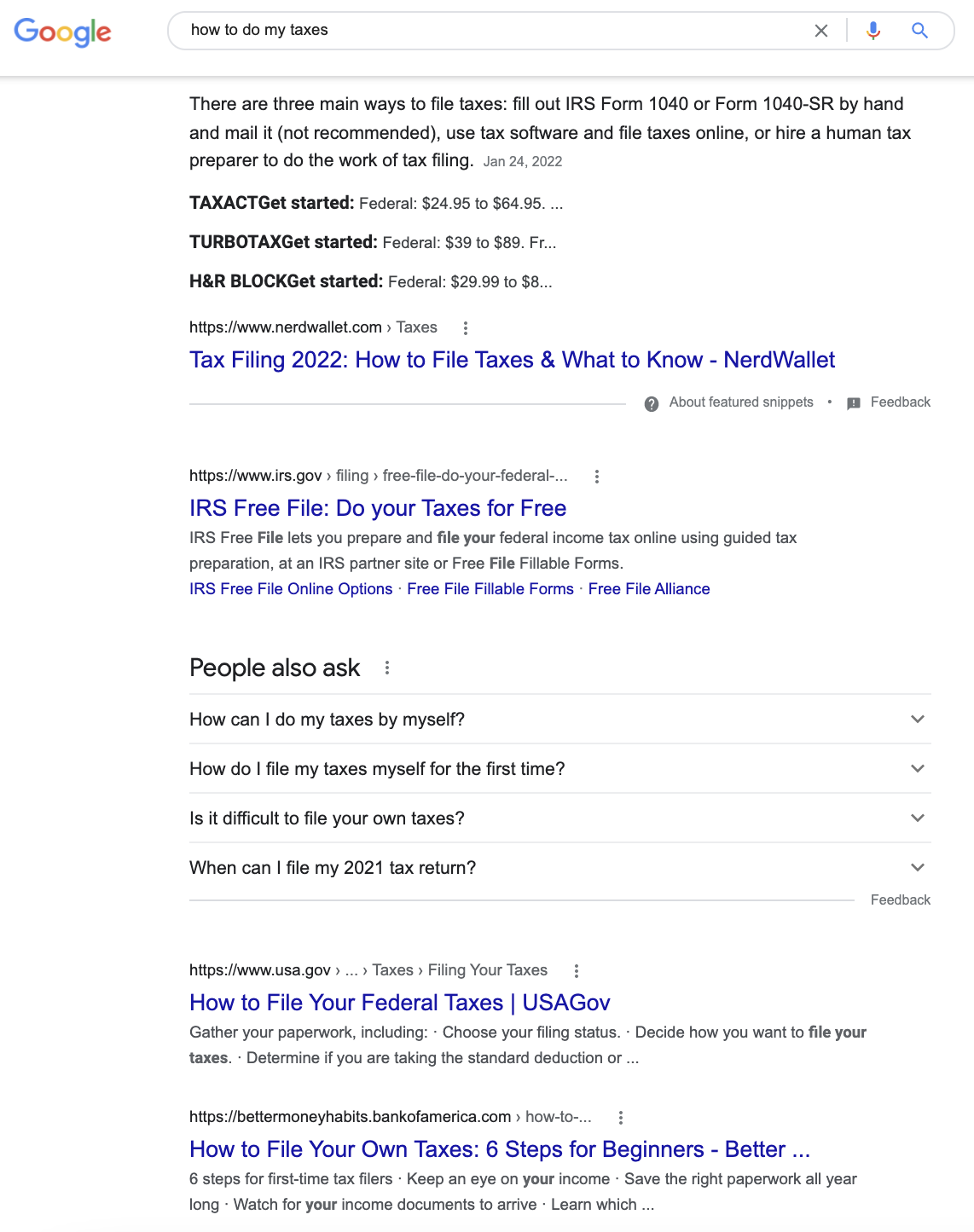
However, this presents a major challenge for smaller brands and businesses looking to enter the financial space through organic search.
Additionally, as financial content is created, there are legal and other financial issues.
It doesn’t stop there.
Implementing this strategy presents additional challenges that are often more annoying than the creative thinking stage.
This is due to the multiple legalities and bureaucracy behind most financial services brands.
Here are some content marketing tips for financial services brands I’ve learned along the way.
Financial Services Content: Common Challenges and Solutions
1. Compete in organic search
Due to Google’s strict measures EAT and YMYL Guidelinesa financial blog or website can never compete with Turbotax or Nerdwallet.
The most obvious solution is to create thought leadership for their brand.
Of course, this raises a well-known catch-22.
To build authority, you need exposure, but Google struggles to do that for the broad topics that provide the most exposure.
Here are some solutions to up our content game and come up with unique ideas.
solution
- Become a thought leader by writing guest posts Write books or ebooks related to your industry for well-known bloggers, or build your brand on social media.
- Long-tail keywords for unique topics Lower search volume and better for your audience.
- Guest posting opportunities for experts Write on your website and generate some buzz/authority.
- Create content featuring multiple financial experts Provides additional relevant information on broader topics.
- Partnerships with data or analytics companies Original research on trends.
- Create surveys on a wide range of topics Find out how industry trends are changing.
- Leverage video and alternative media Create shareable content on your website.
2. Compliance with regulations
As with medical businesses, false information can quickly get your clients into trouble with the authorities.
Of course, this can ruin your image, which is hard to build when you’re the focus of a lot of negative criticism.
Unfortunately, financial services in particular are subject to some of the strictest regulatory scrutiny when it comes to producing online content, sharing and promoting your brand on social media.
FINRA (Financial Industry Regulatory Authority) is a well-known regulator that monitors everything on social media, from influencers to financial services content.
FINRA’s Rules Designed to “protect investors from false, misleading statements, exaggerated statements and material omissions”.
In addition to FINRA, there are many additional regulations targeting various segments of financial services content.
E.g, Office of the Comptroller of the Currency Strict rules are in place to regulate the accuracy, clarity and compliance of content particularly relevant to banking services.
solution
- Create a disclaimer Protect your customers from legal liability.
- Update their website to reflect regional privacy laws to avoid liability.
- Hire knowledgeable writers financial services.
- Set strict guidelines for content Based on well-known regulatory hurdles.
- Make sure your clients follow the legal review process to ensure proper compliance.
- stick to topics you are familiar with Their legal team is experienced.
3. Look for knowledgeable writers
In the above solution, I outline the need to find writers with expertise in financial and regulatory affairs.
However, as someone who has managed a team of freelancers for years, this is certainly easier said than done.
The biggest problem is finding those who are subject matter experts. Once you find an expert, two other problems come to the fore – the author is either too expensive for your budget or poorly written.
solution
- reverse engineer EATFind authors of premium SERP articles and offer them freelance partnerships (if within budget – many of the best financial writers won’t reach for articles for less than $1 or $750 per article!)
- Use LinkedIn arrive Create accurate ads about what you’re looking for, with examples and budget in mind. You’ll get a lot of noise there, but you’ll find a capable person. My rider success rate is about 10% – yes, 1 in 10 writers are usually able to create what they need.
- hire and Train in-house writers.
4. Time is of the essence
Government and independent financial reports are generated daily, so financial news and current events move quickly.
The last thing you want is a post about a big story in a week-long comment. These frustrations are further amplified when dealing with the extended review process for enterprise companies.
If your clients provide financial advice or reports of any kind, the review process must be optimized to extract content in real time.
solution
- Develop content guidelines for legal compliance Reduce review time with your clients.
- priority Live and Interactive Content Editorial review.
- something about Simplified review with other partners (maybe take ownership of the channel or go one step ahead).
5. Target the right readers
You will meet a wide variety of people with different levels of expertise in the financial world.
Readers are easily overwhelmed by jargon and complicated financial procedures, especially when dealing with topics like taxes, cryptocurrencies, retirement accounts, and investment portfolios.
Simplify content So it’s important that most readers can understand it, but it’s also important to produce the best content for those readers who are most likely to go further with your or your client’s brand.
You need to develop a strategy that caters to people looking for general financial advice, to increase client authority, and to create targeted content for people who are particularly interested in hiring their company.
solution
- Simplify top funnel content to reach a wider audience.
- Meeting customers in the funnel with a CMS Based on their interactions with your website (the content can be more complex).
- Develop intent by following up on relevant recommendations and selling points based on their engagement history.
- Provide this information to sales for follow up With sales calls that focus on specific customer pain points.
6. Update outdated content
In general, stale content can be a waste on any website, but it can leave a site with outdated or non-compliant content in a world of legal issues.
The solution is simple but time consuming.
solution
- Site-wide audit with website crawler like screaming frog and download all URLs into a spreadsheet. After the main run, I recommend semi-annual or quarterly for large accounts.
- Which topic trends to analyze upper most samlash Or any tool to decipher what needs to be updated or disposed of.
- remove any temporary content Obsolete or no longer compliant.
- Update evergreen content Traffic has dropped significantly.
7. Find resources
As you know, financial content is complex.
If you’re writing on behalf of other companies or yourself, it’s hard to justify a budget for a blog post, spending more than $750 between research and labor.
solution
- Set a budget to deal with the extra burden of writing long content full of financial advice.
- Set clear expectations in terms of time and money when working with other content marketing partners.
Although financial services and all YMYL content have higher barriers than other niche areas, Return on investment in content marketing same height.
Target a mix of evergreen and trending content and follow the advice above to talk to each target customer and meet the strict regulations and legalities of financial content.
More resources:
Featured Image: eamesBot/Shutterstock


