


We live our lives according to personal and work calendars, so why not adopt this organizational principle and apply it to our marketing strategy? Input: social media calendar.
What is a social media calendar?
A social media calendar is an internal tool in which you can plan, assign, create, and schedule content that will eventually be published to different social networks.
Some companies use basic tools such as spreadsheets or Airtable base to track this information, while others use special software such as CoSchedule. No matter what you use, your entire team should be easily accessible and collaborative, and it should be customizable to meet your needs.
Bottom line? Social media calendars can help you save time, Create content more efficiently And methodically simplify the workflow for your team members.
The complexity of a social media calendar depends on the scope and scale of your social strategy. If you publish on many platforms and/or publish multiple times a day, your calendar may be very complex and require a super organized structure.
You may be wondering why you should plan your posts a month in advance-after all, shouldn’t social media be spontaneous? good, Yes and noIdeally, your participation is spontaneous, but when it comes to providing value to your followers, destiny favors planners.
Benefits of using social media calendars
- It keeps your campaign on track. Whether you plan to publish daily, weekly, or at a different cadence, scheduling a release time in advance will ensure that you stay consistent.
- It limits the chance of repeated posts or typos. It’s easy to make mistakes when you type quickly, or accidentally repeat the exact same phrase 3 times in a few days. Seeing all the posts in front of you will provide you with better proofreading opportunities.
- It gives you time to create compelling content and try new perspectives. When you have a week or more to think about what you want to say, you will have a better chance to say valuable content, and when you don’t have to publish new posts every day, you will have more bandwidth to create improvisations Posts are kept in line with current events and hot topics.
Now that you understand the importance of social media calendars, how do you create your own calendar? We provide you with a handy step-by-step guide and some examples of different ways to successfully organize and build a calendar so you can understand the actual application.
How to create your monthly social media calendar
1. Review your existing strategy
Before implementing a new strategy, you need to understand which aspects of the current strategy are effective (and which are not). How have you handled your social media accounts so far? Who is responsible for writing posts? Do you schedule the time completely, or just write and publish immediately?
If certain elements of your existing strategy are performing well for you, consider including these elements in your calendar. For example, if one person’s content performs better than others, maybe they wrote all the copies, and their team members are responsible for processing the images.
2. Know your audience
in any marketing strategy, Knowing your audience is the key. Analyze the performance data in your previous posts and see if you can determine which types of content resonate most with your followers.Are they Participate in social posts Those suggestive questions, or do they seem to prefer humor to seriousness?
Once you know what kind of content will resonate with your audience, you can plan to increase your attention to this type of content and consider what similar types of posts that you haven’t tried before might also attract their attention.
3. Optimize the content of each specific social platform
Analyze the performance of your previous posts and divide the data by platform. Evaluate which content gets the most attention in each situation, and if you haven’t done so, focus your attention on the platform that might be best for you.
Are tweets with polls better than plain text? Are scrolls better than static images? Take note of the best performance on each platform so that you can replicate your success as you build your calendar.
4. Establish goals and benchmarks
As with any strategic tool, your social media calendar should push you to various smaller goals in the process of achieving your ultimate goal.Define these goals with your team: maybe you want Gain a certain number of followers weekly, Increase your social presence Or let each post get the least number of likes, shares or comments.
Whatever you choose, make sure to write your benchmarks and specify metrics to measure progress so that you can track your success and redirect as needed along the way.
5. List the types of content you want to post on the channel
Which aspect of the brand’s personality do you want to show through content? If you want to position yourself as an expert, you may want to stick to educational content and stay away from stupidity. However, if you want your followers to see you as a smarter peer, you may need to plan for some irreverent comments on current events or topical humor to keep it light-hearted and engaging.
Maybe you want to be educated on LinkedIn, but more stupid on Twitter, based on your previous analysis of the most effective on different platforms.Either way, you need to make sure to follow Guidelines Regarding the frequency of publishing promotional content.
No matter what content you decide for each platform, stick to it-consistency is the key to creating a unique voice on social media.
6. Plan your add-ons
Your calendar should not only contain a copy of every post; you should also collect additional assets in advance. Pictures, infographics, diagrams, links, and any other content you plan to add to your post should be ready when you finish your calendar.
Similarly, if you want to publish a topic day or post as part of a series, now is a good time to set it up. You don’t want your next #tbt post to be published on the opening day without a retro photo of your company!
7. Establish a workflow
Once you have brainstormed everything and defined goals, you can establish a workflow for implementing the strategy.
Decide how often you want to post on each channel, and choose the best time of the day based on your own data analysis or general situation Best Practices. Then designate different team members to be responsible for different steps: who will write the content, who will proofread, and who will get the final approval?
After determining the workflow, write it in a shared document so that your team can revisit or edit it at any time.
8. Plan your calendar
Now you can start to hone and complete this month’s posts!Write the content of your brainstorming rigorously subtitle And pair them with compelling images that need to be shared.
When you plan which posts to post on which day, take note of any holidays you might want to make special content and images for, and solicit feedback from everyone on the team to ensure that your calendar is open to anyone who might use it. It is intuitive to humans.
Different kinds of social media calendars
There is no single way to create your social media calendar-it all depends on what works best for your team and which programs you are most likely to use.
For example, if you use on Monday or Posture In your organization, you can access pre-made templates for social media content planning (or any type of content planning, really).
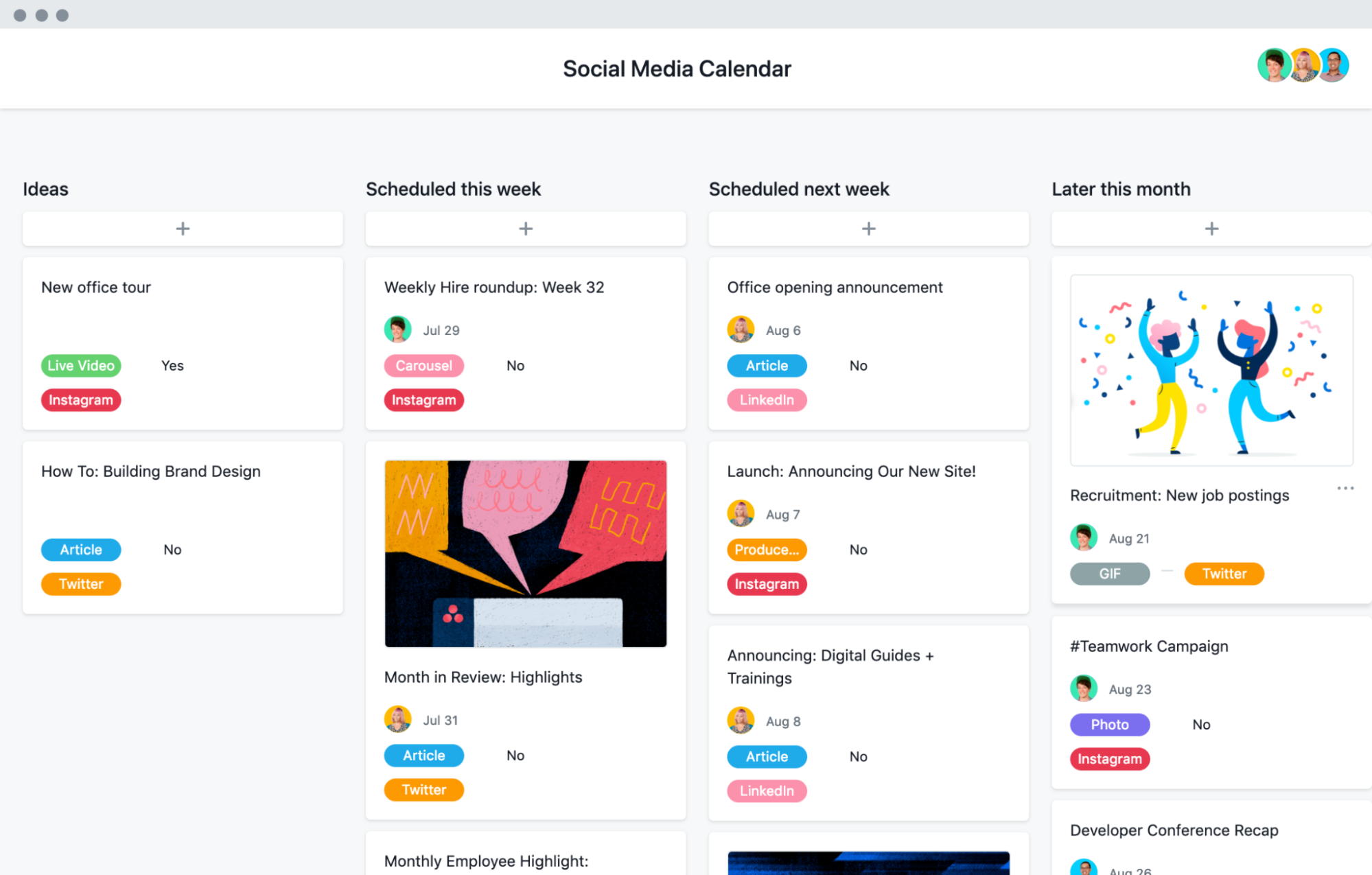
Or, you can switch to Google Suite, in which case you can easily build your own template Google Forms or Google Calendar, Input fields or use color labels to depict important information, such as publication date, channel, and topic.
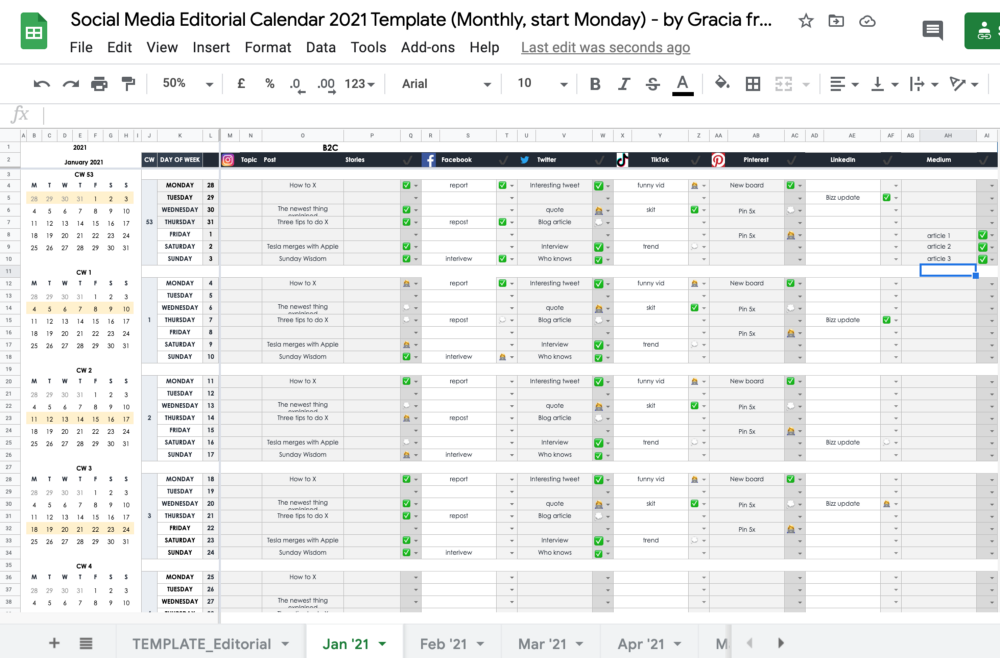
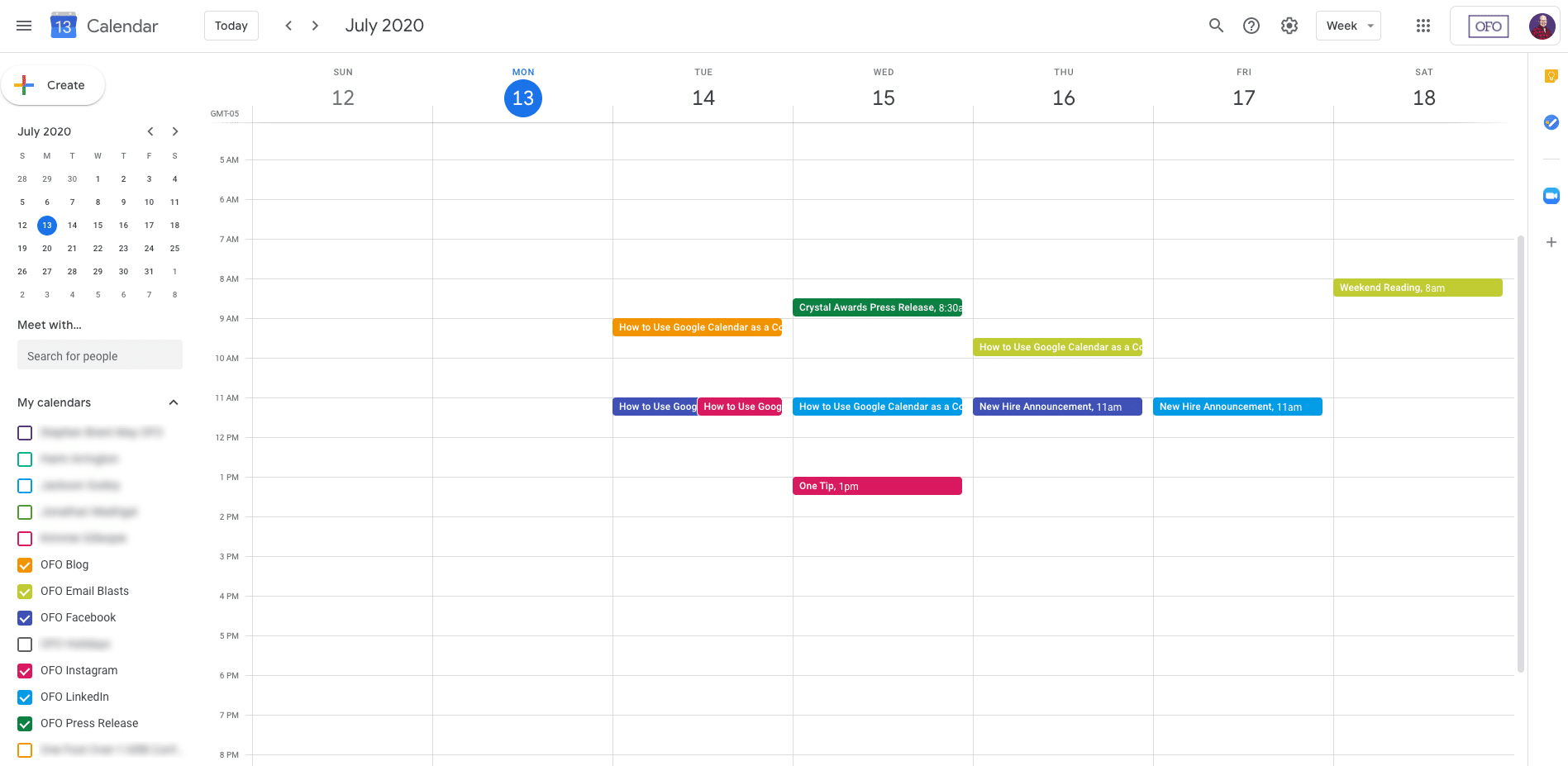
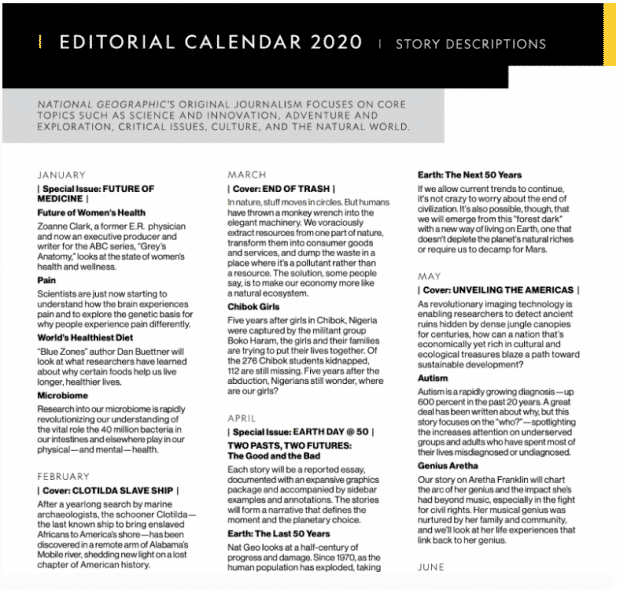
Or, you can design your own template, maybe like this National Geographic An editorial calendar, which includes a brief description of the cover story and several key feature articles each month:
Organizing your social media calendar seems to require a lot of work, and when you do this for the first time, it is definitely an improvement-but in order to reap the benefits of the entire month, the upfront effort is worth the effort. In addition, it can make your team more flexible when you need to create time-sensitive posts.


