


Antibiotic resistance is a growing problem. my own research showed that when the infection is antibiotic-resistant, the risk of complications increases, as does the cost of treating the infection. According to the CDCantimicrobial resistance is a major public health problem:
…resulted in at least 1.27 million deaths worldwide in 2019 and caused nearly 5 million deaths. In the United States, more than 2.8 million antimicrobial infections occur each year. Over 35,000 people lost their lives as a result…
Given the global health burden, one would expect pharmaceutical companies to rush to invest in antibiotics. However, this is not the case.One article in nature To summarize the question:
The estimated cost of developing an antibiotic in 2017 was around $1.5 billion1Meanwhile, industry analysts estimate that the average revenue generated from antibiotic sales is around $46 million per year. Kasim Kutay, chief executive of investment firm Novo Holdings, said: “The money is small and nowhere near what is needed to justify the investment.”
Antibiotic income is low because there are many low-cost, generally effective antibiotics available for most infections; new antibiotics are used only for a limited (but increasing) number of antibiotic resistance. In addition, management issues mean that doctors should try not to use newer antibiotics. The increasing use of new antibiotics increases the risk of developing resistance to these drugs.an article of Kruger et al. (2020) Note that this is the “fire extinguisher problem”, which is an important object, but not used. Venture capitalists also generally lack interest in investing in antibiotic development.
One potential solution to this problem is the transferable exclusivity extension (TEE) system. EFPIA commissioned a report on the subject 2019 and 2022. in this system
… Manufacturers of new antimicrobials that meet certain criteria will receive a voucher (“TEE”) upon approval of the antimicrobial by European regulators. Recipients can use this coupon to extend their marketing exclusivity on one of their products for a period of time, or sell to another company, which can then use it to extend one marketing exclusivity on their own products. TEE has been proposed as an incentive measure with sufficient power to incentivize research and development of antimicrobials. It is within the current capacity of the European Union (EU) and will provide pull incentive funding in a stable manner, independent of Member State (MS) grants and with no up-front costs, but there are concerns about its use in Europe, particularly with regard to Cost of TEE.
2022 report Aims to quantify the benefits and costs of TEE systems. The benefits of TEE are difficult to estimate. While the benefits of using additional antibiotics may be estimable, the likelihood of failure of many of our current antibiotics is difficult to estimate.it’s a bit like Black Swan Events, events that are relatively unlikely to occur in any given year, but may be more likely to occur over longer time frames and have catastrophic effects on society. In addition, antibiotic resistance affects not only diseased individuals, but broader sources of value, including:
- Spectral value. The benefits of replacing broad-spectrum antibiotics with pathogen-specific narrow-spectrum antibiotics to prevent ‘collateral damage’ to the microbiome and reduce AMR accumulation.
- transfer value. The benefit of avoiding spreading the infection to others in the population. (Look Morton et al. 2019)
- enable value. Benefits of performing surgical and medical procedures. (Look Morton et al. 2019)
- Diversity value. The benefits of providing a range of treatments to reduce selection pressure and preserve the efficacy of existing antibiotics (see Teillant et al. 2015)
- insurance value. Provides the benefit of treatment in the event of a sudden or severe increase in the incidence of a certain bacterial infection. (Look Megiddo et al 2018)
- novel action value. The benefit of having a new mechanism of action (MOA) that helps prevent cross-resistance between antibiotic classes and paves the way for “successor” products with the same MOA
- productivity. Impact on employee efficiency and overall economic activity. (Look Codecasa et al. 2015)
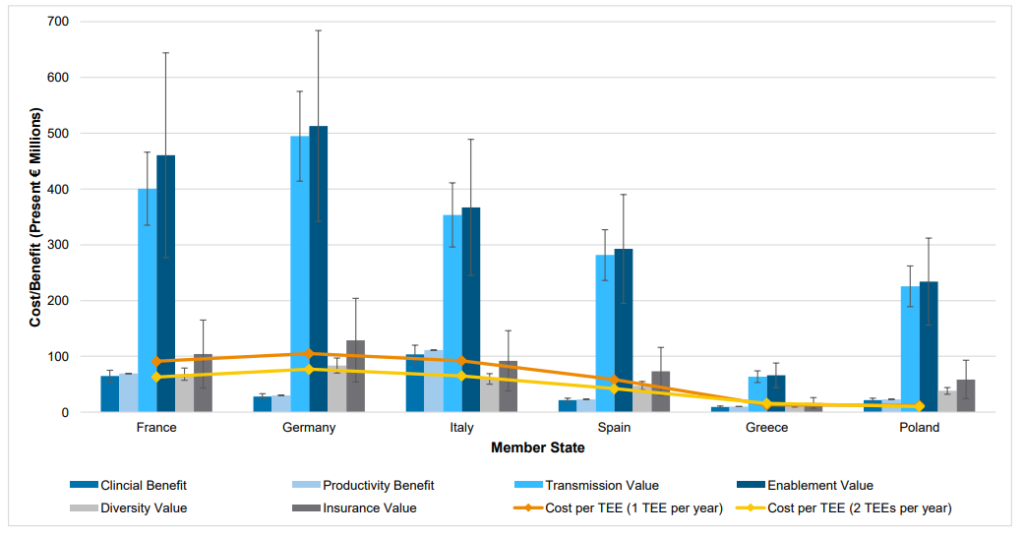
Interestingly, most of the benefits of TEE are not direct clinical value to infected patients, but transmission value, enabling value, and insurance value. The table below provides these estimates.
On the other hand, the cost of implementing TEE mainly depends on two factors: (i) the higher drug prices for which TEE vouchers are ultimately applied, and (ii) additional administrative costs. As expected, 2022 report. It is estimated that approximately 98% of the additional costs come from higher drug prices and only 2% from higher administrative costs. The authors found that TEE vouchers for 1 antibiotic each year would cost European countries hundreds of millions of euros. The cost of 12-month TEE vouchers to different European countries is: Germany 121 million euros, France and Italy 105 million euros each, Spain 66 million euros, Greece 15 million euros and Poland 14 million euros.
Online, the report found that the benefits of TEE outweighed the potential costs. Details of the specific benefits and costs are shown in the figure below.
key papers
- Morton, A., Colson, A., Leporowski, A., Trett, A., Bhatti, T. & Laxminarayan, R. (2019) How should the value attribute of novel antibiotics be considered in reimbursement decisions? MDM Policy and Practice. 4(2) https://doi.org/10.1177/2381468319892237
- Teillant, A., Gandra, S., Barter, D., Morgan, D. & Laxminarayan, R. (2015) Potential burden of antibiotic resistance for surgery and cancer chemotherapy antibiotic prophylaxis in the United States: a literature review and modeling study. The Lancet, 15(12): 1529-1437. https://doi.org/10.1016/S1473-3099(15)00270-4
- Rothery, C., Woods, B., Schmitt, L., Claxton, K., Palmer, S., and Sculpher, M. (2018) A Framework for Valuing New Antimicrobial Drugs: Implications of Alternative Funding Arrangements Assessed by NICE. ipuru. Available at: https://pure.york.ac.uk/portal/en/publications/framework-for-value-assessment-of-new-antimicrobials(f0bc0ec9-9236-4cc7-9498-0002bd31f429).html
- Megiddo, I., Drabik, D., Bedford, T., Morton, A., Wesseler, J., and Laxminarayan, R. (2018) Investing in antibiotics to mitigate future catastrophic consequences: what is the value of having effective antibiotics Mitigate pandemic flu? Wiley Health Economics. 28(4):556-571. https://doi.org/10.1002/hec.3867
- Codecasa, L., Toumi, M., D’Ausilio, A. et al. (2017) Cost-effectiveness of bedaquiline in Italian MDR and XDR tuberculosis. J Mark Access Health Policy. 5(1):1283105. https://doi.org/10.1080/20016689.2017.1283105


