Today, we are honored to introduce to you the Pavel Skrzypchinski, Economist at the National Bank of Poland. The views expressed in this article are those of the author and should not be attributed to the National Bank of Poland.
We have updated the job-to-worker gap discussed in our previous post: [1], [2], [3], [4].
The recent releases of “Employment Situation – March 2023” and “Job Openings and Labor Turnover – February 2023” from the US Bureau of Labor Statistics allow us to update the job-worker gap and business cycle indicators based on it. For March 2023, we assume job vacancy levels to fall from 9.9 million in February 2023 to 9.8 million, which is consistent with what Indeed’s high-frequency data suggests (https://www.hiringlab.org/data/).
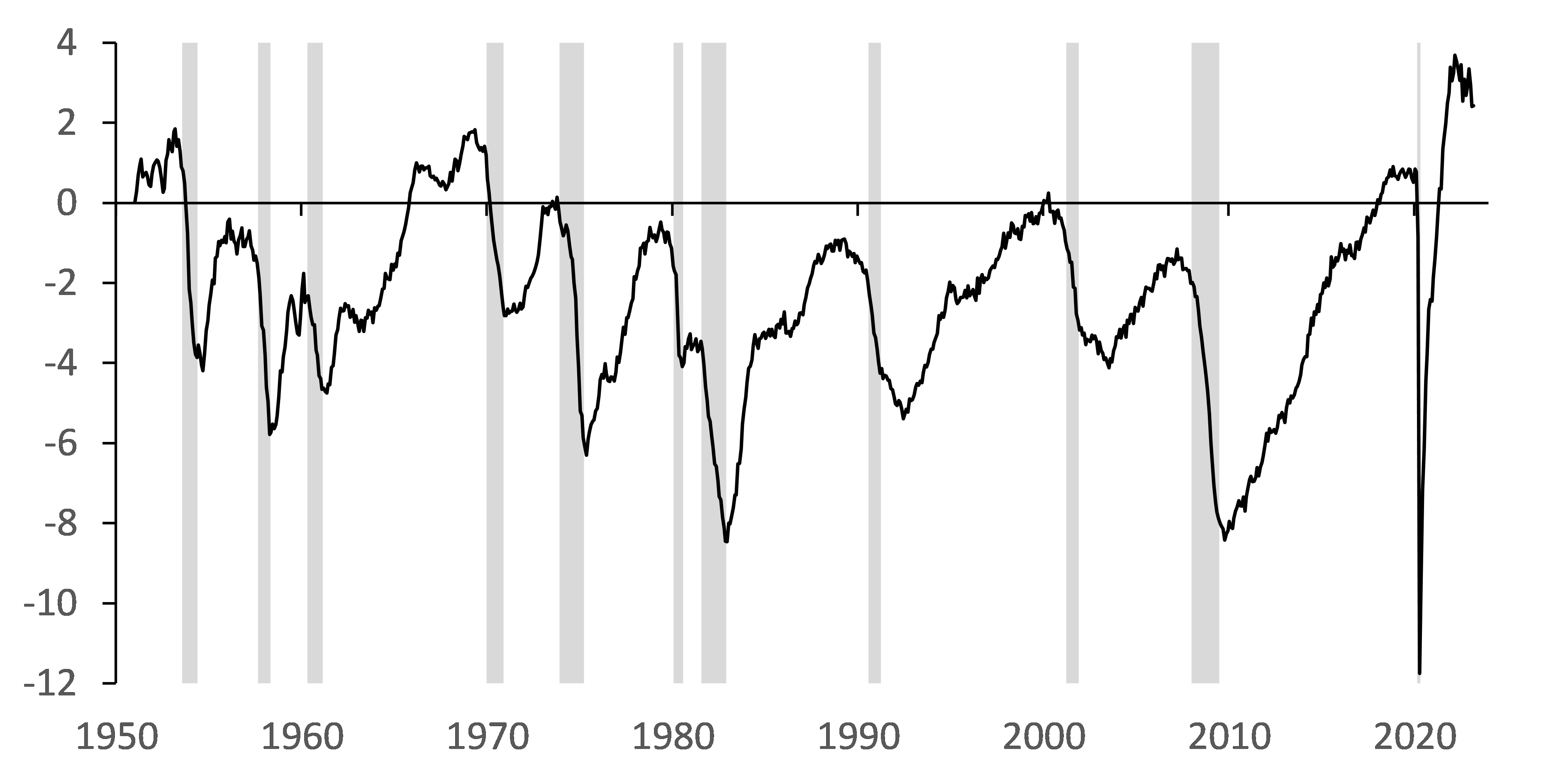
In March 2023, the gap between jobs and workers was 2.4% or 4 million, unchanged from February 2023 but down 0.5 percentage points or 900,000 from January 2023.
figure 1. Job-worker gap (percentage)
With these new data, the Employment-Worker Gap Business Cycle Indicator (JWGBCI) fell from -0.62 points in February 2023 and -0.46 points in January 2023 to -0.93 points in March 2023, reaching a reading of -0.93 points. recession threshold. Recall that this indicator uses smoothed gaps, i.e. we calculate the change in the three-month moving average of the employment-worker gap relative to the previous twelve-month maximum.
figure 2. Job-Worker Gap Business Cycle Indicators (Percentage Points)
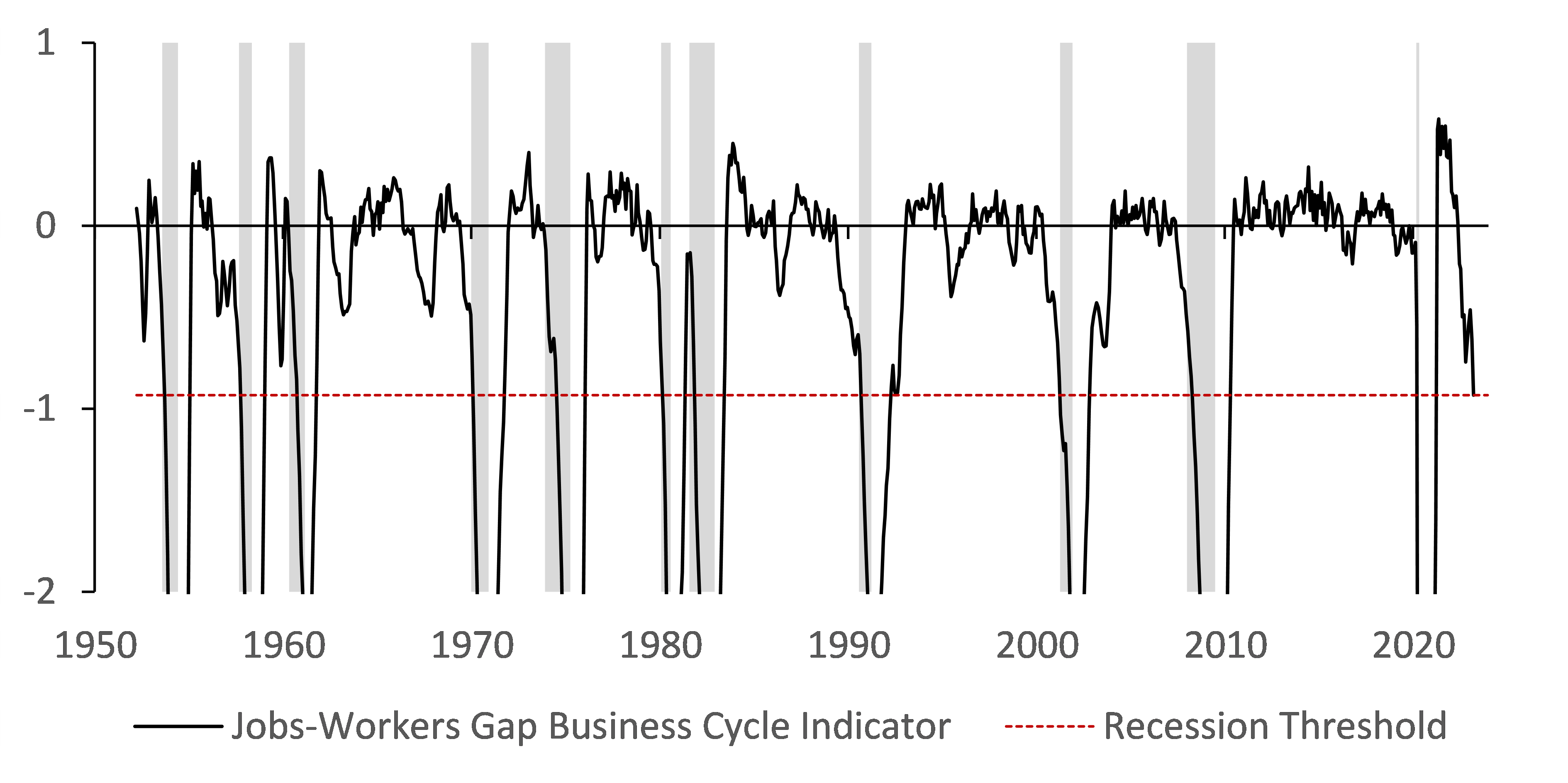
A summary of this update follows. The most recent reading of the employment-worker gap and the business cycle indicators based on it suggest that labor market conditions have softened over the past year to a point that has historically been strong enough to predict a recession. Whether this case is true or a false positive remains to be answered by future data releases, not just the labor market itself. Overall, Recession Watch has been activated and can now also be viewed through the lens of labor market incoming data.
This article was sponsored by Pavel Skrzypchinski.