


This week is Big Data Week. Today the Australian Bureau of Statistics (ABS) released the latest labor force figures (April 13, 2023) – Australian workforce – March 2023. March’s result was weaker than February’s strong result, but still relatively strong. Employment has increased, favoring full-time work and keeping pace with population growth, so the unemployment rate has fallen slightly. The employed population grew moderately. Overall a good result. There are some caveats though – the underlying (“assumed”) unemployment rate is closer to 4.9% rather than the official 3.5%, suggesting that the labor market remains weak. On the downside, the broad underutilization rate rose by 0.3 percentage points to 9.7 per cent, meaning 1,402,700 Australian workers were still unemployed in some way (officially unemployed or underemployed). Despite what mainstream commentators claim, this level of slack means Australia is not really close to full employment. Falling inflation combined with a stable labor market to keep unemployment relatively low runs counter to the RBA’s modeling used to justify rate hikes. Guess which one is wrong?
In its– media release – The ABS states:
Unemployment rate held at a seasonally adjusted 3.5% in March…Employment rose by about 53,000 and the number of unemployed fell by 1,600, keeping the unemployment rate at a nearly 50-year low of 3.5%…
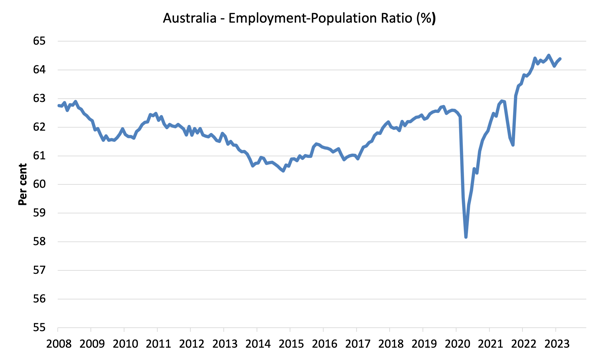
…As the number of people employed rose, the employment-to-population ratio rose 0.1 percentage point to 64.4%, and the participation rate remained at 66.7%. Both indicators are near record highs for November 2022…
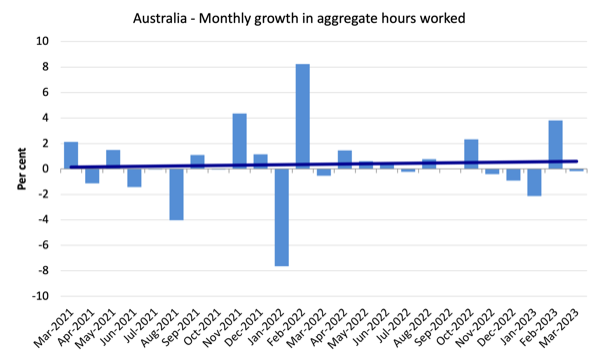
Seasonally adjusted monthly hours worked fell 0.2% in March 2023, following a strong 3.8% gain in February.
Conclusion: There are no clear signs of any major contraction yet. It’s a very stable situation.
While the Australian Bureau of Statistics claims there is a “tight labor market” and that “employers are finding it difficult to fill a large number of vacancies”, this is not reflected in the wages data.
Employers are not yet willing to bid for labor at higher wages because they have become accustomed to obtaining labor cheaply with persistently high levels of slack and low wage growth.
So when they complain about not being able to fill vacancies, they are really saying that they are not prepared to offer decent wages to attract the workforce.
Employment increased by 53,000 (0.4%) in March 2023
1. Full-time employment increased by 72,200, while part-time employment decreased by 19,200.
2. The employment-to-population ratio increased by 0.1 percentage points to 64.4%.
The best of both worlds.
However, there is something fishy going on, as the underemployment rate rose by 0.4 percentage points (see below), but all the job gains were full-time jobs.
That conjunction doesn’t add up.
The Australian Bureau of Statistics provides a feature article this month – Insights into Working Hours, March 2023 – which states that working hours fell by 3.2 million hours (see below) and that “the proportion of employed persons who, for various reasons, worked fewer hours than usual increased between February 2023 and March 2023”.
But that doesn’t explain the rise in the underemployment rate while full-time employment has grown strongly.
We’ll have to wait for ABS to explain the anomaly.
The chart below shows the monthly growth in full-time (blue bars), part-time (gray bars) and total employment (green line) for the 24 months to March 2023, using seasonally adjusted data.
I took observations from September 2021 to January 2021 – they were outliers due to the Covid wave at that time.
The table below provides an accounting summary Labor market performance over the past six months Provides a longer-term perspective, breaking through monthly changes and better assessing trends.
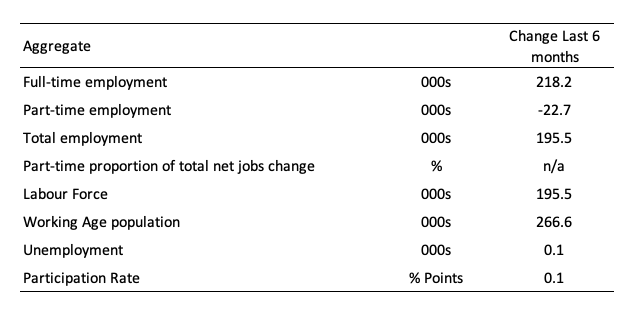
Given changes in workforce estimates, sometimes check Employment Population Ratio (%) Because the underlying population estimate (the denominator) is less cyclical and subject to change than the labor force estimate. This is another measure of the robustness of economic activity to the unemployment rate, which is sensitive to fluctuations in the labor force.
The graph below shows the employment-to-population ratio since January 2008 (ie since the global financial crisis).
In March 2023, the ratio increased by 0.1 percentage point to 64.4%.
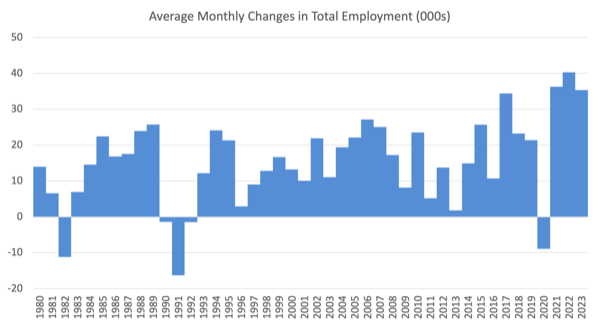
For perspective, the chart below shows the average monthly employment change over the calendar years from 1980 to 2022 (so far).
1. Average employment change of -890 in 2020, rising to 36,300 in 2021 as lockdown measures eased.
2. The average monthly change in 2022 is 40,300.
3. The average change so far in 2023 is 35.4k (but this reflects poor January results).
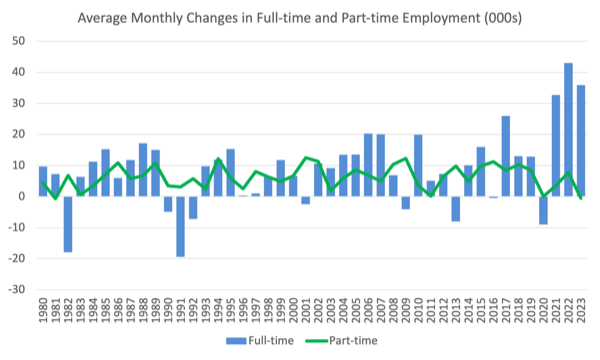
The graph below shows the average monthly change (in thousands) of full-time and part-time employment (bottom graph) since 1980.
3.2 million fewer hours worked in March 2023 (-0.17%)
The chart below shows the monthly growth (in percent) over the last 24 months.
The dark linear line is the simple regression trend for monthly variation (sloped upward by the two outlier results).
It is now clear that the February results were not characteristic of events and the March results are consistent with the relative static of the past 12 months.
Actual and Trend Employment
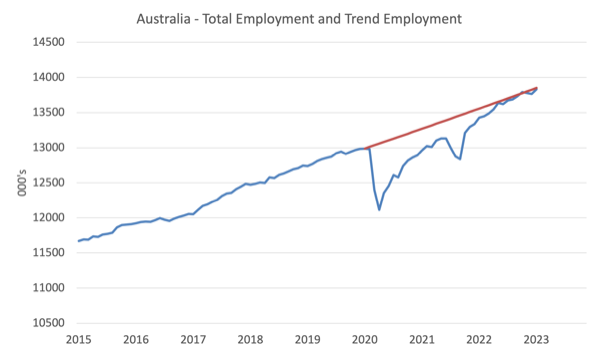
The Australian labor market is now larger than it was in March 2020, and employment is on the verge of returning to pre-pandemic trends.
The graph below shows total employment (blue line) and what it would have been if growth had continued at the average rate from 2015 to April 2020.
By March 2023, the gap has narrowed by 38,900 to 19,500.
Population slowdown – “what-if” unemployment analysis
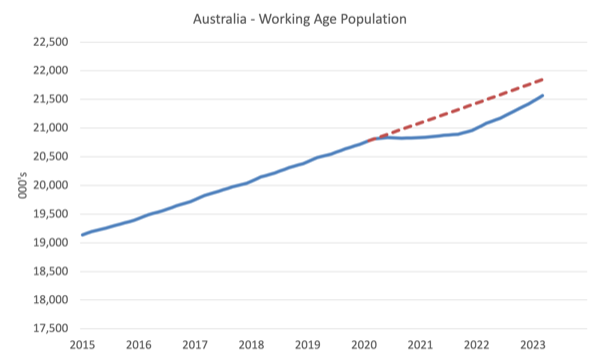
The graph below shows Australia’s working-age population (15+) from January 2015 to March 2023. The dashed line is projected growth if the pre-pandemic trend continues.
The difference between the two lines is that the working-age population fell after Covid immigration restrictions.
The March 2023 civilian population is 281,800 fewer than the March 2023 population, if pre-pandemic trends continue.
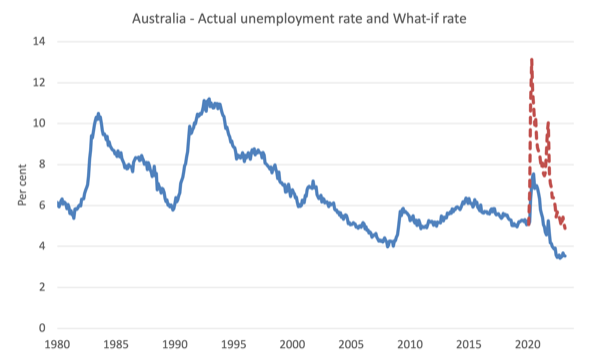
The graph below shows the evolution of the real unemployment rate since January 1980 to March 2023, the dashed line is the “assumed” rate assuming the most recent peak participation rate (recorded in November 2022 = 66.8%), extrapolated labor Age population (based on growth rates from 2015 to March 2020) and actual employment since March 2020.
It shows what the unemployment rate would be given real job growth if the trajectory of the working-age population followed past trends.
In this blog post – Australia’s external border closure cut unemployment by around 2.7 percentage points (April 28, 2022), I provide a detailed analysis of how I calculated the “hypothetical” unemployment rate.
Therefore, instead of the current 3.5%, the unemployment rate in March 2023 would be 4.9%, taking into account employment performance since the pandemic.
The finding skews sharply different from what has happened since the pandemic began.
Unemployment falls by 1,600 to 507,000 in March 2023
Thus, net employment change has largely kept pace with population growth.
However, also keep in mind the “what-if” analysis above, and look at the impact of declining engagement below.
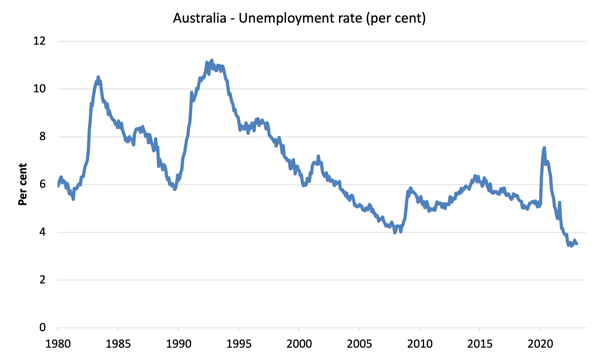
The chart below shows the national unemployment rate from January 1980 to March 2023. Longer time series help to form some perspective on what is happening now.
Broad labor underutilization rate rises 0.4 percentage points to 9.7% in March 2023
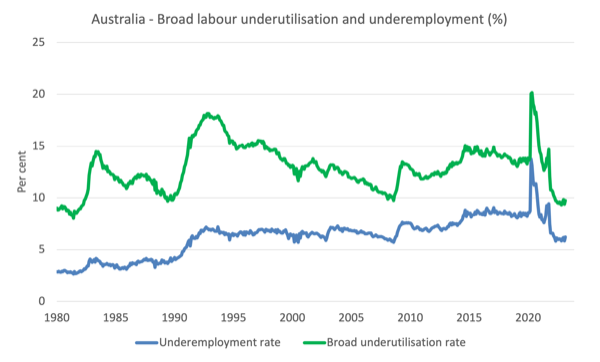
1. The underemployment rate rose by 0.4 percentage points to 6.2% (an increase of 58,100).
2. The total number of underemployed workers is 895,600.
3. The total labor underutilization rate (unemployment plus underemployment) rose by 0.4 percentage points to 9.7 percentage points.
4. A total of 1.4027 million people are unemployed or underemployed.
NOTE: My query on these numbers above. Overall, 9.7 percent of the wasted available labor force is underemployed.
The chart below plots Australia’s seasonally adjusted underemployment rate (blue line) from April 1980 to March 2023 and the broad underemployment rate (green line) for the same period.
The difference between the two lines is the unemployment rate.
Youth labor market stable in March 2023
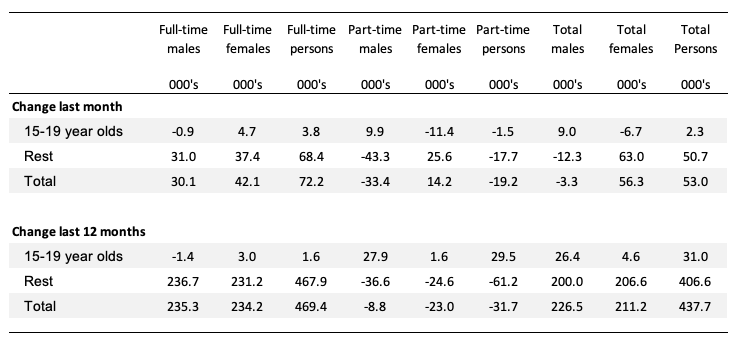
In March, teens gained 2,300 full-time net jobs. Part-time employment fell slightly.
The table below shows the distribution of net employment by full-time/part-time status and age/gender category (15-19 and others) for the past month and the past 12 months.
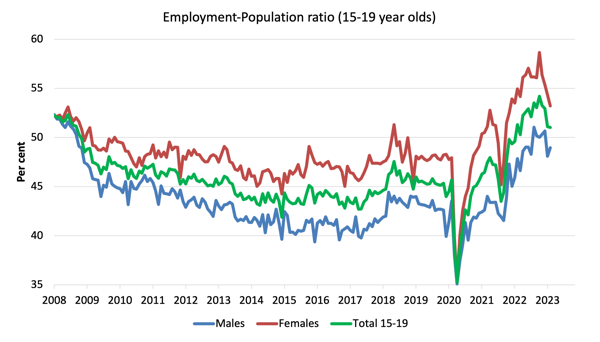
To put teen employment in context of size (relative to their size in the population), the chart below shows the employment-to-population ratios since June 2008 for males, females, and the total population ages 15-19.
You can interpret this graph as describing the change in employment relative to each cohort’s underlying population.
Judging from recent developments:
1. The proportion of males increased by 0.9 percentage points month-on-month.
2. The proportion of women decreased by 1.1 percentage points.
3. The overall employment population of teenagers decreased by 0.1 percentage points compared with the current month.
in conclusion
My standard monthly caveat: Given the way labor force surveys are constructed and conducted, we always have to interpret monthly movements with caution.
My overall rating is:
1. March results were weaker than February’s strong results, but still relatively strong.
2. Employment growth is skewed toward full-time work and keeps pace with population growth, so the unemployment rate has fallen slightly. The employed population grew moderately. Overall a good result.
3. A few caveats though – the underlying (“assumed”) unemployment rate is closer to 4.9% instead of the official 3.5%, suggesting that the labor market remains weak.
4. On the downside, the broad underutilization rate rose by 0.3 percentage points to 9.7%, meaning that 1,402.7 thousand Australian workers were still unemployed in some way (officially unemployed or underemployed).
5. Despite what mainstream commentators claim, the large slack workforce means Australia is not really close to full employment.
Enough for today!
(c) Copyright 2023 William Mitchell. all rights reserved.


