


We all want new, improved medicines. Drugs that provide incremental benefits (often called “me too” drugs) are all well and good, but truly revolutionary therapies are even better. However, how to distinguish the “novel” degree of a treatment method? Is there a way to quantify this?
In fact there are. One way to achieve this is based on the molecular structure of the therapy. For example, Tanimoto distance Measures the proportion of chemical features shared by two compounds. Nikolova et al. year 2004 Summarizing this approach, the calculation is as follows:
Krieger, Li and Papanikolaou 2022 Use this approach to quantify how drug development of new drugs has more positive information spillovers to drug development than incremental drugs. This article provides an example of the application of the Tanimoto distance below.
More
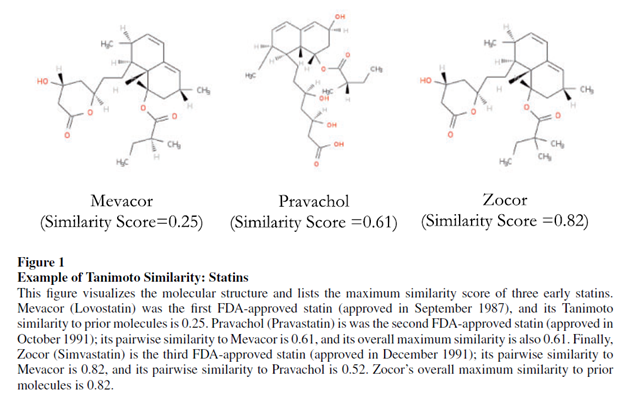
Using Tanimoto distance as a measure of novelty, the authors found the following:
…new drug candidates are less likely to receive FDA approval, but are based on more valuable patents. Consistent with simple models of expensive external financing, we show that positive shocks to firm net worth lead firms to develop more new drugs. This suggests that even large firms may appear risk-averse, reducing their willingness to invest in potentially valuable radical innovations.
You can read the full text here.


