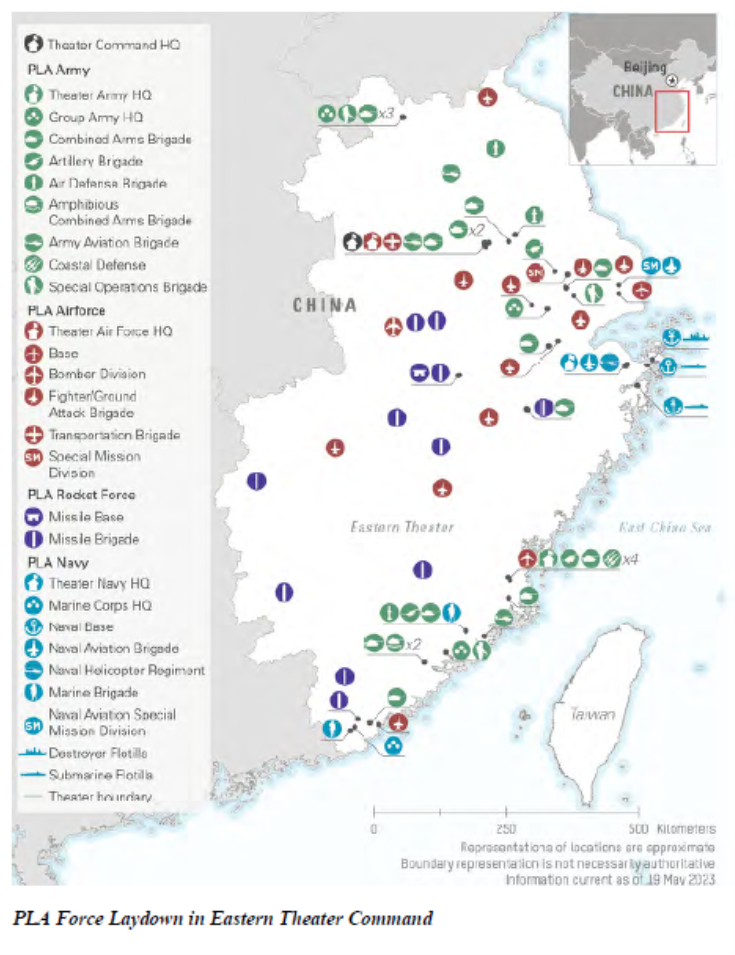
from Department of Defense Report 2023 On the military and security developments of the People’s Republic of China.
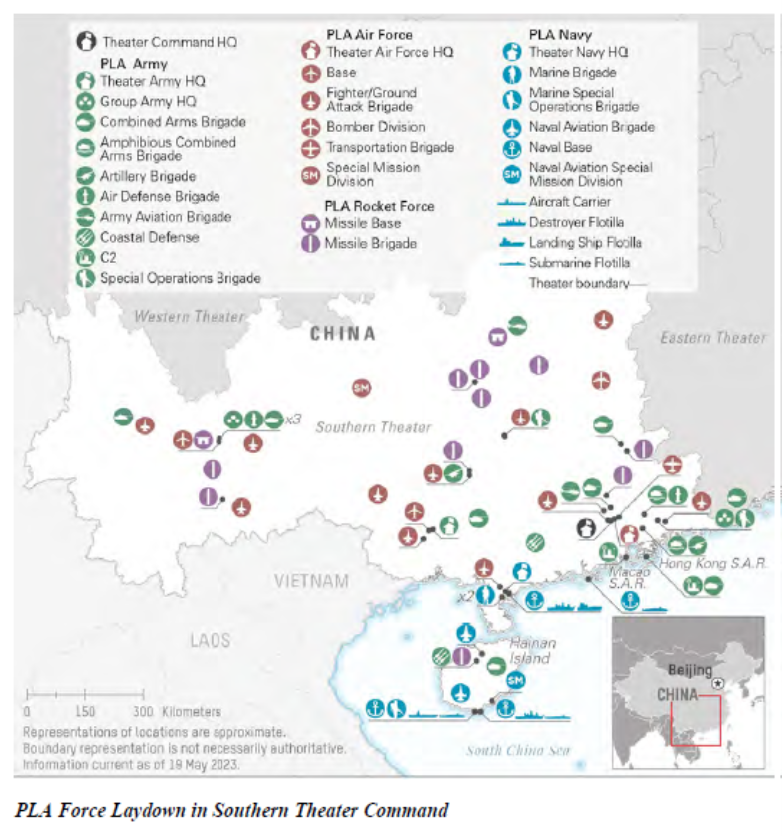
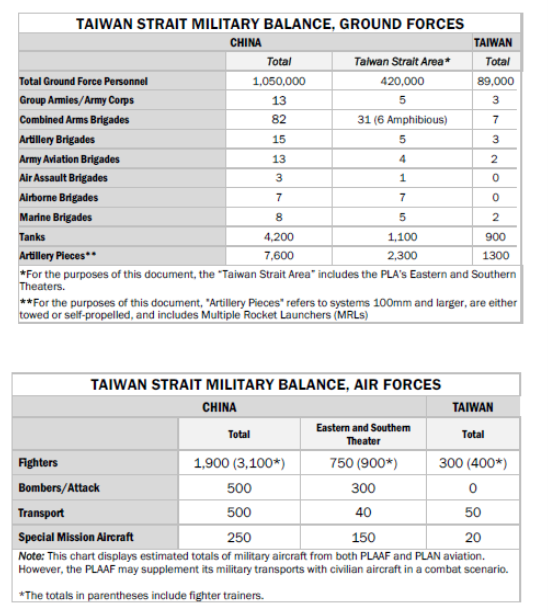
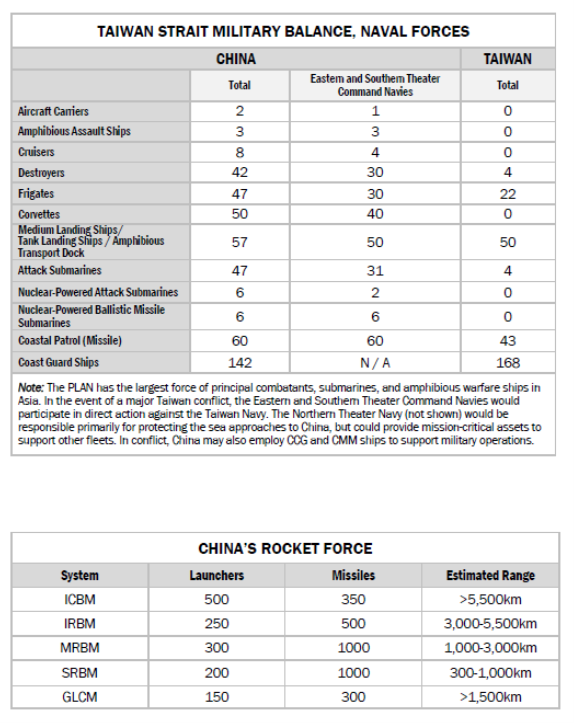
The report states:
The People’s Liberation Army’s current posture in responding to the Taiwan conflict
People’s Liberation Army. The People’s Liberation Army has strengthened its layout in the eastern theater and the Taiwan Strait coast, and enhanced the People’s Liberation Army’s firepower, mobility and rapid strike capabilities. Significant reorganization and amphibious assault training in recent years may indicate that the Taiwan contingency is a high priority for the Army. The PLA’s primary contributions to a Taiwan invasion scenario would likely include extensive amphibious, Army aviation, and air assault operations.
The PLA has deployed six combined amphibious brigades, four of which are located in the eastern theater (nearest Taiwan) and two in the southern theater. In 2022, the Army will continue to conduct individual and coalition amphibious assault training to strengthen its rapid reloading, long-distance transportation, beach grabbing tactics and logistical support capabilities under complex sea conditions. Media reports also stated that the People’s Liberation Army extensively uses sea, air, and ground drones to support amphibious assault operations. The PLA Amphibious Brigade reportedly conducted realistic large-scale amphibious operations, almost certainly in support of an invasion of Taiwan scenario.
plan. The PLA Navy is improving its air defense, anti-ship and anti-submarine capabilities, further developing maritime nuclear deterrence, and introducing new multi-mission platforms capable of performing a variety of missions during peace and war, and has strengthened its posture against Taiwan since entering Taiwan in 2022 August of the year. New attack submarines and modern surface combatants with air defense capabilities and fourth-generation naval aircraft enter the force, aiming to achieve maritime superiority within the FIC and to deter and counter any potential third-party intervention in the Taiwan conflict.
In recent years, China’s amphibious fleet has focused on purchasing a small number of ocean-going dock landing ships and amphibious assault ships. There is currently no sign that China is significantly increasing the number of landing tank ships (LSTs) and medium landing crafts. Although the PLA has not invested in the large number of landing ships and medium-sized landing craft that analysts believe will be needed for the PLA to launch a large-scale attack on Taiwan, it is possible that the PLA has assessed that it has sufficient amphibious capabilities and has mitigated the gap through investment in other combat capabilities, such as civilian Transport vessels and rotary wing assets can bridge this gap. The PLA is also likely to have confidence in the Chinese shipbuilding industry’s vast ability to produce the necessary ship-to-shore connectors relatively quickly.
People’s Liberation Army Air Force. The Chinese Air Force has always maintained combat readiness to respond to various capabilities required for emergencies in Taiwan. It has a large number of advanced aircraft that can fight against Taiwan without the need for refueling, giving it a powerful capability to conduct air and ground attack operations. Some long-range air defense systems provide strong defense against attacks targeting key military installations or population centers in mainland China. China’s development of support aircraft provides the PLA Air Force with improved ISR capabilities to support PLA operations. The Chinese Air Force has also improved its refueling capabilities, expanded its ability to operate away from China, and enhanced its ability to threaten third-party intervention. Throughout 2022, the combat level of the Eastern Theater Air Force will be higher than in previous years. Compared with 2021, the number of aircraft invading Taiwan’s air defense identification zone is higher and the frequency is higher, indicating that the PLA Air Force’s ability to maintain pressure on Taiwan has improved.
PLRF. The People’s Liberation Army is preparing to conduct missile attacks against high-value targets, including Taiwan’s command and control facilities, air force bases and radar stations, in an attempt to weaken Taiwan’s defense capabilities, weaken Taiwan’s leadership, or destroy the public’s will to fight. By 2023, the PLA Air Force will increase its presence in the Taiwan Strait with new missile brigades, which may indicate an increasing number of deployed missiles.
…
I noticed that Speaker Johnson plan Funding for arms transfers to Taiwan (or Israel and Ukraine) was apparently omitted in order to avoid a government shutdown.Biden has proposed $7.4 billion Assistance to Taiwan and other Indo-Pacific countries.
I think some people think the threat to Taiwan is exaggerated.I tend to agree with those who agree more Aggression Events related to China’s actions warrant urgent action to support key allies (and producers of critical commodities such as semiconductor chips).The need for speed may increase the recent use of government Drawing rightseven if arms transfers compete with Ukrainian needs.