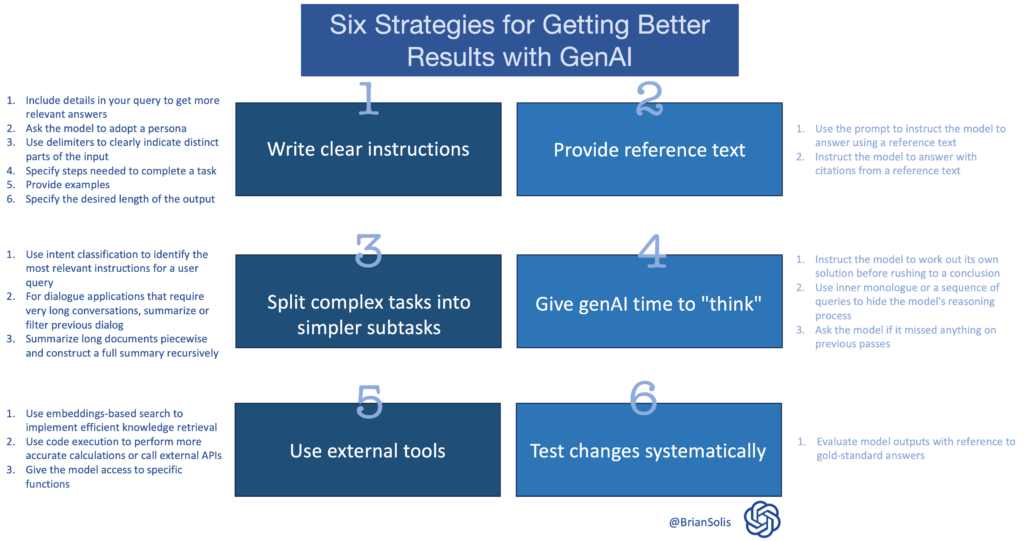
OpenAI released Reference guide Improve the results of ChatGPT or any generative AI platform. These approaches are not mutually exclusive. You can combine many of them for better results.
The point is, experiment!
To help, I've captured the high-level tips and supporting pillars of each series in a simple infographic.you can download it here.
1) Write clear instructions
These models can't read your mind. If the output is too long, please ask for a short answer. If the output is too simple, ask for expert writing. If you don't like the format, please demonstrate the format you would like to see. The fewer times the model guesses what you want, the more likely you are to get it.
Strategy:
2) Provide reference text
Language models can confidently invent fake answers, especially when asked about esoteric topics or quotes and URLs. Just like a note can help students do better on a test, providing reference text for these models can help reduce the number of answers required.
Strategy:
3) Split complex tasks into simpler subtasks
Just as it is good practice in software engineering to decompose complex systems into a set of modular components, so is the task of submitting them to a language model. Complex tasks tend to have higher error rates than simple tasks. Furthermore, complex tasks can often be redefined as workflows of simpler tasks, where the outputs of earlier tasks are used to construct the inputs of subsequent tasks.
Strategy:
4) Give the model time to “think”
If asked to multiply 17 by 28, you might not know it right away, but you can still figure it out over time. Likewise, models make more inference errors when they try to answer immediately rather than taking the time to figure out the answer. Asking for “chains of ideas” before giving an answer can help the model reason about the correct answer more reliably.
Strategy:
5) Use external tools
Compensate for model weaknesses by feeding it the output of other tools. For example, a text retrieval system (sometimes called RAG or Retrieval Augmentation Generation) can tell the model about the relevant documents. Code execution engines like OpenAI's code interpreter help models perform mathematical operations and run code. If a task can be accomplished more reliably or efficiently with a tool rather than a language model, then it can be offloaded to take advantage of both.
Strategy:
6) Systematically test changes
It's easier to improve performance if you can measure it. In some cases, modifications to cues will achieve better performance on a few isolated exemplars, but lead to poorer overall performance on a more representative set of exemplars. Therefore, to ensure that changes have a net positive impact on performance, it may be necessary to define a comprehensive test suite (also known as an “evaluation”).
Tactics: