

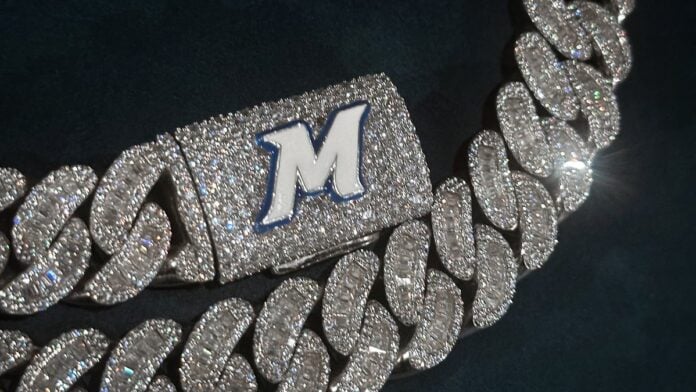

Open two product pages in side-by-side browser tabs. The descriptions match almost word for word: VVS1, D-color moissanite, 925 sterling silver, 18K gold-plated finish, same style of chain. A shopper comparing them on paper would call them the same product. In person, one can look sharp and substantial while the other looks thin, uneven and dull at the joins.
That gap between the listing and the piece is the central subject of Samuel Madrid’s work at Miami The Jeweler, the downtown Miami shop he founded after roughly a decade studying jewelry. His view is that materials set a ceiling and execution decides how close a piece gets to it.
What a spec sheet leaves out
A typical listing covers stone type, stone grade, metal and finish. Those are inputs. The things that decide how a chain looks on a neck mostly go unlisted: how precisely the stones are set, how evenly they are spaced, how much the piece weighs, how the links are proportioned, how well the plating was applied and how the clasp is built.
Product photography can blur the difference further. Studio lighting flatters stones, and a single still image hides how a chain moves. Two pieces that share every listed spec can photograph alike and still wear very differently.
Execution lives in the details
Setting is the most visible variable. MTJ focuses on small, clean prongs that hold stones securely without crowding them, with stones aligned at consistent heights. A setter who lets heights or angles drift produces a chain that flickers unevenly when it moves, even if every stone is the same grade.
Proportion and weight come next. Link size, link thickness and stone size need to relate to each other in a way that looks intentional. MTJ treats substantial construction and appropriate weight as part of quality, because a piece that feels light and flimsy in the hand reads that way when it is worn too.
Then the finish. On yellow-finish moissanite pieces, MTJ uses 18K gold plating over 925 sterling silver. Even color across every link, clean coverage around the settings and smooth edges all depend on preparation and care at the finishing stage. Plating of any quality can wear over time with friction and chemicals, which makes a careful initial finish more important, not less.
The last detail is often the first to fail: the clasp. Two chains with identical stones can differ completely in how securely they close.
The shop’s thesis
MTJ frames the issue in a single line that runs through its approach: the problem was never moissanite, the problem was mediocre moissanite jewelry. Moissanite is a distinct gemstone, silicon carbide, with a higher refractive index and greater dispersion than diamond and a hardness of about 9.25 on the Mohs scale. As raw material it gives a jeweler a lot to work with. What a maker does with it determines whether the finished chain looks premium.
Madrid’s own advice to people building anything points the same way: “No matter what you do, just make sure you learn how to do it better than anyone else.” At MTJ that translates into a hard production rule. If a piece misses the top standard, the team melts it down and starts over.
The same standard covers the diamond side, where MTJ sets natural and lab-grown diamonds in solid 10K, 14K or 18K gold. Identical diamond specs can hide the same variation in setting and construction.
How to compare when you cannot see both in person
Online shoppers can close some of the gap by asking better questions. Ask for a video of the piece in daylight, moving, rather than a still photo. Ask for the weight. Ask whether the stated stone grade covers every stone in the piece. Ask the seller to state whether a yellow finish is plating or solid gold, and over which metal. Ask to see the clasp up close.
Then look at how the seller answers. Specific, plain answers suggest a maker who pays attention to execution. Vague answers suggest the listing is doing most of the work.
Why a showroom helps
Seeing pieces in person remains the most reliable way to compare execution. In a showroom you can lay two chains side by side, check alignment in natural light, feel the weight and work the clasp. You can also compare moissanite and diamond pieces next to each other and decide which fits what you value.
Miami The Jeweler keeps that option open at its showroom at 22 NE First St, Suite 225, on the same downtown street as the Seybold Jewelry Building. For shoppers further away, the MTJ website and Instagram at @miamithejeweler show the collections.


