


We’ve brought together leading economists, authors, and activists to unravel some of the biggest issues of our time. How do we revitalize our economies, what does a future without fossil fuels look like, how do we localize our supply chains to equitably distribute wealth?
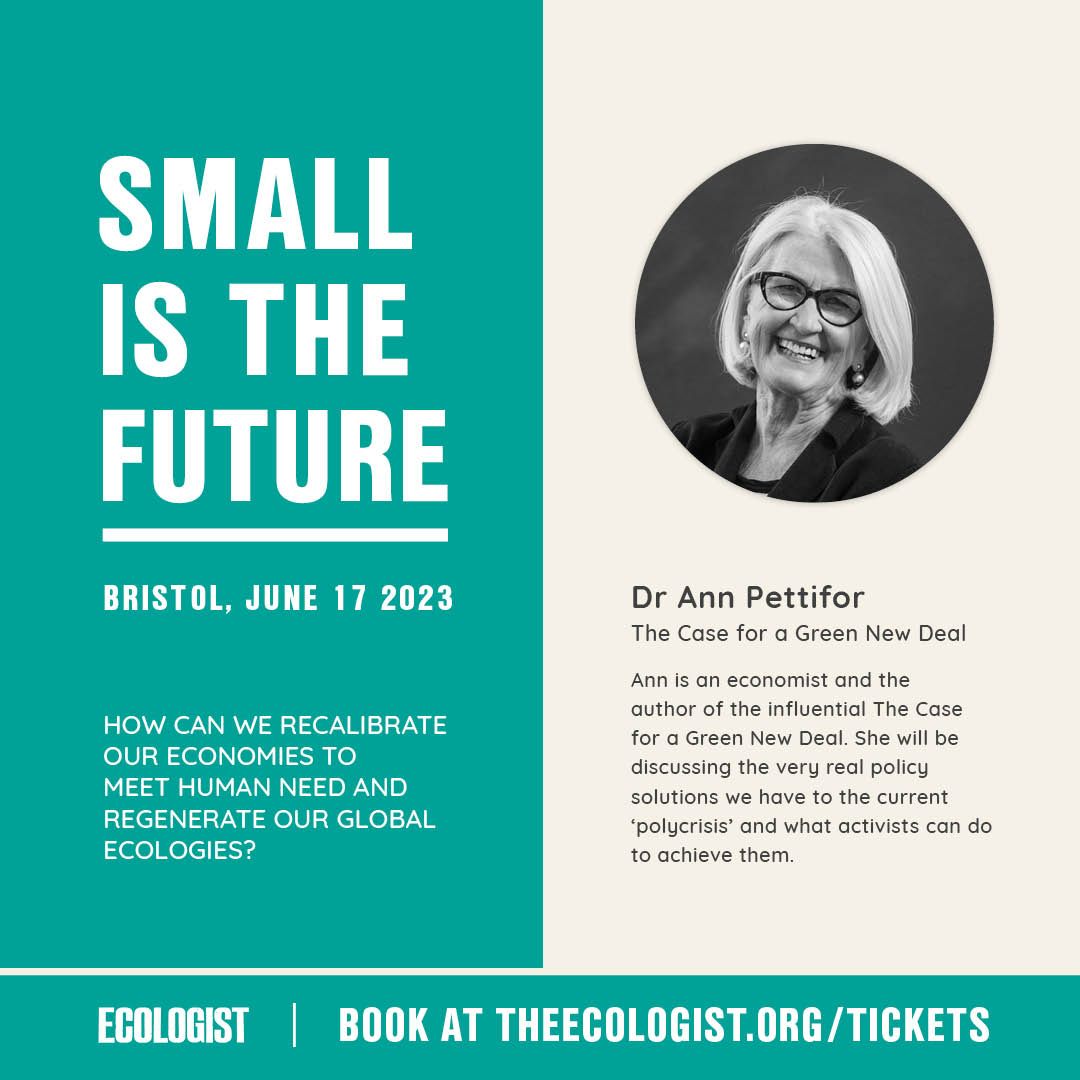
SMALL IS THE FUTURE will take place on Saturday 17th June 2023 at Paintworks in Bristol. Speakers include Dr Ann Pettifor, Charlie Hertzog Young, Satish Kumar, Professor Herbert Girardet and Gareth Dale. Buy tickets here.
We do understand that these problems are huge, fraught with complexity, and that there are no overnight solutions, certainly not problems that can be solved in a day.However we hope small is the future Will be a point of reference, a way of navigating us through the chaos of climate breakdown.
We are honored to host a distinguished panel of economists including Ann Pettifor, renowned economist and author of the influential book The Case for the Green New Deal; James Meadway, economist and co-author cost of living crisis (and how to get rid of it); and Satish Kumar, Editor Emeritus revival and ecologist journaland founder of the Schumacher Academy.
Salt
Profits have soared for global energy majors amid the cost of living crisis. Shell reported record full-year revenue of nearly $40 billion in 2022, almost double what it achieved in 2021. And if that wasn’t enough, Exxon Mobil reported an annual profit of $56 billion, a record for the company.
We live in an era of unprecedented economic inequality, driven by the greed of the few – accumulating wealth at the expense of all living systems on Earth.
According to a new report from Credit Suisse, it is calculated that 47.8% of global household wealth is held by just 1.2% of the world’s population. I could go on throwing out stats, but I think we all get the point.
This is the same point made by EF Schumacher in the 1970s, when the concept of “small is beautiful” was the antidote to the capitalist philosophy of “big is better”.
Schumacher has his eyes on a future powered by renewable energy, localized supply chains and an economy based on natural regeneration, which Schumacher calls a “permaculture economy”. That is, a state of persistence, a viable way of sustaining life on Earth for future generations.
extreme
It is not surprising that young people, especially in the southern hemisphere, recognize the climate emergency and fear the future.
The Intergovernmental Panel on Climate Change has highlighted that climate breakdown poses numerous risks to natural and human systems if we continue towards a global temperature increase of 1.5 degrees Celsius by 2040.
But what would a just transition away from fossil fuels look like? Is the Green New Deal radical enough to create the fundamental changes we need? As activists of our time, do we have the skills, knowledge and drive to help us weather unprecedented human and ecological catastrophes.
It became clear that while we were able to identify the problem, it was difficult to come up with a solution. We hope Small is the Future will be a starting point. We welcome all curious minds to learn how the current destructive economic system can be reversed to the benefit of all.
We hope to see you at Paintworks on Saturday 17th June 2023 – we’ll discuss what the smaller future looks like and how we’re going to get there.
the author
Yasmin Dahnoun is Assistant Editor ecologist. Buy tickets here.

