


Horsetail (Equisetum hyemale) contains a special form of absorbable silica that strengthens and restores teeth, bones, connective tissues, hair, and nails. It also offers a host of other benefits. Here’s how to use this easy-to-grow plant.

Image by Annette Meyer from Pixabay
UPDATE: We now offer 100% pure, powdered Equisetum hyemale—hand-wildcrafted in pristine wilderness areas—in the TGN store. Click here to get yours!
Equisetum Hyemale (Horsetail)
Botanical Name: Equisetum hyemale
Family: Equisetaceae
Other Common Names: Dutch rush, scouring rush, winter scouring rush, rough horsetail, snake grass, barred horsetail, Kamchatka horsetail
Parts Used: Aerial parts
Energetics: Dry
Thermal Properties: Neutral
Actions: Anti-microbial, diuretic, nutritive, styptic, tonic (integumentary), vulnerary
Taste: Sweet, bitter
Plant Uses: Horsetail is used for strengthening and repairing of bones, teeth, skin, hair, nails, and connective tissue. It has wound-healing and anti-microbial properties, making it useful as a wound powder. Horsetail also has uses as a kidney and bladder herb and may help to lower high cholesterol.
Plant Preparations: Horsetail is most often used in its powdered form, but is sometimes chewed fresh. Teas and tinctures of horsetail are not recommended, but have some anecdotal evidence of benefits. Equines benefit from having horsetail as an optional plant for grazing.
Toxicities/Warnings: High silica content can cause digestive issues. Contains the enzyme “thiaminase.” Excessive consumption over an extended period can cause vitamin B complex deficiency. Can accumulate environmental toxins. Harvest only from clean areas.
Introduction to Equisetum Hyemale
The Equisetum genus is said to have originated over 350 million years ago. Its closest relatives are ferns and other non-flowering spore producers. The fossil record shows that these plants could grow up to 50 feet high at one time. Though no longer towering, these plants still thrive across much of the world.
You May Also Enjoy:
“How to Grow Equisetum Hyemale”
“Overhaul Your Medicine Cabinet With Herbal Remedies”
“Homesteading Basics: Is the Fruit You Eat Bad for Your Teeth?”
Our particular species of interest for this profile is Equisetum hyemale. The word “Equisetum” is a combination of “equi,” meaning “horse,” and “seti,” meaning “bristle.” This refers to the overall appearance of plants in this genus, and to their rough, bristly texture. The word hyemale refers to winter, and is a reference to this species’ tendency to remain evergreen in warmer regions.
Horsetail is very high in silica, which is necessary for its growth and for the completion of its life cycle. The silica is responsible for its texture and makes the plant useful as a sanding or scouring tool. It has been used as a cleaning scrub for pots and pans, a fine-grit sandpaper for wood, and a polishing scrub for metals by various cultures throughout history and into the modern day. Historically, the plant has been bleached first by repeated wetting and drying in the sun, but many campers make use of the fresh plant as well.
Benefits
- Heal Teeth and Gums: This is the main plant for healthy teeth and gums.
- Strengthen Bones and Tendons: Maintain balance or correct imbalances or weaknesses in your supportive and connective tissues.
- Protect and Cleanse the Kidneys: Horsetail’s diuretic actions helps to flush toxins and particulate matter from the kidneys,
- Strengthen Hair and Nails: Horsetail’s absorbable silica helps to grow strong, healthy hair and nails.
- Nourish the Skin: Stimulate collagen production in the skin to reduce signs of aging and maintain youthful skin.
- Build Cartilage Health: Horsetail helps to strengthen cartilage and support correct joint function.
- Stimulate Wound Healing: Horsetail powder stops bleeding, prevents infection, and stimulates healing.
- Manage Cholesterol: Lab test with rats indicate that horsetail has cholesterol-lowering properties.
- Cancer Fighter: Horsetail has shown anti-cancer properties in laboratory tests with rats, and may have similar properties in humans.
Medicinal Properties
Horsetail is the best plant for tooth health. It strengthens and repairs teeth, fixing them firmly in their sockets, and even allows for the regrowth of enamel. This trait of strengthening carries over to the other supportive and connective tissues of the body, such as bones, tendons, and skin. Horsetail seems to desire to increase the strength and structural integrity of these tissues, as though it were trying to armor us up for the rigors of life. It does this mainly through its high levels of silica.
You May Also Enjoy:
Silica is a highly abundant element in nature, and is most often found in poorly absorbed forms, such as quartz. Just as beach sand isn’t absorbed into the oceans, most forms of silica will not be absorbed into our bodies. Horsetail uses a special form of silica that is easily absorbed by humans, making it much more useful, and at lower doses than would be needed through other means. Silica is not considered by the FDA to be a nutrient, and no RDI is available. Even if it were, the exact amount would be difficult to fix, due to differences in the absorbability of various forms.
The exact way in which silica helps to strengthen bones, teeth, and other tissues is the subject of some contention. While some claim that the silica bonds to the tissues, enhancing their strength directly, others claim that silica only forms a temporary bond. While attached to the tissue in question, it forms a scaffold upon which the body builds up the calcium and other elements that make up these tissues. Then, after the tissues have been created, the body releases the silica to be eliminated from the body. Still others believe that the mere presence of silica may be enough to stimulate growth and repair processes in the body, or that the presence of silica in the digestive tract may, somehow, assist in the absorption of calcium and other minerals.
Any or all of these may have some degree of truth. Whatever the exact method, horsetail has a real affinity for strengthening the rigid and connective tissues of the body, and can be found within these tissues. Most surprisingly, it has the ability to stimulate the formation of new tooth enamel, a feat typically thought of as impossible.
The Grow Network now offers 100% pure, powdered Equisetum hyemale—hand-wildcrafted in pristine wilderness areas—in our store. Click here to get yours!
Horsetail is often used as a beauty aid. It is used to strengthen weak hair and nails, and helps to maintain and restore elasticity to skin. With its antimicrobial and healing properties, horsetail can also be used topically both as a wound powder and to stop bleeding.
While not as dramatic and showy as its other properties, horsetail’s diuretic effect helps to cleanse the kidneys and bladder. It has also been shown to have a cholesterol lowering effect in rats, which may carry over into people, and may have potential as a cancer fighter as well.
Nutrition Properties
Horsetail has a very high silica content—25% of its dry weight. While silica is not considered a nutrient, it plays a role in the body by giving strength to bones and similar tissues. Most forms of silica are not well absorbed by the body, meaning that even if you were to consume a large amount, very little of it would be of use to you. One of the benefits of horsetail is that its form of silica is absorbable, meaning that you can gain its benefits without consuming an unreasonable amount.
You May Also Enjoy:
Equisetum hyemale is a good source of calcium, iron, magnesium, manganese, and potassium. Based on closely related horsetail species with similar nutrient profiles, it is also likely to be high in Vitamin A.
Preparation and Typical Dosage
Fresh Stems
Chewing the fresh stems is probably the most direct way to access horsetail’s benefits. Chew up a section of the stem until you have extracted all of its juices, then spit out the pulp. You could also chew it until you feel that you are able to swallow the pulp. However, this will depend on the age of the stem and how much roughage your system can handle. Younger stems are more tender and contain a higher percentage of the plant’s most absorbable form of silica.
While this method is beneficial to the teeth in one way, it can be harmful in another way. Due to its abrasive nature, excessive chewing of horsetail may cause tooth wear. This is especially true if your teeth are already weak. Periodic chewing of fresh horsetail should be fine for most people, but use discretion.
Powder—Internal
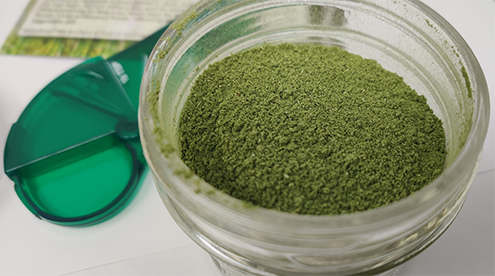
Stir a heaping teaspoon of powdered horsetail into water and drink it all. Start with a bit less the first few times you take it, so that your body can adjust to the sudden increase in dietary silica. Children can consume half of this amount. Horsetail can be taken in this way for 6-10 days each month to maintain health. However, a person with weaker teeth and bones can take larger doses for a longer period of time. The body enjoys taking horsetail in spurts. Taking it for 5-10 days, followed by a few days off, will be more effective than a continual daily dose.
Powder—External
Horsetail can also be used as a wound powder. Gently press the powder onto a fresh wound to stop bleeding. Mix powder with water to create a thick paste and apply this to wounds as a poultice. This will encourage healing and prevent infection.
Other Preparations
Teas and tinctures are not advised, due to their relative inefficiency in providing the body with absorbable silica. Nevertheless, some have reported success with these methods, and they can be tried at your discretion.
Animal Health
Some animals, particularly equines, enjoy an occasional snack of Equisetum. While there is some discussion about it being potentially toxic to horses in large quantities, the danger from free grazing appears to be very minimal. Horses and their relatives will usually seek out the plant when it is needed for maintaining or restoring tooth health. Planting a patch or container with horsetail can allow them to better regulate their own health.
Plant Food
An infusion or decoction of horsetail can be given to your other plants as a high mineral fertilizer. Horsetails’ high silica content, as well as the presence of a small amount of nicotine, help to discourage fungi and predatory insects, making it a beneficial foliar spray as well.
Precautions/Dangers/Contraindications
Safety concerns with this plant are mainly centered around preparation. Chewing the raw plant can, ironically, wear down the teeth, due to its high silica content. However, this is only a concern with excessive consumption over a lengthy period.
The fresh plant also contains a chemical called thiaminase. This chemical can rob the body of thiamine, one of the B vitamins. However, this is typically only a problem with excessive consumption over a long period and can usually be offset by a healthy diet containing plenty of B vitamins. Thiaminase is also deactivated by heating or drying.
You May Also Enjoy:
“The Hidden Dangers of Commercial Dental Care”
When preparing the dried plant as a powder, care should be taken to avoid breathing in its dust. Airborne silica can damage the respiratory system. High silica content can also cause distress to the digestive system. Increase your use of the plant gradually to give your body a chance to adjust and to find your own limits.
Horsetail is an accumulator of environmental toxins. Care should also be taken to harvest plants from unpolluted locations.
Plant ID
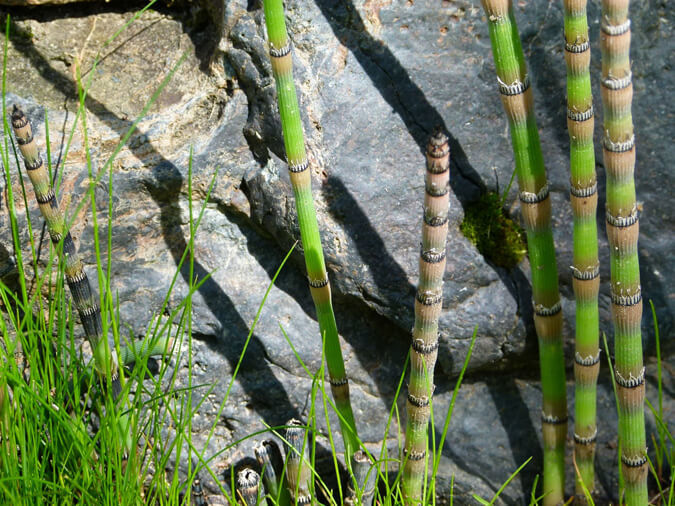
Horsetail is a spore-producing perennial, related to ferns. But unlike the feathery-leaved ferns, horsetail is more rush-like, consisting of multiple upright stems with no obvious leaves. Technically, horsetail does have leaves, though they are tiny and wrapped around the stem as a kind of toothy sheath on each of the stem’s nodes. These sheaths are bordered by thin black lines above and below.
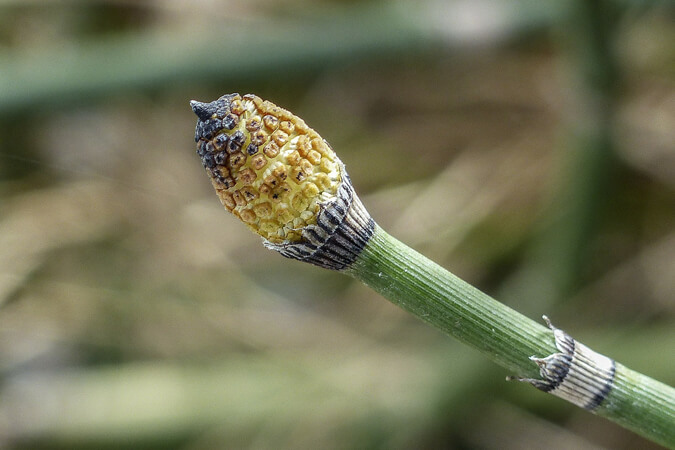
Photosynthesis is carried out mainly by the stems, which are usually non-branching. The stalks are evergreen in warmer regions and are deciduous in colder areas. At certain stages of growth, some of the stems will be topped by a pinecone-like structure, which produce the plant’s spores.

Carl Axel Magnus Lindman [Public domain]
The various species of horsetail can often be mistaken for one another. Care should be taken to select the correct species, as not all horsetails are equally edible or medicinal. In fact, some can have toxic properties when taken over prolonged periods. The main features to differentiate this species from the others are the un-branching stems and the patterned sheaths at each stem node.
Where Equisetum Hyemale Grows and Where to Find It
Horsetail can be found throughout much of the Northern Hemisphere, and has also found its way into South Africa and Australia. It is often invasive, growing in wet and waterlogged ground and spreading via underground rhizomes. It tends to grow in large colonies and can tolerate poor, acidic soils and low-oxygen environments.
Look for horsetail near streams and ponds; in ditches, swamps, and moist woodlands; and in other wet areas. It can grow in up to 4 inches of standing water. In lower latitudes, horsetail prefers partial shade. In higher latitudes, look for horsetail in full sun.
Many people will find horsetail creeping into their yards and even gardens. It’s also used as a decorative plant in bog gardens and can be grown in containers. The plants are much easier to propagate from root cuttings than from spores. However, care should be taken when deciding where to plant them, as they can be difficult to remove once established.
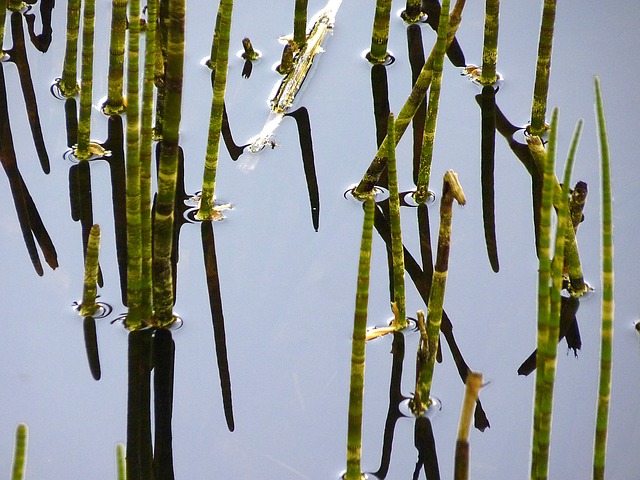
Image by Yves Bernardi from Pixabay
This plant can often be purchased at plant nurseries under the names barred horsetail (Equisetum japonicum) or Kamchatka (Equisetum camtschatcense). Despite the different names, these are both varieties of the same E. hyemale species. However, be careful to verify that the plant really is the right species. “Flexible” labeling seems to be fairly common with horsetail.
How and When to Harvest
The aggressive spreading nature of this plant makes it a bane to homeowners, but a boon to wildcrafters. Breaking the plant’s stems stimulates the roots to begin production of multiple new stems. Similarly, tilling around horsetail will only create a multitude of the plants as each root fragment will create its own new plant.
While horsetail can tolerate a fair amount of harvesting and keep coming back, continual harvesting will eventually weaken and even kill the plant. Doug Simons recommends harvesting only 1/8 of an established plant as a sustainable amount. Stems can be harvested at any time that they are green, which for many locations will be year-round. However, the new spring growth is the most tender and has the highest amount of absorbable silica.
Conclusion
We hope you’ll be encouraged to start using horsetail, and to see what this wonderful plant can do for you and your family. If you are looking for even more information on horsetail and its applications for dental health, be sure to check out Alternatives to Dentists, in which holistic healer Doug Simons and Marjory Wildcraft explore 100% natural dental care methods that you can use to regrow tooth enamel, prevent and reverse cavities, and even treat abscesses!
Learn more about these effective, non-toxic dental care techniques here!

You May Also Be Interested In:
__________________
This article was originally published on April 22, 2019.
Psst! Our Lawyer Wants You to Read This Big, Bad Medical Disclaimer –> The contents of this article, made available via The Grow Network (TGN), are for informational purposes only and do not constitute medical advice; the content is not intended to be a substitute for professional medical advice, diagnosis, or treatment. Always seek the advice of a qualified health care provider with any questions you may have regarding a medical condition. If you think you may be suffering from any medical condition, you should seek immediate medical attention. You should never delay seeking medical advice, disregard medical advice, or discontinue medical treatment because of information provided by TGN. Reliance on any information provided by this article is solely at your own risk. And, of course, never eat a wild plant without first checking with a local expert.
(Visited 44,642 times, 1,132 visits today)

The Grow Network is a global network of people who produce their own food and medicine. We’re the coolest bunch of backyard researchers on Earth! We’re constantly sharing, discovering, and working together to test new paths for sustainable living—while reconnecting with the “old ways” that are slipping away in our modern world. We value soil, water, sunlight, simplicity, sustainability, usefulness, and freedom. We strive to produce, prepare, and preserve our own food and medicine, and we hope you do, too!


