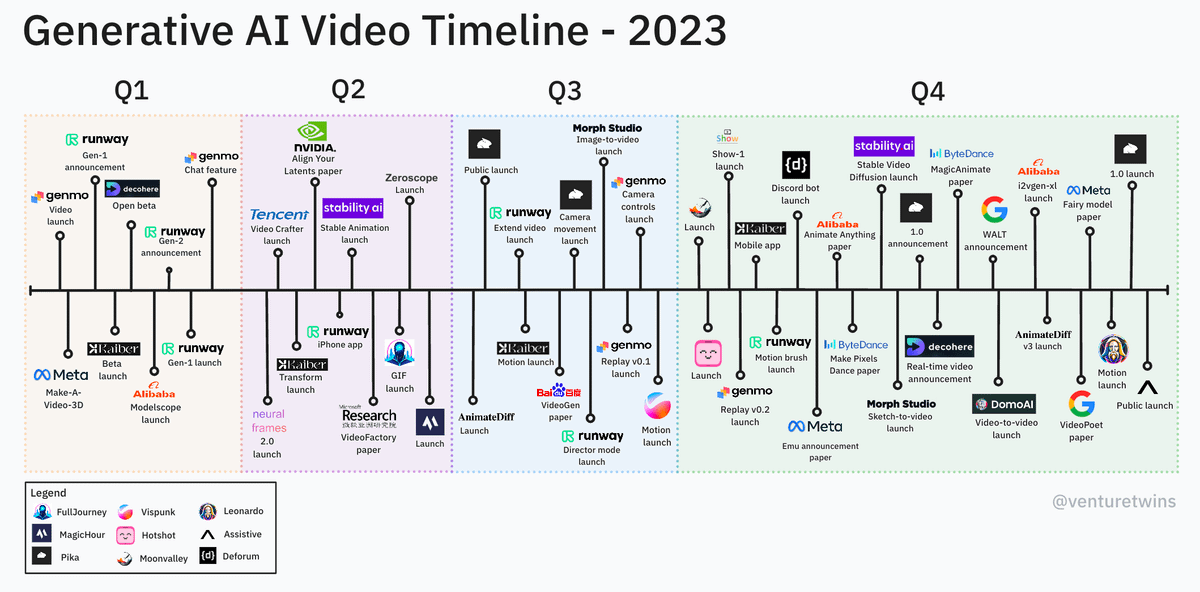
Generative AI Video Timeline by Justine Moore
Shortly before the transition from 2023 to 2024, a16z partner Justine Moore publish An insightful post 🧵 exploring the evolution of generative AI films and her thoughts on its current state and near-term future.
So, what’s next for AI movies?
First, as Moore's timeline shows, this is a category that's out of control.She has tracked 21 promising businesses that have emerged in just one year, not including a string of up-and-coming startups that didn't make her list
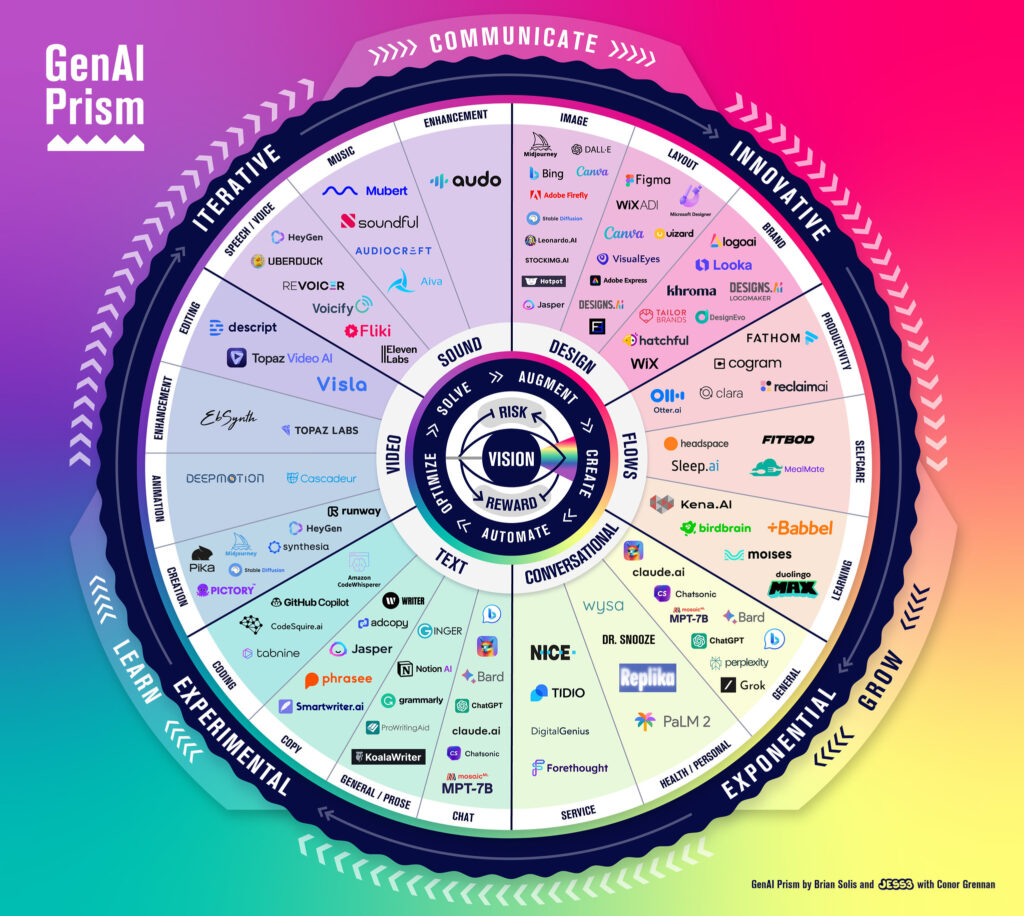
In fact, her work inspired how we prioritized this category in our next edition GenAI Prism (Jess 3 + Connor Grennan)
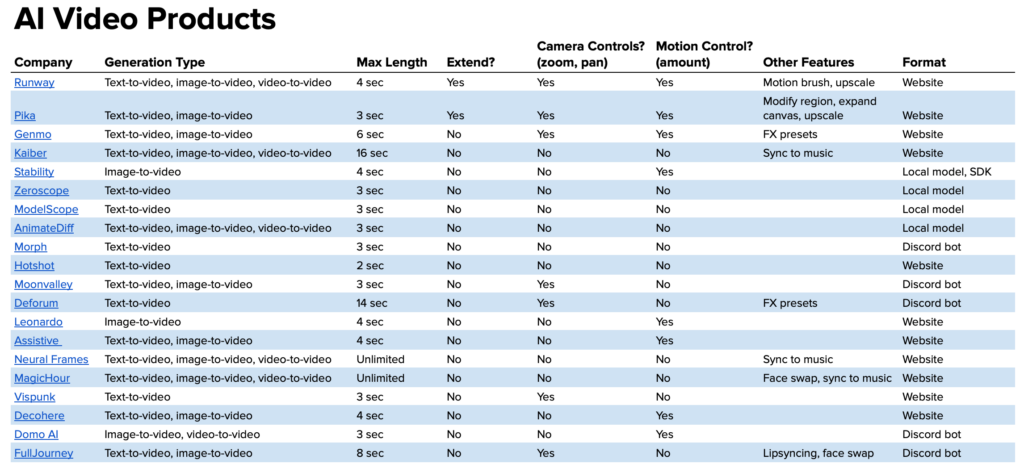
What do these 21 companies have in common? According to Moore, most companies focus on the following:
🔗 Temporal Continuity – Are the characters/scenes consistent from frame to frame?
🕹️Control – Can you control what happens + how the camera moves?
⏳ Length – Can you make a clip longer than a few seconds?
Moore also predicts that integrated workflows are on the horizon…
“Making a high-quality film requires a lot of work, from scripting/storyboarding to editing, upgrading, sound…” she observes. “Most products are focused on pure power generation – you can splice together output from elsewhere.”
Her point is, creators need an end-to-end workspace!
This is an example of the solutions today’s creators must cobble together.
The behind-the-scenes creative process of taking a wonderful shot🎬
MidJourney → Magnific AI → RunwayML pic.twitter.com/kZycz4POgZ
— Amar Raishi (@ammar) December 3, 2023
Her questions for 2024 are ones we should follow too…
1) Will Meta and Google finally release their model?
2) What is the role of open source? Many products are built based on SD, but the real basic model is often closed.
3) Who will crack the data challenge? High-quality, tagged video material is scarce.
Moore organized a public Google Docs Follow the 21 AI video companies she follows through links.
That’s it for this round! Stay tuned for the next issue of Artificial Intelligence Generating Insights.