


Concrete is undoubtedly one of the most important building materials in existence. According to statistics, in the United States alone, more than 370 million cubic yards are used every year. New York Times. Its historical use can be traced back to the beginning of 500 BC, and now the world produces approximately 10 billion tons of concrete every year.
Concrete is highly regarded in the construction industry because of its great strength, versatility and longevity. Some records indicate that this popular man-made material can last more than a thousand years. But the real concrete magic happens during the curing process, which refers to the critical process that occurs immediately after pouring and completion.
Cured concrete plays a vital role in ensuring the durability, strength, and integrity of the completed project. This process usually involves maintaining the correct temperature and humidity conditions for a longer period of time.
Well-cured concrete has just the right amount of moisture and heat, so it can maintain a hydrated state for a long time and ensure the best development of stability, strength, and proper thawing and frost resistance. Proper curing is also essential to improve the anti-scaling and abrasion resistance of concrete and to optimize the volume stability.
Today, we will quickly understand the working principle of concrete curing.
What exactly is concrete curing?
You can forgive thinking that curing is just drying the concrete. but it is not the truth. What happens during the curing of concrete is actually a complex chemical process in which moisture is incorporated into the grain structure of the cement, helping to retain some moisture in the bulk material.
Curing involves providing the necessary time, temperature, and humidity conditions for the concrete to achieve the desired characteristics. This chemical hydration process enables the concrete to reach the required strength, gain volume stability and properly harden.
How long does it take to cure concrete?
As we mentioned, fully cured concrete must have enough moisture to cure over a longer period of time. After the concrete is poured and set, the hydration reaction may continue to occur for several years. Knowing when the concrete curing process is complete can be tricky.
The time required for the concrete to fully cure depends on a number of important factors, including:
- Conditions under which the concrete is finally exposed
- Main weather conditions
- Required concrete strength
- The shape and size of the concrete structure
- Proportion of ingredients in concrete mixture
The American Institute of Concrete (ACI) generally recommends that curing measures be maintained until at least 70% of the required compressive strength is reached. According to experience, most concrete projects, including structural concrete (such as retaining walls, bridge decks, etc.) and ground concrete slabs (such as driveways, floors, sidewalks, etc.), require a curing time of at least 7 days. The ambient temperature should always be maintained at 40 Above °F.
Of course, the actual curing time will depend on the ambient temperature, the type of cement used, the size of the concrete and the shape of the concrete components. ACI’s recommended 7-day cure time of 70% compressive strength level is related to the minimum temperature requirement of 40°F.
If the concrete is cured at a temperature much higher than 40°F, it will reach the required 70% strength within 7 days. Likewise, certain concrete mixtures may require longer or shorter curing times.
The American Concrete Institute recommends that the use of ASTM C 150 I type cement concrete requires at least 7 days. Similarly, ACI recommends curing ASTM C 150 Type II, Type III, and Type IV/V cements for at least 10, 3, and 14 days, respectively.
How concrete curing works
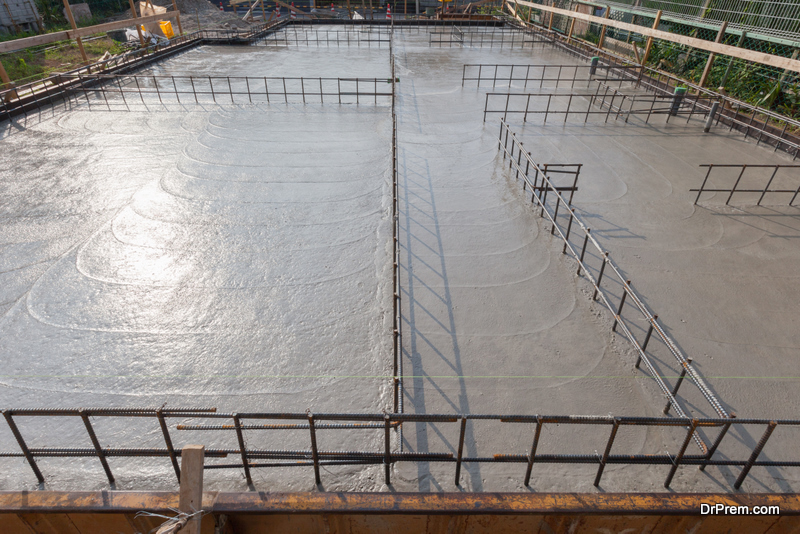 There are three main methods to optimize the concrete curing process.
1. Add water to the concrete surface at the initial stage of curing
The first principle of this method is to retain the mixed water as much as possible in the initial hardening stage. You can use several different methods to achieve this:
Atomization and spraying: Most construction companies use atomization and spraying when the humidity is low and the ambient temperature is much higher than the freezing point. Atomizing the concrete helps reduce cracking due to shrinkage until it finally solidifies.
think: The curing of flat concrete slabs and surfaces in small-scale operations often requires stagnant water. The temperature difference between the concrete and the curing water should not exceed 20°F to prevent the structure from cracking due to thermal stress. When it comes to curing test concrete samples in the laboratory, immersion is another method of “water storage”.
Local form and saturated wet covering: It is also possible to use saturated wood to add or retain moisture in the concrete. Wrapping the solidified concrete with a damp cloth or covering can also help prevent surface moisture loss. As long as the construction schedule allows, you should leave the location form in place. The same is true for saturated wet coverings.
2. Minimize the loss of water on the surface of the concrete
Reducing surface moisture loss may be the most effective way to cure concrete. Contractors use at least two common methods to seal moisture:
Application of sealant on the surface: When you apply a film-forming compound to the surface of concrete, it helps to contain moisture as long as it is needed for curing. Moisture inhibitors can be white pigments (most suitable for hot and sunny conditions) or translucent, for general curing. The cured sealant must meet the requirements of ASTM C13155 and should be applied to the concrete surface immediately after completion.
Use cover as a solid barrier: Most companies use non-porous plastic or paper to retain moisture. But before using the covering, the surface should be thoroughly moistened.
3. Heating to speed up the curing process
The third and most modern option is to accelerate hardening and strength development by adding heat and more moisture to the concrete. A variety of devices can be used to provide additional heat.
Heating coil: In most cases, heating coils are embedded near the surface of the concrete to help prevent it from freezing when the temperature drops during the curing process.
Concrete blanket: If concrete elements are affected by freezing conditions, concrete blankets can be used to insulate them during curing. Of course, these blankets should be used when the concrete becomes hard enough.
Thermal pad/form: Electrical concrete pouring formwork or pads can also provide covering and insulation for precast concrete structures.
Live steam: Fresh steam at atmospheric pressure should be maintained at around 140°F to promote optimal steam concrete curing. Some contractors prefer high-pressure steam curing because it does not require high ambient temperatures to work.
How data loggers help concrete cure
Data loggers have almost become synonymous with highly regulated industries such as biopharmaceuticals, food, and healthcare.this Thermal sensor As an environmental condition monitor for the entire cold chain, allowing the safe storage and delivery of sensitive items such as COVID-19 vaccine. Facts have proved that these devices can also play a key role in the concrete curing process.
how so?
Due to the nature of concrete, curing will be affected by several variables, the most common being weather factors and ambient temperature. Therefore, good curing practices require monitoring of these conditions in order to detect and correct any discrepancies as early as possible.
This is where industrial data loggers come into play. Using modern digital data loggers (DDL), humidity levels and ambient temperature can be automatically measured, monitored and recorded. with, According to DixonData loggers can help organizations handling concrete reduce opportunities for human error, minimize operating costs, and protect their assets.
Most importantly, DDL can be designed to automatically transmit monitoring data collected from concrete to a centralized location that can be accessed and analyzed remotely. More importantly, the data logger can be configured to send customized alerts via text, phone or email when conditions are out of range.
in conclusion
Curing plays a vital role in ensuring that the concrete reaches the required level of strength and durability. However, the process is affected by the humidity level and ambient temperature deep in and near the surface of the concrete material. The use of data loggers helps ensure effective monitoring of these conditions and timely detection of deviations.
Articles submitted by community writers


