FREE: 5 SECRETS TO FAST HEALTHY DINNERS
This post may contain affiliate links, which help keep this content free. (Full disclosure)
What is your favorite food in the world? Mine is eggs. Always has been. There are so many delicious ways to enjoy them, and perfect hard boiled eggs are one of my favorite ways. Today, I want to show you how to boil eggs perfectly every time – and how to peel boiled eggs easily, too!
Boiled eggs were one of the first foods I learned to make as a kid. But, I refined my favorite method for boiling eggs only a few years ago. I had a pretty good idea of how I like them, but I wanted to make a definitive chart. That means you can make them just how you like them. Every single time.
As a scientist at heart, it was really fun for me to do the testing for this article. So even if you already know how to boil eggs – and I know many of you do! – I hope you’ll still get something out of it. Because when it comes to boiling eggs, the method does make a difference, and every minute counts for the end result.
This is going to be your ultimate guide for how to boil eggs, the best way to peel them, and how to store them afterward.
The Best Method for Boiling Eggs
There are two main methods for how to boil eggs on the stove.
The most common method is to bring the eggs to a boil, then turn off the heat, close the lid, and let them cook in the residual heat. This method works fine, but it takes longer, because the water stops boiling. I’m not a patient person, so I prefer the second way.
My preferred method for boiling eggs is to boil them the whole time. Once the water comes to a boil, you set a timer and cook them for exactly the number of minutes needed for the level of doneness you want.
Yay for having faster, perfect boiled eggs!
There are actually lots of other ways to boil eggs. People do it in a pressure cooker, slow cooker, or even the oven. I’ll share how to boil eggs using some of these other methods down the line. (And please, let me know if you’re interested in one of them in particular!)
Still, my go-to way to make perfect hard boiled eggs is the stove. It’s super easy, no fuss or equipment required, and is really, really fast.
In addition to the eggs, there are two important ingredients needed to make perfect, easy peel eggs.
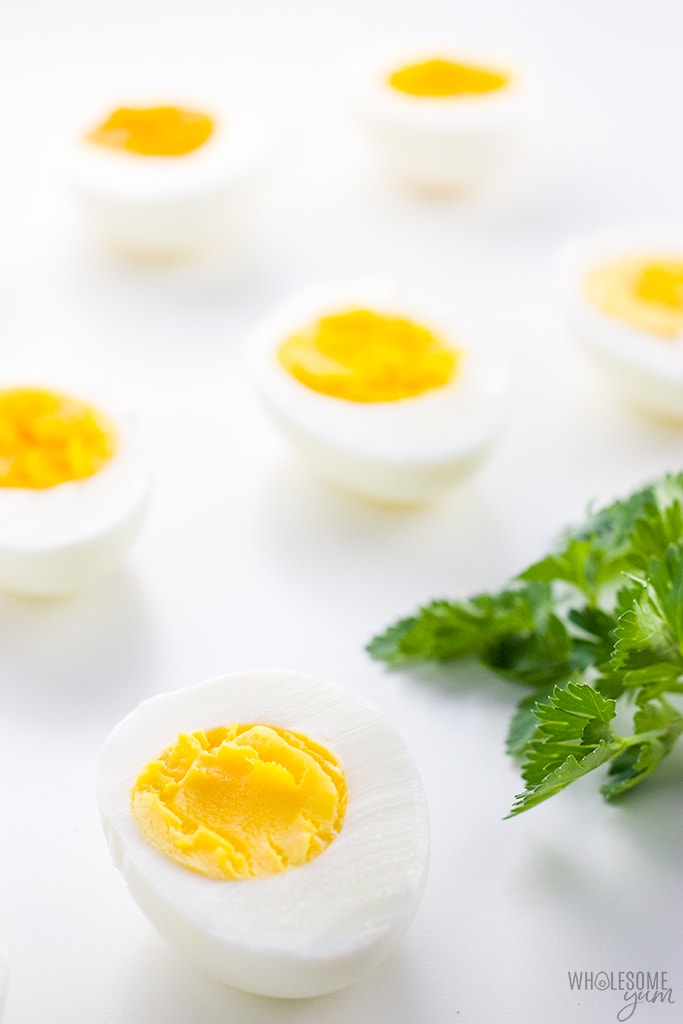
Adding Salt and Vinegar When Boiling Eggs
The first ingredient we add to the water is sea salt. There are a few reasons that adding salt makes for perfect hard boiled eggs.
Some people think that adding salt makes the water boil faster, which is actually not true. However, we add salt to the water because it:
- Increases the temperature of boiling water. Adding salt raises the boiling point of the water slightly. This is not the same as boiling faster! Since the boiling point increases, the time it takes to boil is the same. But, it does heat up faster and in the end boils at a higher temperature. This causes the egg white to cook a little faster, which makes it easier to prevent overcooking the yolk.
- Helps seal and cracks or leaks. If a crack develops in the egg, the salt will aid in coagulation. That basically means it will seal faster when it hits the salt water.
- Makes the egg easier to peel. A tiny bit of salt actually permeates the egg shell. It’s not enough for you to taste it, but it does help with peeling.
The second ingredient we add is vinegar. You can use white vinegar, but since it comes from corn, you can also use apple cider vinegar if you want paleo eggs. The important part is the acidity from the vinegar.
Why does vinegar help create easy peel boiled eggs? It softens the shells! This makes them easier to peel. Yay!
How To Make Hard Boiled Eggs vs Soft Boiled Eggs
How do you like your boiled eggs? It’s really about that yolk. Soft boiled and runny? Medium and creamy? Nice and firm?
The best method for how to make boiled eggs is the same no matter how you like them. Like I said, my favorite is to boil the eggs the entire time and set a timer to get them just right. It’s just a matter of how long…
How Long To Boil Eggs
How long to boil eggs depends on how much you want them done. Hard boiled eggs will take longer, and soft boiled eggs take less time. But, the difference is really just a matter of minutes.
Lucky for you, I tested how long to boil eggs by going through a few dozen of them! I took out a couple boiled eggs at a time, at one-minute intervals. Why two at a time? I wanted to make sure that the result was not a fluke.
Then, I even repeated this twice! This way, we would get a very consistent answer. I wanted to guarantee perfect hard boiled eggs every time!
Can you over boil eggs? Oh, yes. For sure.
How do you know if boiled eggs are overcooked? There are a couple of ways to tell. The first indicator is rubbery whites. Yuck.
The more common way to identify overcooked hard boiled eggs is a greenish-gray surface (ring) around the yolk. You don’t want that.
What causes the greenish-gray ring? It’s a chemical reaction between the sulfur in the egg white and the iron in the yolk. Though not harmful, the yolk will be very dry.
Preventing this is easy. Just boil your eggs for the right amount of time, and you’ll be fine!
How long to boil eggs also depends on the method you use. As mentioned before, the method of boiling until they are done will take less time. If you use the other method, where you bring the water to a boil and then remove from heat, they will take longer.
Hard Boiled Eggs Time Chart
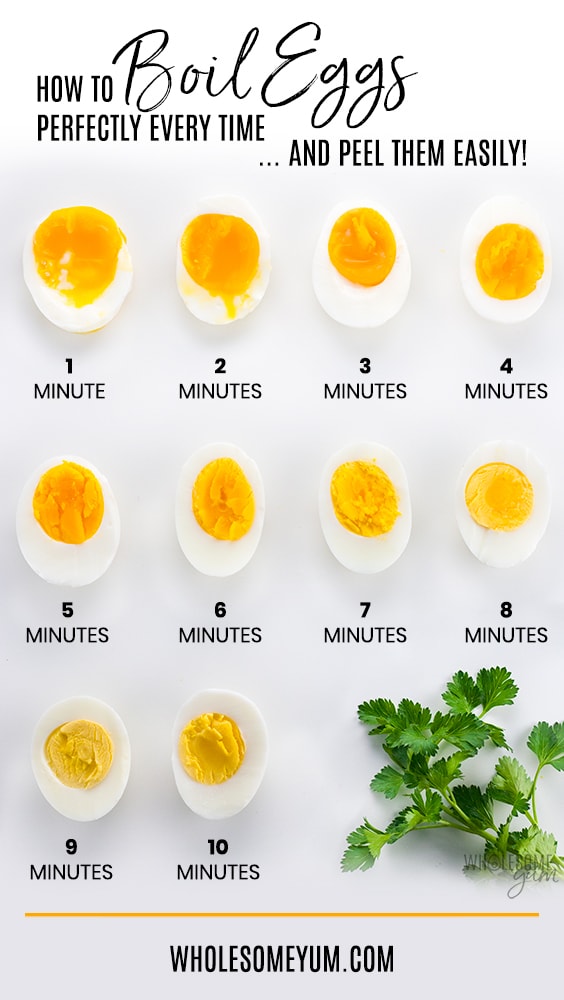
Okay, we need a hard boiled eggs time chart. (I love charts!) Just follow these cook times, and you’ll know how to boil eggs perfectly every time:
| Cook Time | Result |
|---|---|
| 1 minute | Very runny soft boiled eggs |
| 2 minutes | Runny soft boiled eggs |
| 3 minutes | Very gooey medium boiled eggs |
| 4 minutes | Gooey medium boiled eggs |
| 5 minutes | Just set medium boiled eggs |
| 6 minutes | Medium-hard boiled eggs |
| 7 minutes | Very creamy hard boiled eggs |
| 8 minutes | Creamy hard boiled eggs |
| 9 minutes | Firm hard boiled eggs |
| 10 minutes | Very firm hard boiled eggs |
Just to be clear, this is how long to boil eggs after the water has reached a rolling boil.
Also, these times are based on large eggs. This is the most common size, and it’s what I buy. The times might take a little longer to get to the same level of doneness if you have extra large or jumbo eggs, or be done quicker if you have medium eggs.
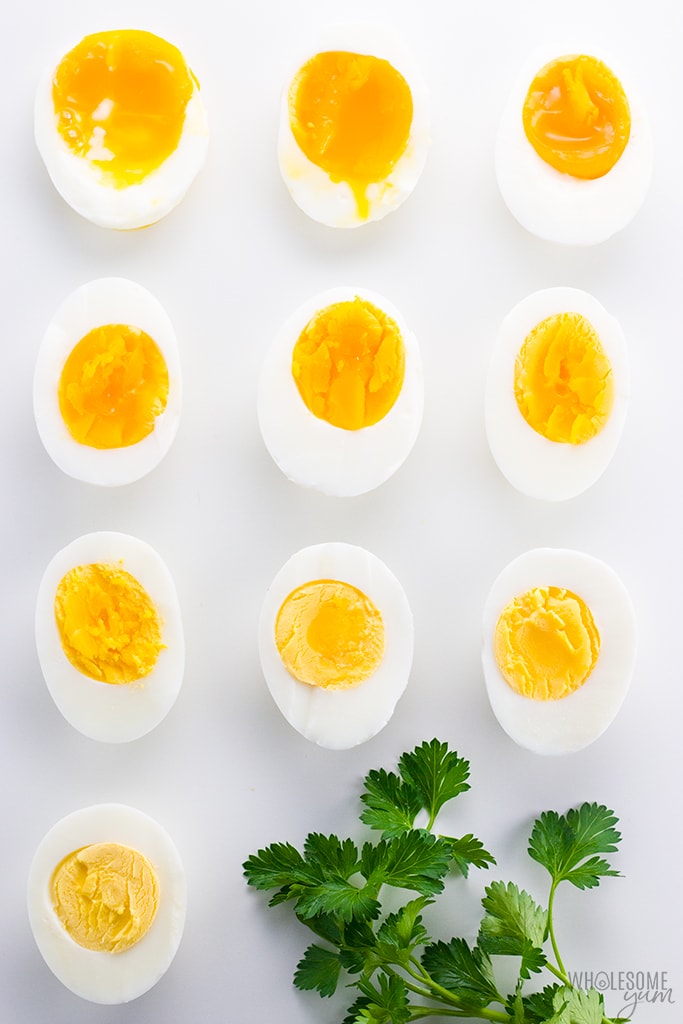
Here is a visual showing how the boiled eggs look after 1 minute, all the way to 10 minutes:
How To Peel Hard Boiled Eggs Easily
Before I figured out how to peel hard boiled eggs, the process drove me crazy. It was so long and tedious, especially if you make a big batch to have in the fridge. I’d pick off little pieces of shell, and could never get a smooth end result.
Fortunately, after some testing, I found a sure, foolproof way to peel hard boiled eggs easily every time. There are several parts to it:
- Start with eggs that are a few days old. Why? Fresh eggs are slightly less acidic, so the white sticks to the inner shell more. As the egg gets older, the shell absorbs more air, becomes more acidic, and also shrinks slightly. All of these aspects create more space between the egg white and the shell. That means easy peel boiled eggs!
- Add salt and vinegar to the water before cooking. I already talked about this above. The salt permeates the shell a little bit, and the vinegar helps to break down the shells, making them easier to peel.
- Cool the eggs in ice cold water for ten minutes. There are multiple reasons to do this. First of all, it stops the cooking process from residual heat, so you don’t end up with overcooked eggs. But just as importantly, it makes for easy peel boiled eggs! The reason is, some of the water permeates the shell, which helps loosen the bond to the egg white.
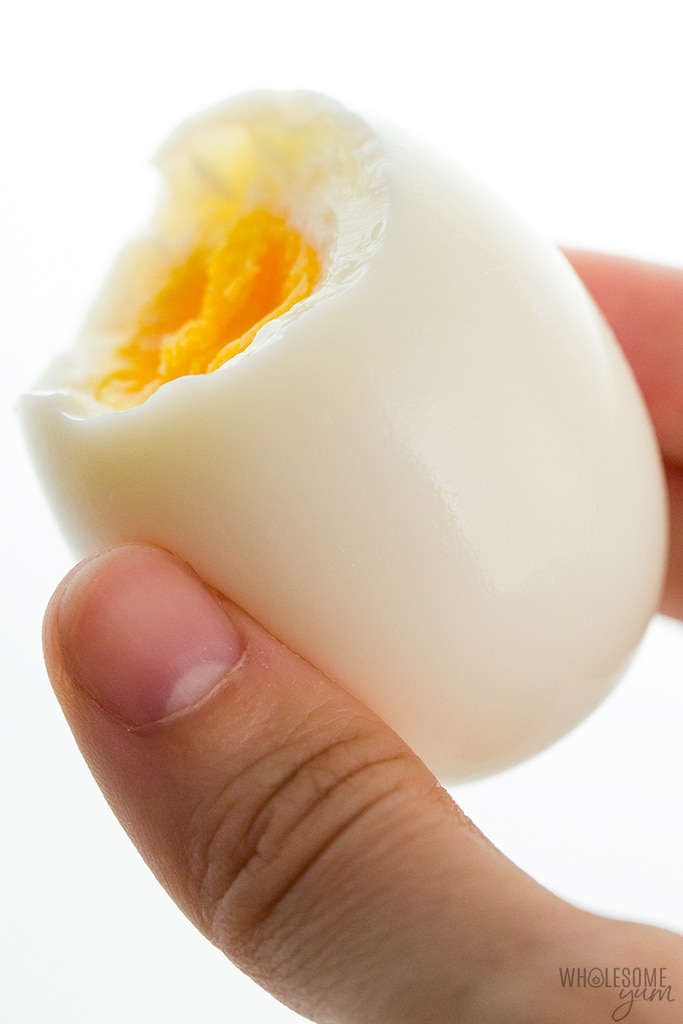
- Roll the egg on the counter. I’ve tried different techniques for how to peel boiled eggs, and this one wins, hands down. Simply roll the egg on the counter with the palm of your hand, creating cracks all over. This process helps loosen the shell in general. Then, start peeling at one of the cracks toward the center of the egg, and the shell will come off effortlessly from there.
When it comes to the vinegar, you can use either regular white vinegar or apple cider vinegar. White vinegar is derived from corn, so use apple cider if you want to avoid that.
A tiny amount of vinegar does permeate the egg shell, but don’t worry. You won’t taste it!
Some people swear that adding baking soda helps to make eggs easier to peel. I tried it, but it didn’t make any difference. The vinegar did. Yay!
You might also be wondering when the right time is to peel hard boiled eggs. That depends on how long you plan to store them.
How To Store Hard Boiled Eggs and When To Peel Them
Once you know how to boil eggs perfectly, you’ll probably make them in batches. Why wouldn’t you? They make such wonderful snacks and store well.
Hard boiled eggs are okay at room temperature for a couple hours, but beyond that, store boiled eggs in the fridge. They will keep for about a week.
The soonest time to peel hard boiled eggs is after they have sat in cold or ice water for ten minutes. Give them at least this long, to prevent overcooking and make the peeling process easier. However, don’t leave them in the water for too long without refrigeration, because bacteria can grow.
If possible, do not peel hard boiled eggs until you are ready to use them. The shell will protect them and they will last longer. Just refrigerate them in the shells and only peel when you need them.
That being said, if you still prefer to peel your eggs all at once, you can. After peeling, store the remaining eggs submerged in cold water in the fridge. You’ll need to change the water every day, so it might not be much of a time savings. Alternatively, you can drape damp paper towels over the eggs instead of submerging in water, but it’s still recommended to swap them daily.
Unfortunately, freezing boiled eggs is not recommended. I’ve tried, and the texture when thawing them is just terrible. Don’t do it!

Hard Boiled Egg Nutrition – How Many Calories in a Boiled Egg?
When it comes to nutrition, boiled eggs are exceptional.
Eggs contain 13 essential vitamins and minerals, including vitamin D, calcium, iron, potassium, riboflavin, vitamin B12, biotin, pantothenic acid, iodine, zinc, selenium, molybdenum, and choline. And, each egg contains 6 grams of quality protein, meaning it has all the essential amino acids. 1, 2 The nutrients of the egg are found in the yolk, and the white contains the protein.
Choline, one of the most important nutrients in egg yolks, has been associated with lower risk of liver disease, cardiovascular disease, and neurological disorders 3.
How many calories in a boiled egg? It depends on the size. A large egg, which is most common, has only 70 calories and 0 grams carbs. Yay!
Not surprisingly, eggs are pretty much the perfect food for a low carb diet. And, the American Heart Association and American Diabetes Association no longer limit egg or cholesterol intake, which used to be a concern with eggs. The myth of the relationship between egg consumption and cardiovascular disease has since been debunked. 4, 5
In fact, studies have shown that consuming whole eggs daily, as part of a low carb diet, actually improves cholesterol and insulin sensitivity. It also improves lipid and glucose markers in diabetic patients, and can aid in weight loss. 6, 7, 8, 9
Soft or Hard Boiled Egg Recipes and Uses
Now that you know how to boil eggs perfectly every time, I hope you’ll make them more often!
If you need ideas for how to use boiled eggs, I’ve got you covered! The most common ways are salads, like cauliflower potato salad or seven-layer salad.
You can also dunk cheese sticks or veggies into a soft boiled egg, make a breakfast sandwich on keto bagels, or mash the yolk with mayo and spices for simple deviled eggs. Check my low carb & keto food list for the full list of low carb foods, to give you more ideas of what you can combine with eggs.
But my favorite way to enjoy boiled eggs? Simply plain with a little salt and pepper. When you have that idyllic creamy yolk, that’s all you need to enjoy perfect boiled eggs.
- Large Stock Pot – This one is a great universal size for everything from family dinner soups to these easy peel hard boiled eggs!
- Apple Cider Vinegar – This kitchen staple is useful for many culinary and health applications. Once it’s in your cabinet, you’ll find yourself reaching for it often.
- Sea Salt – Not all salt is created equal! This one is easy to pinch and full of naturally occuring minerals. It’s also a must for both cooking and eating your boiled eggs.

Reader Favorite Recipes
The recipe card is below! Readers that made this also viewed these recipes:
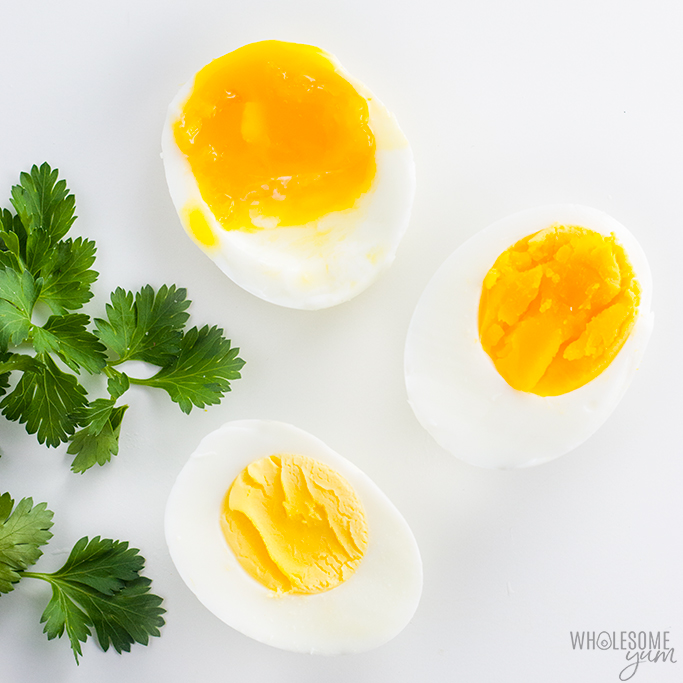
How To Boil Eggs Perfectly Every Time – Easy Peel
The ultimate guide for how to boil eggs perfectly every time – and the best method for how to peel hard boiled eggs easily! Includes a time chart to make perfect boiled eggs how you like ’em, the best add-ins to the water for easy peel eggs, storage tips, and more.
Cook Time 7 minutes
Total Time 7 minutes
Recipe Video
Tap on the image below to watch the video.
Like this video? Subscribe to my YouTube cooking channel for healthy recipes weekly! (Click the bell icon to be notified when I post a new video.)
Ingredients
Tap underlined ingredients to see where to get them. Please turn Safari reader mode OFF to view ingredients.
Instructions
Tap on the times in the instructions below to start a kitchen timer while you cook.
How To Boil Eggs Perfectly
-
Place eggs in a single layer at the bottom of a large saucepan or pot. Add enough water to cover the eggs with at least 1 in (2.5 cm) of water over them.
-
Add a tablespoon (15 mL) of vinegar and a tablespoon (14 g) of sea salt to the pot. Stir gently.
-
Place the pan onto the stove over high heat. Bring the water to a rolling boil.
-
Once the water is boiling, set a timer to the following number of minutes based on how you want your eggs.
- 1 minute – Very runny soft boiled eggs
- 2 minutes – Runny soft boiled eggs
- 3 minutes – Very gooey medium boiled eggs
- 4 minutes – Gooey medium boiled eggs
- 5 minutes – Just set medium boiled eggs
- 6 minutes – Medium-hard boiled eggs
- 7 minutes – Very creamy hard boiled eggs
- 8 minutes – Creamy hard boiled eggs
- 9 minutes – Firm hard boiled eggs
- 10 minutes – Very firm hard boiled eggs
-
Right before the timer is about to go off, turn on the faucet to the coldest that it goes and let it run until the water is ice cold. Once the timer goes off, drain the hot water and place the pan under the cold running water, letting the ice cold water fill the pan. The water will turn lukewarm from the heat of the eggs and pan. Keep running the water (it will overflow from the pot), until the water in the pan is ice cold. Leave the eggs in the pot for about 10 minutes, until they reach room temperature.
How To Peel Boiled Eggs Easily
-
Once the eggs are at room temperature (but not colder), you can peel them.
-
To peel an egg, roll it on the counter with the palm of your hand, pressing gently to make cracks all over the shell. The peel will come right off!
-
If not using right away, see notes in the post above about how to store hard boiled eggs and when to peel them.
Recipe Notes
Serving size: 1 egg
Video Showing How To Make Perfect Boiled Eggs:
Tap here to jump to the video for this recipe — it’s located directly above the ingredients list. It’s the easiest way to learn how to make Perfect Boiled Eggs!
Nutrition Facts
Amount per serving. Serving size in recipe notes above.
Calories 70
Fat 5g
Protein 6g
Total Carbs 0g
Net Carbs 0g
Fiber 0g
Sugar 0g
Nutrition facts are provided as a courtesy. Have questions about calculations or why you got a different result? Please see our nutrition policy.
Want to save this recipe?
Create a free account to save your favourites recipes and articles!
© Copyright Maya Krampf for Wholesome Yum. Please DO NOT SCREENSHOT OR COPY/PASTE recipes to social media or websites. We’d LOVE for you to share a link with photo instead. 🙂