


Maybe you’ve heard of Amazon Attribution and the Amazon Brand Referral Rewards program and wonder how they can help build your business.
With cost-per-click (CPC) rising on Amazon and the platform taking a tougher stance on black hat ranking tactics, more and more sellers have been looking for ways to drive external traffic to Amazon product detail page.
Additionally, some brands—especially those without direct-to-consumer (DTC) sites, or those looking to leverage sales from external traffic sources to help boost the e-commerce giant’s organic rankings—will turn to doing things outside of Amazon ads to help drive those rankings to get the desired conversions.
In the past, the downside of sending external traffic to Amazon was the inability to track traffic results and conversion rates.
Amazon doesn’t allow pixels to be added to its product detail pages, making it difficult to determine the effectiveness of external campaigns driven to Amazon.
In addition to the lack of transparency about your external traffic performance, you must also factor in Amazon’s fee costs as well as advertising costs when calculating profitability.
To address this, Amazon has introduced two programs that work together to help you understand how your external traffic is performing and recover credits from fees for products you send to Amazon.
These programs are Amazon Attribution and Amazon Brand Referral Bonuses.
Why drive external traffic to Amazon?
In general, it is best to start with Amazon Advertising Platform Because of increased visibility of campaign performance and reduced cost of many products.
However, sometimes it does make sense to drive external traffic to Amazon.
Amazon’s Top of Funnel ad product is still in its infancy, and some targeting isn’t as advanced as what you’ll find on other platforms.
In some cases, there are more opportunities to effectively advertise to specific demographics or target groups outside of Amazon, such as Facebook, Google, or Instagram.
Additionally, most of Amazon’s advertising products severely limit the number of creatives you can include in your ad.
For many Amazon ad types, the primary creative comes from the list itself. As a result, it can be difficult to create customized ads for different audiences, or provide education or brand awareness for a product.
Ads created on Amazon often allow for more freedom in creative imagery and text.
Generally speaking, it can be more expensive to send external traffic to Amazon because you pay Amazon fees in addition to the external fees for advertising.
This extra cost means you need a higher return on advertising to be profitable.
This is not an option for every seller or every product. However, if your profits allow, we’ve seen overall sales and profitability improve when done right.
Amazon Attribution and Brand Referral Bonus Program
For situations where sending traffic from outside Amazon makes sense, there are two programs that can help you increase your campaign’s visibility and reduce your overall cost.
This Amazon Attribution Program It’s been a few years. It enables you to drive external traffic and view specific data on the results of the traffic you send to Amazon.
In July 2021, Amazon launched Brand Referral Rewards Program.
With this program, when you drive external traffic, Amazon will use the traffic you send to Amazon product detail pages to discount the referral fee you pay for the products you sell.
Remember, to use the Brand Referral Rewards program, you must first participate in Amazon Attribution and Brand Registry.
Below are the details of both programs.
Amazon Attribution Program
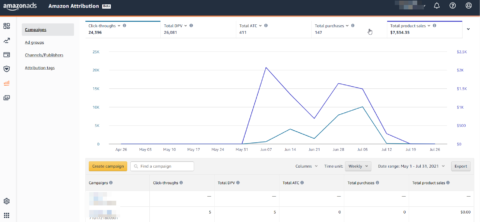
The program allows you to track specific metrics of traffic sent using Amazon Attribution Links.
As part of this program, Amazon creates custom links to track specific metrics generated as a result of the traffic you send to product detail pages.
Amazon Country That:
“Attribution reports include clicks as well as Amazon conversion metrics such as detailed page views, add to cart, and purchases. Reports are available through downloadable reports and in the console.”
To participate in this program, you must be registered Amazon’s Brand Registry program. If you don’t have a live trademark, you can participate in the Amazon IP Accelerator program.
Amazon Attribution works by assigning you a custom link and giving you a 14-day last-touch, cross-device attribution model.
Amazon Brand Referral Rewards Program
The Amazon Brand Referral Bonus is actually a subset of Amazon Attribution. Amazon says that, on average, brands earn 10% from qualifying sales.
The way the program works is that when you send external traffic through the program along with Amazon Attribution, you will receive a referral fee back for when your products are sold on Amazon’s platform.
The amount of referral fee credit you receive will depend on your product category in the same way the referral fee itself is calculated on the platform.
Depending on the ad type, there is a maximum attribution window of 14 days.
Remember, after a sale occurs on Amazon, there is a two-month waiting period before the bonus is distributed to your account.
For example, if your sale occurred in December, you won’t be reimbursed in Seller Central Payments until February.
This allows for customer returns and cancellations.
How to Sign Up for Amazon Attribution
The first step in enrolling in both programs is to ensure that you are enrolled in either the Brand Registry or the IP Accelerator program, depending on your circumstances.
You will need a live trademark to participate in the Amazon IP Accelerator to potentially accelerate the trademarking of your brand or product.
Then, you need to have an active Amazon account and sign up for Amazon Attribution. After completing these steps, you can sign up for the Brand Referral Rewards program.
If you’re looking for a more detailed explanation of how Amazon Attribution and its metrics work, you can take part in the Amazon Learning Console.
This will guide you through the procedure, setup and interpretation of the data.
External advertising, used in conjunction with internal Amazon advertising, can be a powerful strategy for competing or new categories to increase overall sales and/or product adoption.
More resources:
Featured image: DavigGyung/Shutterstock


