


If you follow me on Twitter, you’ll know that I’m one of those harsh critics of the New York Jets and an unsolicited commentator on all things Real Housewives.
But you may also realize that I am a tireless fighter for SEM audience and asset segmentation.
Brands vs. non-brands, first-time shoppers vs. repeat customers, high HHI (high household income) women 25-35 vs. coupon shoppers 65+…each Elements and audiences are different.
It doesn’t make sense to keep everything to the same measurement standard.
Someone might say, “Jon, I have an overall goal. I want all my efforts to hit it. Otherwise, it’s not worth running them.”
I replied, “Okay, give me a riddle. How much cheaper is yours? Branded CPC vs Your Non-Branded, or how much higher are repeat shoppers than first-time buyers? “
While you can have an overall goal, you still need to realize that each element will behave differently.
Additionally, different performance levels must be combined into a single performance KPI (Key Performance Indicator).
If you continue to cancel all efforts that don’t meet the overall KPIs you have set across the board, you won’t be able to acquire new customers and your traffic will quickly drop.
Need proof?ok here you go
Here, we observe “Client N”.
They’re a direct-to-consumer e-commerce brand that sells bacon and a variety of bacon (yes, it’s delicious).
We segment targets into Essential Brands vs Non-Brands, but also NTF (First Time Buyers) vs Repeat Buyers.
-
 Literally how bacon is made…in the search.
Our AOV (average order value) is determined by pricing, which is market price, so we focus on maximizing conversions through ROAS (return on ad spend).
We know that we’re going to get two to three purchases a year from customers for five years.
So while repeat purchases of our brands are super cost-effective and pay the bills, we recognize that they are now considered a depreciable asset.
As a marketer, do you market depreciable assets aggressively because of their low cost, or do you pay wazoo up front for new customers, realizing they’re going to be super good deals on their second purchase?
spoiler: Never stop supporting repeat customers, but work on new ones.
So we have six different KPIs (and why):
Brand repetition
- Low-level CPC KPIs.
- Why: They are brand loyal and have a high likelihood to buy, so we want the lowest possible CPC (cost per click) to direct them to the products we want to push.
BrandNTF
- High-traffic KPIs and mid-level CPC KPIs.
- Reasons: Brand awareness, usually recipients of gifts or other marketing, high conversion probability, CPC is more expensive, so if we can control it, it will be a better LTV ROAS.
off-brand repetition
- CPA (cost per action) KPI.
- They don’t have loyalty, they bought once before but didn’t return it to us by name, so it’s more logical to focus on a specific CPA goal since it’s much less likely to buy again after that.
- The caveat is that this is the least valuable customer and lacks brand loyalty.
off-brand NTF
- High traffic and high impression share KPIs.
- You want as many of these as possible, and in a crowded market, you often have to forgo cost (because it’s not cheap) to gain visibility (make sure you have a great ad.
- You will compensate for the conversion on the backend.
Shopping (we don’t separate NTF from duplicates)
- Conversions and ROAS KPIs.
- This is the money maker after our brand. Increase your sales as much as possible. Considering the ad unit, it’s cheaper to click. Just make sure your ROAS is at least 110%.
display/video
- Brand awareness KPIs.
- This did not allow us to sell directly. It builds brand awareness, so we set the lowest CPV on 30 second video and CPM (cost per 1,000 impressions) and test it regionally to determine the level of first-time brand visitors to the site.
- We collect visitors for remarketing.
Another example is “Customer S”.
They are a chain of senior living communities across the country.
Their focus is to generate leads by submitting a form or a phone call at a certain time.
As always, we sort by branded and non-branded keywords and services offered.Every service has a Different lifetime valuations as recurring income.
The number of independent living is greater, the LTV lasts longer, and the income per resident is lower.
On the other hand, Memory Care had the lowest sales volume, had a shorter LTV duration, but had the highest initial revenue in the first three years.
-
 Understanding SEM-Related Valuations for Senior Living Services
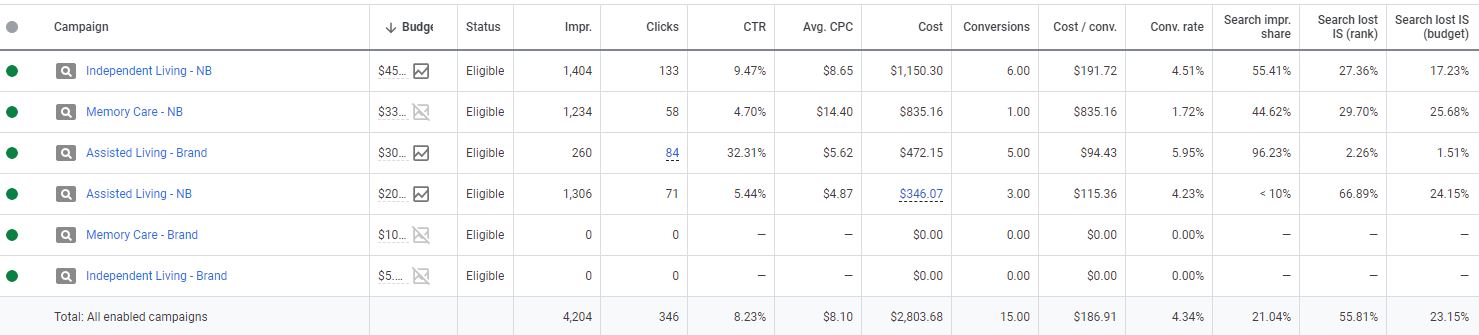
In this case, we set KPIs by service line (ignoring the lack of branded traffic as each location has a different name, which we don’t care about).
We operate with three different KPIs:
Live independently
- High traffic and low to medium CPC KPIs.
- Huge competition, so if you have a good price and a good location, aim for sheer volume. However, if the CPC (from the competition) rises above $11, clicks quickly fall off a cliff because there is no extra budget.
memory care
- CPA KPIs.
- There is minimal competition, but a high degree of researcher, which reduces CTR (click-through rate) and increases CPC. The key is to focus on the CPA itself and realize that LTV duration is 25% of independent living. Three years of memory care earned more than eight years of independent living.
Assisted Living
- Low CPC KPIs.
- There is a lot of competition and everyone is seen as a lot of research. You don’t have to be in number 1, just stand out and get as little traffic as possible, because a $0.50 CPC fluctuation can reduce your traffic with a fixed budget.
OK, I’ve seen your proof. How to do?
Once we identified the necessary KPIs, we set a target number for each to achieve.
This means things like “Brand repeat CPCs cannot exceed $0.50” or “Non-branded NTFs require a minimum of 250 clicks per week, 15% impression share, and a maximum CPC of $0.75”.
We then divide the budget from the part that is most valuable to us to the part that is least important to the budget allocation.
Then we can determine whether budget allocation The overall ROAS target will be met.
take away
No two accounts are the same (like calling the Jets and Giants the same NFL team).
But having said that, not every asset in an account is the same.
So getting a non-branded first-time searcher of Cherrywood Bacon to get the same CTR, CPC, CVR (conversion rate), and ROAS for repeat purchases on branded terms for corned beef hash is like comparing apples to oranges.
Maintaining separate KPI objectives, strategies and elements will lead to more accurate and predictable performance results.
More resources:
Featured Image: Idea Ink Design/Shutterstock

