


a new one Report With funding plummeting in the first quarter of this year, investors may finally be putting the brakes on the runaway industry of digital health, a report from CB Insights found. Global digital health funding was $10.4 billion in the first quarter, down 36% from $16.2 billion in the previous quarter. Total funding in the first quarter also hit a six-quarter low, the report said.
The month-on-month decline in digital health funding was particularly pronounced given that other industries also experienced investment declines, but not as large as the digital health sector — for example, fintech and retailtech fell by only 18% and 11%, respectively. last quarter.
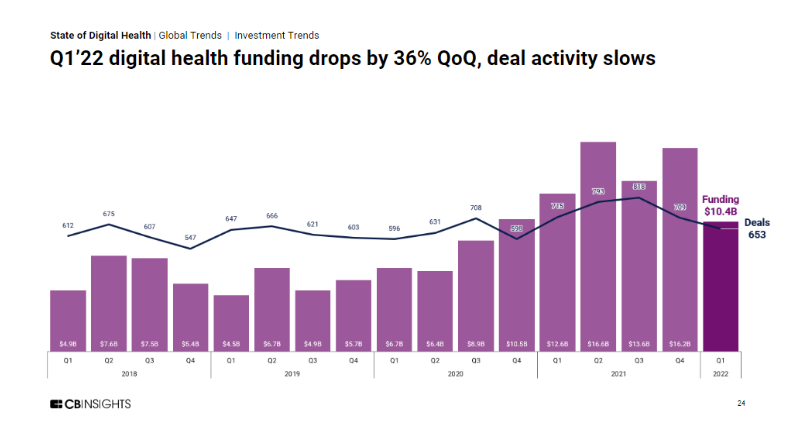
A 36% decrease in global digital health funding was also reflected in the United States. After hitting an all-time high in the fourth quarter of last year, U.S.-based digital health startups raised just $7.2 billion in the first quarter of 2022, a drop of 37%. U.S.-based companies account for 69% of total digital health funding and half of all deals.
Companies raising giant rounds of more than $100 million have faced a challenging climate. Huge rounds halved to $4.4 billion in the first quarter from $9.2 billion in the second quarter of 2021.
In digital health, the sub-sector that is really taking a hit is mental health. Funding fell 60% to $792 million from a high of $1.97 billion in the first quarter of 2021. The first-quarter amounts also reflect the least funding a mental health startup has received since the fourth quarter of 2020. Of the money that did go into the industry, 84% went to startups in the US.
Perhaps it’s no surprise that behavioral and mental health investing has been hit so hard. Behavioral health is largely overfunded, and founders are under enormous pressure to hit metrics, Michael Young, managing partner at OMERS Ventures, said on a panel at the INVEST conference that ended recently in Chicago.
Digital therapeutics also took a hit last quarter, bringing in just $495 million in the first quarter of this year compared to $1.04 billion in the fourth quarter of 2021, a 53% decline.
The decline in telehealth has not been as great as in digital therapy or mental health.it went through a Total funds raised by companies in the first quarter of 2022 decreased by 32% from $4.7 billion in the fourth quarter of 2021. However, there were more deals this quarter — 12% higher than in Q4 2021. The bulk of the $3.2 billion in telehealth — $2.5 billion of which — went to U.S. companies. Europe came in with $311 million in telehealth funding, followed by Asia with $304 million. Of the telehealth deals in Q1 2022, 52% were for early-stage companies and 21% were for mid-stage companies.
However, not all areas of the digital health space have seen declines over the past quarter. In particular, funding for clinical trial technology and health IT increased slightly from the fourth quarter of last year to the first quarter of 2022. Clinical trial technology received $585 million in the first quarter, compared to $584 million in the fourth quarter of 2021. Health IT brought in $2.3 billion in the first quarter of 2022, up from $2.1 billion in the fourth quarter of last year.
Six new unicorns emerged in the first quarter, while 13 new unicorns appeared in the fourth quarter of 2021. Of these 6 companies, 3 are telemedicine.
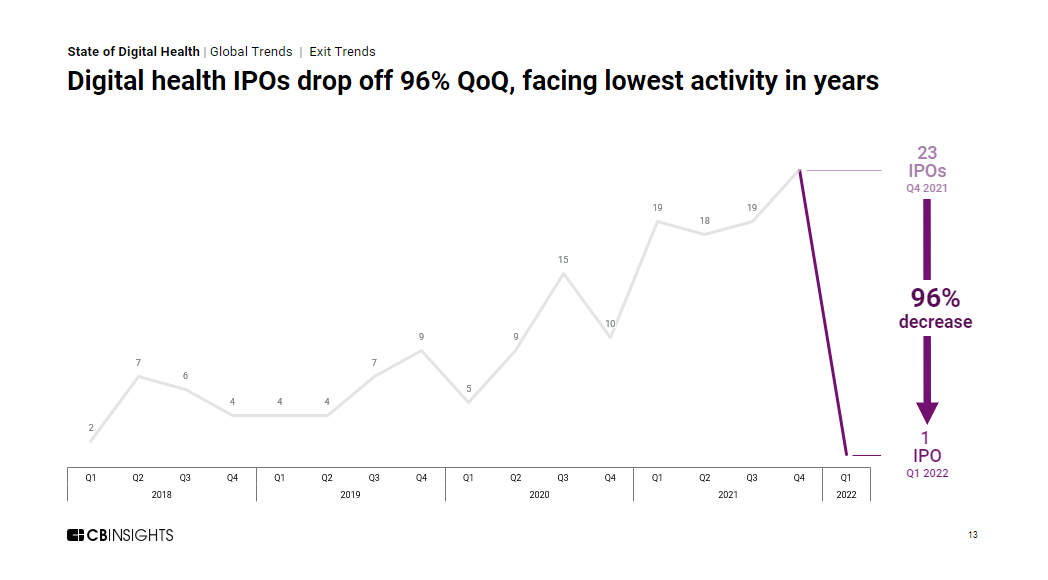
If the funding faucet is less liquid in the private market, it almost dries up in the public market. There was only 1 IPO in Q1 2022, down 96% from 23 IPOs in Q4 2021. Parallel to this sharp decline is the case for SPAC deals: no deals in the first quarter of 2022, compared to six in the fourth quarter of 2021. The report speculates that the sharp drop in public exits may be due to sluggish IPO returns last year.
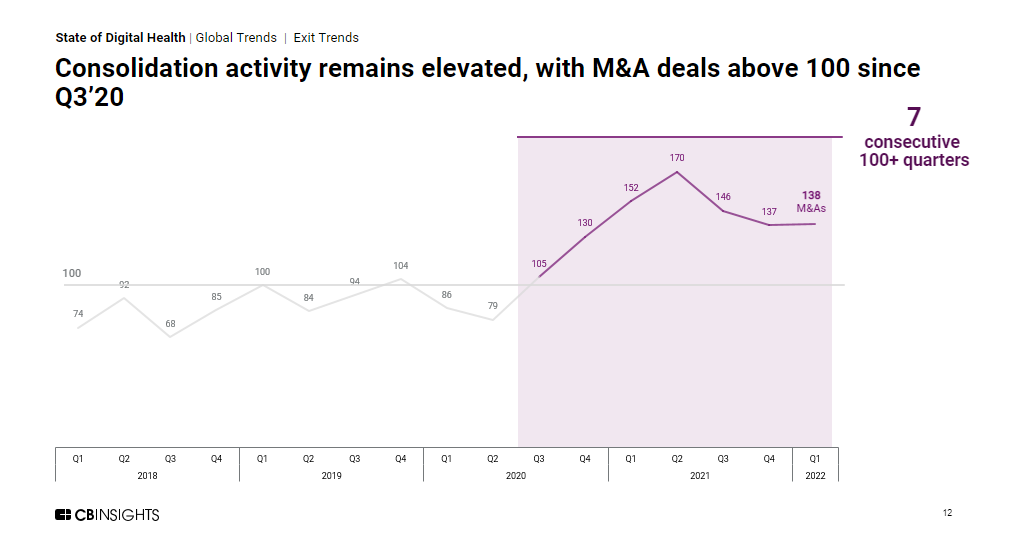
Mergers and acquisitions in digital health have not experienced the same decline, the report said. It has held steady at more than 100 transactions for the past six quarters, peaking at 170 transactions in the second quarter of 2021. In the first quarter, it reached 138 transactions.
Photos: Champion, Getty Images; Graphics: CB Insights


