


The International Olympic Committee (IOC) stated that the Tokyo Olympic Refugee Olympic Team includes 29 refugee athletes in 12 different sports, aiming to convey “a strong message of unity and hope” to the world.
The refugee Olympic team will compete under the Olympic flag. The sports represented by the entire team include track and field, badminton, boxing, kayaking, cycling, judo, karate, taekwondo, shooting, swimming, weightlifting and wrestling.
At the opening ceremony Olympic GamesThe International Olympic Committee stated in a statement in early June that refugee athletes will follow Greece in the parade for a second parade, “sending a strong message of tolerance and demonstrating the power of the human spirit to the world.”
Who are the members of the refugee Olympic team?
At this year’s Olympics, the refugee Olympic team (officially abbreviated as EOR, based on the French translation équipe olympique des réfugiés) is composed of 25 athletes from 11 countries who live and train in 13 host countries.
Four other athletes from the refugee program of the International Judo Federation will also participate in the first ever Olympic Judo mixed team event.
AFP AFP via Getty Images
The following is a complete list of 29 athletes from the refugee Olympic team:
- Abdullah Sedic, Taekwondo (under 68 kg)
- Ahmad Badreddin Wais, cycling (time trial)
- Aker Al Obaidi, wrestling (Greek-Roman, under 67 kg)
- Alaa Maso, swimming (freestyle 50m)
- Angelina Nadai Lohalith OLY, athletics (1500m)
- Alam Mahmoud, badminton (singles)
- Cyrille Fagat Tchatchet II, weightlifting (under 96 kg)
- Dina Pouryounes Langeroudi, Taekwondo (under 49 kg)
- Dorian Keletela, athletics (100m)
- Eldric Sella Rodriguez, boxing (under 75 kg)
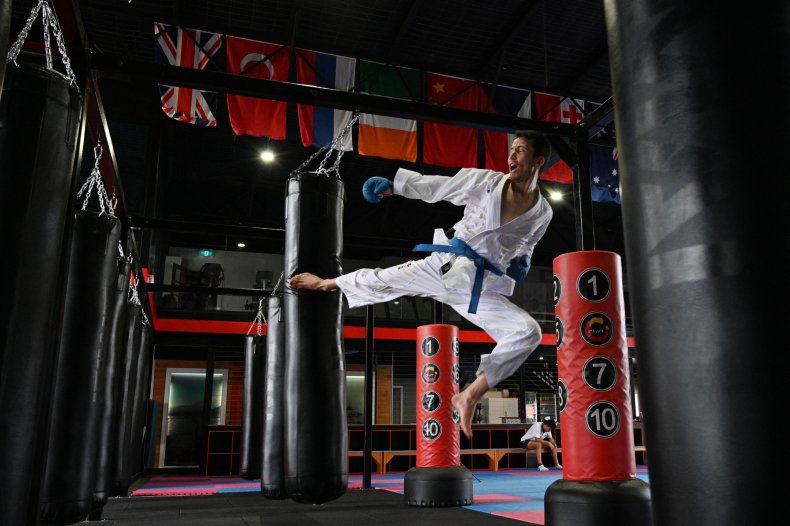
- Hamoon Derafshipour, Karate (under 67 kg)
- Jamal Abdelmaji Eisa, athletics (5,000m)
- James Nyang Chiengjiek OLY, athletics (400m)
- Kimia Alizadeh OLY, Taekwondo (under 57 kg)
- Luna Solomon, shooting (air rifle 10m)
- Masomah Ali Zada, cycling (time trial)
- Paulo Amotun Lokoro OLY, athletics (1,500m)
- Popole Misenga OLY, Judo (under 90 kg and mixed group)
- Rose Nathike Likonyen OLY, athletics (800m)
- Saeid Fazloula, canoeing (500m)
- Sanda Aldas, Judo (below 57 kg)
- Tachlowini Gabriyesos, Athletics (Marathon)
- Wael Shueb, Karate (kata)
- Wessam Salamana OLY, boxing (below 57 kg)
- Yusra Mardini, OLY swimming (100m butterfly and freestyle)
- Ahmad Alikaj, Judo (mixed team)
- Javad Mahjoub, Judo (mixed group)
- Muna Dahouk, Judo (mixed group)
- Nigara Shaheen, Judo (mixed team)
How are athletes selected for the team?
The International Olympic Committee stated that these players were selected from refugee athletes currently supported by the International Olympic Committee through the Olympic Scholarship Program for Refugee Athletes. According to the International Olympic Committee, the program provides financial support to 56 eligible athletes, providing them with financial support to enable them to train for the Olympics, “while continuing their sports career and building for their future.”
The IOC explained that the selection was based on several criteria, including the athletic performance of the “primary” athletes and their confirmed refugee status. United Nations UNHCR (UNHCR).
The International Olympic Committee stated: “Personal background and balanced representation in sports, gender and region are also taken into consideration.”
Participation conditions and team selection process are set by the Olympic Solidarity, which provides assistance to the National Olympic Committee (NOC), and cooperates with UNHCR, the National Olympic Committee and the International Federation. The International Olympic Committee pointed out.
Why is there a refugee Olympic team?
The International Olympic Committee explained that EOR aims to deliver a message of hope and solidarity and to raise awareness of the “plight of more than 80 million displaced people” worldwide.
Thomas Bach, President of the International Olympic Committee, said in early June: “When you, the IOC refugee Olympic team and athletes from the National Olympic Committee from all over the world, finally gathered in Tokyo on July 23, Will send a strong message of solidarity, resilience and hope for the world.”
UNHCR High Commissioner Philippe Grandi also stated in June: “Surviving the anxiety of war, persecution and exile has made them extraordinary people, but they are now performing well on the world stage as athletes. One fact makes me very proud.
Grandi added: “This shows what might happen when refugees have the opportunity to reach their full potential.”
The first ever refugee Olympic team with 10 athletes participated in the 2016 Rio de Janeiro Olympics.
After its success, the International Olympic Committee decided in 2018 to set up a refugee Olympic team at the Tokyo Olympics.
The success of the 2016 Olympic Refugee Team also witnessed the establishment of the Olympic Refugee Fund (ORF) in September 2017 to support “the protection, development, and empowerment of young people who are displaced through sports around the world, 365 days a year.” The International Olympic Committee said.
Said Khan/AFP via Getty Images


