


My name is Greg Ryabtsev and I am an expert in the production of coconut charcoal for hookah.
I have been working in Indonesia for over 20 years. Our charcoal factory produces 10 tons of hookah charcoal every day. More than 80% of coconut charcoal for shisha is sold wholesale in the United States, Australia and Turkey.
We are proud to be coconut charcoal suppliers Some of the top brands in the shisha industry are Australia’s Naara shisha brand and Saudi Arabia’s Platinum Plus brand.
Now let’s get to the point. The main reason why shisha smells when lit with coconut charcoal.
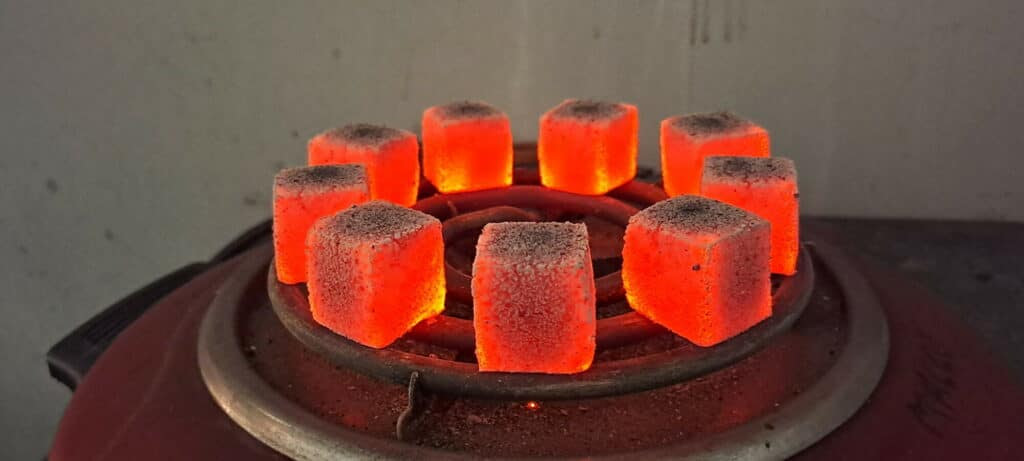
In 90% of cases, this smell appears within the first few minutes of heating coconut charcoal – it’s the smell of cassava.
What is cassava? It is a starch made from cassava roots. Yes, this is the same potato starch that everyone has in their kitchen. Only in Indonesia, potatoes are scarce but cassava is abundant.
Why is tapioca flour added to hookah charcoal?
It is added to prevent it from breaking, cracking and splitting. If a piece of shisha coconut charcoal falls apart or cracks, one of the reasons (actually there are many) is the tapioca flour.
Without tapioca flour, the charcoal will fall apart.
Why does starch (i.e. tapioca flour) smell?
Reason 1: The cassava flour is not roasted enough
To do this, let’s first take a look at the basic process of making hookah charcoal.
First, coconut husks are ground and toasted into a fine powder, then a small amount of tapioca flour (about 3% to 6%) is added to the mixture.
The mixture is then passed several times through an extruder, where the mixture is heated and the cassava is “cooked.” The result is a batter made from coconut shells and tapioca flour.
So if you don’t heat the mixture enough or compress it enough at this stage, the tapioca won’t bake – it will still be raw.This is the smell of raw burning cassava that we can smell when lighting hookah charcoal
Reason 2: Cassava becomes sour
The mixture should “rest” after passing through the extruder. Yes, just like your grandma’s dough. There is another danger here.
Depending on the type of cassava, temperature passed, resting time will vary. If the mixture does not sit sufficiently, the charcoal will crack.
If the mixture had been left for a few more hours, the kitchen would have reeked of cassava.
Reason Three: “Fuzzy” Coconuts
forward carbonize charcoal (roasted without oxygen), the coconut “hair” is removed. If cleaning is not done well and raw materials are not sorted at the production site, these hairs can cause odors and visible smoke.
These are the three main and most common reasons. Of course, there are others.
Reason 4: Wrong type of cassava
There are hundreds of varieties and brands of cassava in Indonesia. They differ in the growing area and production methods of the root vegetables themselves.
For example, we found experimentally that only sun-dried cassava from certain areas of Central and East Java is best suited for use as coconut charcoal. However, cassava dried in automatic dryers, although more expensive, does not provide the required stickiness for briquettes.
Reason Five: Lizard Incident
This is where rare exotic species come into play. For example, a lizard or frog enters the kiln during the carbonization of coconut shells. Its bones are ground up and made into charcoal blocks for hookah. Or if workers were in the charcoal mixing tank during their lunch break. Food particles land on the mixture and become rotten – that’s the extra flavour.
Reason Six: Overly Chemicalized Charcoal
The manufacturers went too far with the chemistry. Many hookah charcoal manufacturers, especially those who sell it cheaply, sort coconut shells and simply add chemicals: bleach and liquid glass instead of processing them properly.
This way the ash content of the coconut charcoal will be lighter and the briquettes themselves will be stronger. These chemicals, especially liquid glass, can also emit odors. Plus, it can give you a headache.
Reason 7: Water factor
Yes, water also affects the smell of briquettes. Our factory only uses mountain spring water. This was easy for us because the factory is located in Magelang, 400 meters above sea level, and water flows to us from nearby mountains.
If we used tap water, it would be too “heavy” for coconut charcoal. This water must be purified and then protected.
One last thing. If you light coconut coals on an electric stove to make shisha, you will need to clean it regularly. Otherwise, once you get the smelly block, all subsequent fires will be equally smelly, even if the coal itself is normal.
These are the main reasons why hookah charcoal smells bad.
Write in the comments about your experiences with shisha charcoal and any other issues you are interested in discussing.Come in and discuss

