AInsights: Executive insights into the latest generation of artificial intelligence…
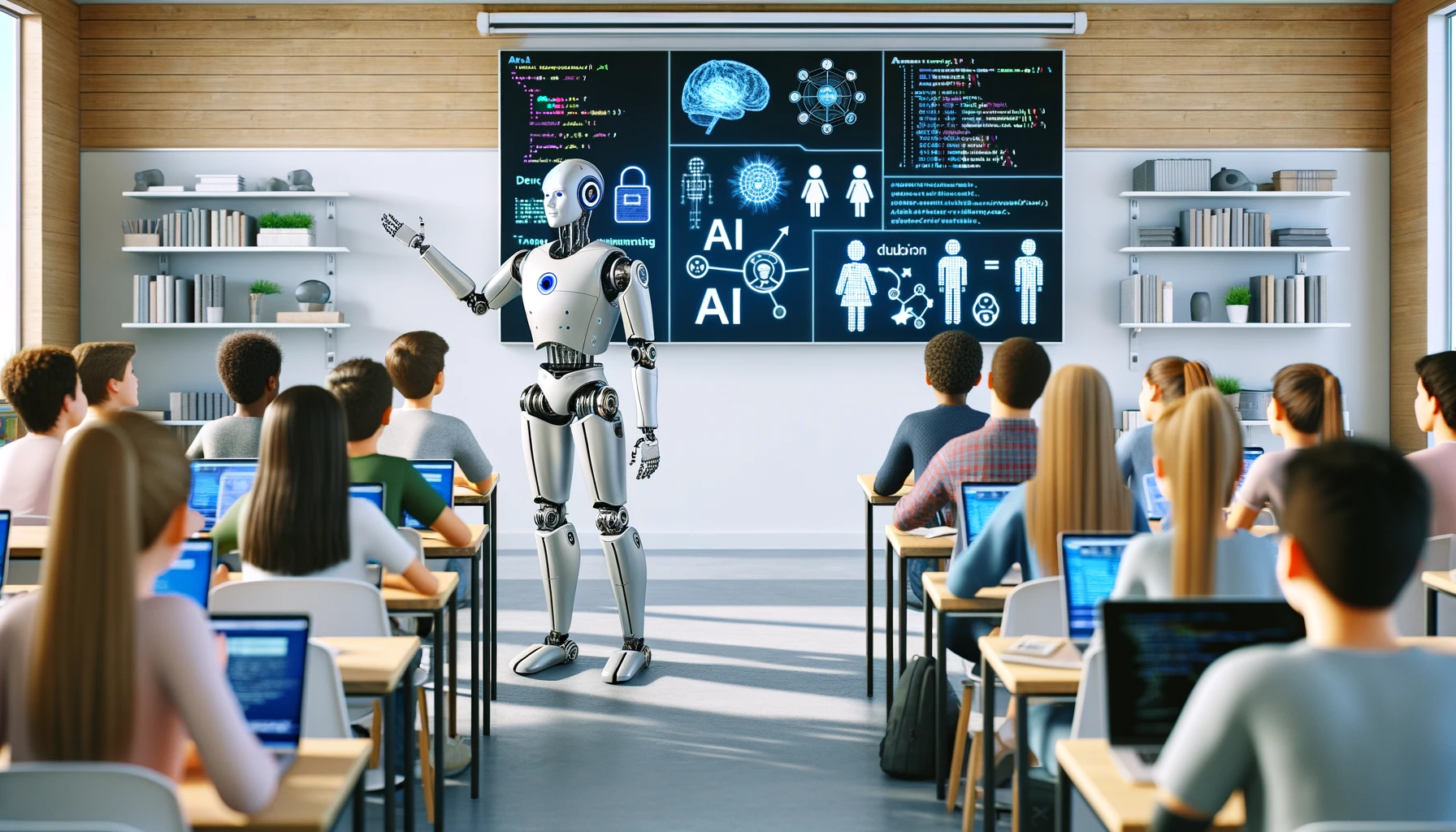
Create using DALL-E
NVIDIA’s Jensen Huang said teaching children how to code is no longer the goal, the purpose of artificial intelligence is to make programming human
At the World Government Summit, NVIDIA's Jensen Huang told the audience that kids no longer need to learn how to code. Cue the screeching sound of brakes.
“I wanted to say something, but it sounded completely opposite to what people were feeling,” Jensen said on stage. “Nearly everyone who's sat on a stage like this over the last 10, 15 years will tell you that it's critical that your kids learn computer science.”
He continued: “Everyone should learn how to program. In fact, it's almost the opposite. Our job is to create computing technology so that no one needs to program, the programming language is human. Now everyone in the world It's programmers. That's the wonder of artificial intelligence. These countries, those who understand how to solve problems in digital biology, education of young people, manufacturing or agriculture, those who understand domain expertise are now available to you at any time Technology.”
We don't need to teach our children how to @NVIDIA's Jensen Huang.
*cue record scratching*
He might be right! What would it look like if we learned how to become more efficient, creative, imaginative, curious, and inventive in the use of artificial intelligence?
“I want to say something, and… pic.twitter.com/rT7MEYt4vh
— Brian Solis (@briansolis) February 25, 2024
Artificial Intelligence Insights
Huang's point is controversial, but necessary. There's a reason it sparks debate and thought. In the spirit of what he said, what we really need to focus on is the skills, subjects and experiences that prepare students for the future that is being built.
I studied procedural design in school. Granted, what I learned is no longer relevant to the world of programming, but I did learn the importance of logic, algorithms, critical and results-based thinking. While AI tools can help with certain tasks, they cannot replicate the cognitive processes and learning experiences necessary for academic growth and skill development, nor their success in the future workforce (and ours!).
Think of AI as your cognitive exoskeleton, your co-pilot, enhancing everything you do every step of the way. Artificial intelligence is the key to realizing intelligence as a service. But it’s your prompting, your imagination, your creativity, and your resilience that make the difference in your AI-driven results.
OpenAI offers ChatGPT memory, a super cookie that learns how to personalize and optimize output for you
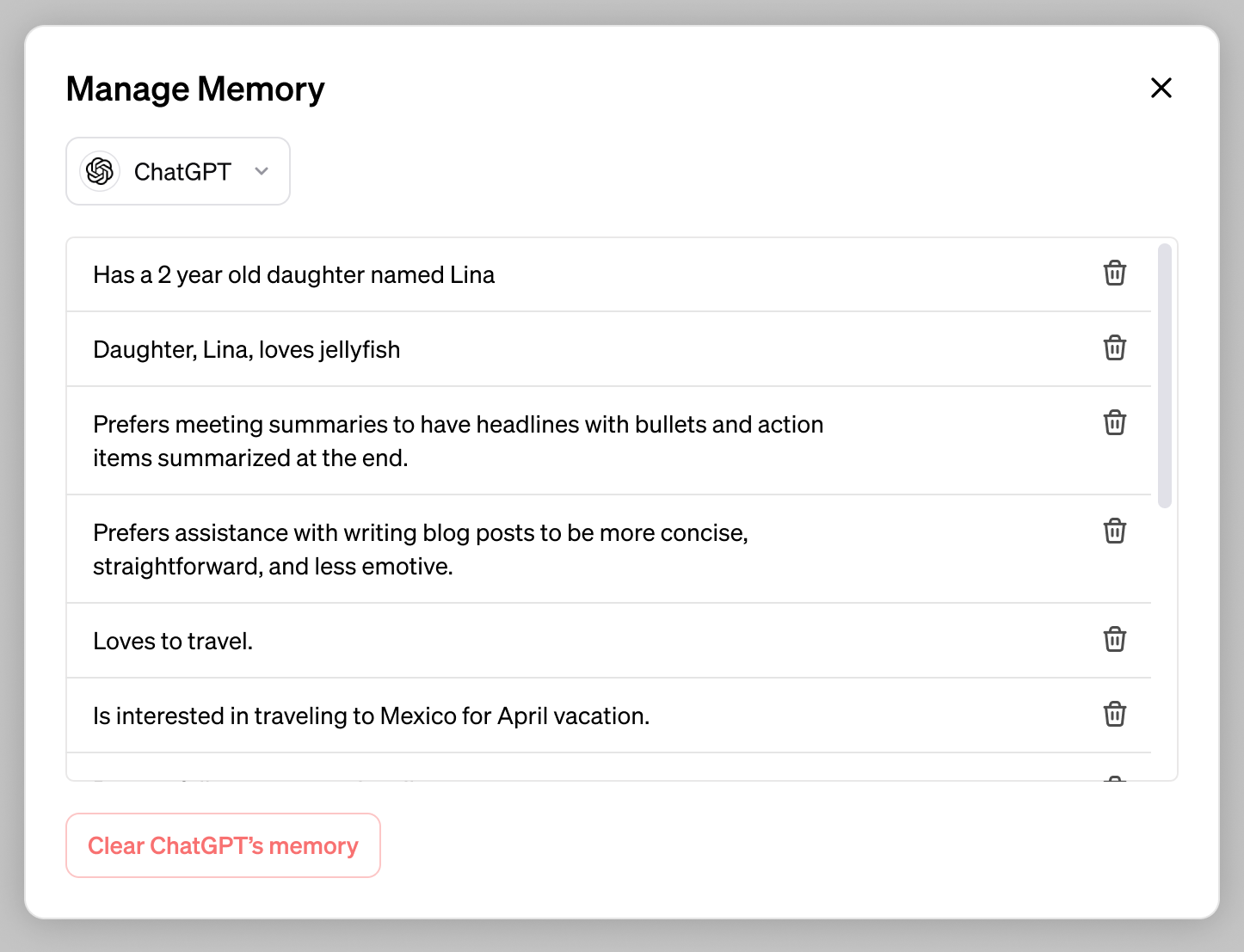
OpenAI announces integration memory Enter ChatGPT to improve its ability to learn over time and personalize responses. This memory feature enables ChatGPT to remember details such as user preferences, name, occupation, and personal likes and dislikes, allowing for more personalized and contextual conversations.
Users can ask ChatGPT to remember specific content or let it learn on its own. The idea is that ChatGPT will get better as you use it.
Here are some use cases shared by OpenAI:
- You've explained that you prefer meeting notes to have a summary title, bullets, and action items at the bottom. ChatGPT will remember this and review the meeting this way.
- You've told ChatGPT that you own a nearby coffee shop. When it comes to brainstorming social posts to celebrate a new location, ChatGPT knows where to start.
- You mentioned that you have a young child who loves jellyfish. When you ask ChatGPT to help create her birthday card, it suggests a jellyfish wearing a party hat.
- As a kindergarten teacher with 25 students, you prefer 50-minute lessons with follow-up activities. ChatGPT keeps this in mind when helping you build your course plans.
If you create or use a GPT, it is important to note that the GPT will also have its own unique memory.
Artificial Intelligence Insights
As apps, websites, and chatbots become smarter, personalization is becoming more commonplace. We were and still are “wowed” by our ability to generate artificial intelligence. But now we’ve also learned to expect more. As we master collaboration with artificial intelligence, it’s helpful to understand that we’re not the only party to the learning equation. ChatGPT memory will enhance future conversations by anticipating our needs, remembering our preferences and helping us make better use of the platform. It will also ensure continuity, helping us pick up where we left off, as if it's still thinking about our last conversation even as we move away.
All in all, improving speed of results, personalizing responses, and improving efficiency will help us learn and grow through artificial intelligence cognitive exoskeletons.
Google Gemini 1.5 is accelerating development to compete more effectively with ChatGPT and Claude
Google has been chasing Bader since the massive “Code Red” scramble in December 2022, and now Gemini 1.5.
This is a big deal for power users, because although it comes standard with a context window of 128,000 tokens, some developers and enterprise customers can deposit and withdraw up to 1 million tokens. This means that Google's Gemini model (multi-modal) can handle more information, context, and produce better results accordingly.
🚨BREAKING: Google Gemini 1.5 just destroyed ChatGPT and Claude with biggest ever 1 Million tokens.
It can now understand 4+ Harry Potter books, several GitHub code repository, entire podcast, and 1-hour video🤯
Here's 3 examples of what that means: 🧵👇 pic.twitter.com/ggH5uWMwbS
— Min Choi (@minchoi) February 15, 2024
Artificial Intelligence Insights
What does it mean? What are tokens and why should you care?
Well, if you are a power user or aspire to be a power user, the tokens are equivalent to computing power and capacity. The more you feed it, the more it can handle for you.
That means 1.5 Pro can handle a lot of information – including an hour of video, 700,000 words of text, 11 hours of audio, more than 30,000 lines of code, or a library of more than 700,000 words of code. Google claims in its research that they have also successfully tested up to 10 million tokens.
Below is an example of a use case, results, and tokens required for execution.
complex reasoning
Cross-modal understanding and reasoning
Use longer blocks of code to resolve issues
Three alternatives to Google in specific apps
Jeremy Caplan of FastCompany has a helpful article article Help users discover new use cases beyond traditional Google search.Kaplan list Puzzled, Dexamethasoneand arc search as his preferred AI applications and provides very specific examples for each.
When choosing Perplexity over Google . . . You have a narrow query like “Are moon cactus found in the wild?? ” See how Google results not that helpful confused result.
Puzzled
Try to puzzle over highly specific topics.Gloria, author learning curve In the newsletter, Kaplan said she relies on Perplexity when she needs a highly customized response or advice for a specific scenario. I use it because its results also include references for additional reference.
Dexamethasone
When you need specific insights shared by experts in forums like podcasts, try Dexa. Rather than analyzing the wider web like Perplexity, Dexa focuses on podcast content.
The app identifies relevant episodes and links to the moments when your topic was discussed. You can watch or listen to the original content, or read a quick summary.
arc search
Arc Search is a mobile browser application designed to enhance the search experience by providing fast and non-obtrusive customized web excerpts. Be sure to use its “Browse for me” feature to activate the artificial intelligence. As with the confusion, its source is revealed for further reference and research.
Artificial Intelligence Insights
I use Perplexity as my daily “answer engine”. It helps when I need a quick and trustworthy summary. I try Dexa when I need to reference a podcast conversation with one of my favorite experts. Arc Search also seems promising, however, it's currently limited to iOS and I'm waiting for its cross-platform functionality to be available on my Mac!
All in all, these are solid tools and I'm always looking for productivity tips and boosters.
It makes me wonder how many things Google has that it won't be able to copy at some point, or if it currently plans to focus on competing with the likes of ChatGPT and Claude.
Please subscribe Artificial Intelligence Insights.
Please subscribe to my guru newsletter, Solis Quantum.