When I was in London recently, I noticed a noticeable increase in people on the streets, who were clearly out of work and looking to be in serious difficulty compared to my last visit in 2020. Of course, in the meantime, the world has endured (and is enduring) a major pandemic that has permanently damaged human health. Latest figures from the Office for National Statistics (ONS) – UK labor market overview: February 2024 (Posted February 13, 2024) — Provides some hard data that matches my anecdotal observations. British society has become much sicker since 2020, with a huge increase in the number of workers unable to work due to long-term illness – millions of them. Further analysis showed that this group was distributed across all age groups. A significant part of the increase will be the damage done to the NHS by COVID-19 and austerity. Massive fiscal intervention is needed to change the trajectory of the UK, which is not only grappling with a global climate catastrophe but now also experiencing increasing rates of illness in its workforce, with workers of all ages being too sick to work Retire early. As the coronavirus continues to spread and evolve into new variants, people will become multi-infected and the situation will get worse. It amazes me that governments have not addressed this issue and introduced policies to reduce infection rates.
COVID-19 Costs
In the early years of the pandemic, it was easy for skeptics to wax lyrical on Twitter and write books denouncing any coronavirus restrictions because there was so much uncertainty and noise about the disease and so little available data.
So there's the so-called Barrington Declaration, which essentially says that all of us should have nothing to worry about if we get COVID-19, except those who are very susceptible to respiratory illnesses.
Given that we are bringing this disease into nursing homes, hospitals, etc., they have no plan for how the rest of us can provide services to the very vulnerable.
But hey, small details.
We are witnessing massive mortality in nursing homes and rising rates of hospital infections.
An old friend of mine recently fell and fractured her hip and ended up in the hospital and never came out—she contracted COVID-19 there and died there.
Regardless, more data is emerging and the picture is becoming clearer — this is a devastating disease, and research epidemiologists now speculate that because of the way the virus attacks all of our major organs, The peak of human health has now passed.
The study points out that for decades, health science has been victorious in the war against deadly diseases such as smallpox and typhoid, but the new coronavirus epidemic will not achieve such success, and human health is now permanently damaged.
And we will begin to increase the cost of existing “liberal” policies that allow disease to spread freely through the population.
We are too stupid to regulate ourselves to avoid catching or spreading the virus.
The latest workforce data released by the Office for National Statistics (ONS) shows the huge costs society will incur in the future by allowing the disease to spread so widely. UK labor market overview: February 2024 (Published February 13, 2024).
First, some concepts.
For statistical purposes, statisticians divide the population into the following categories:
1. Whether you are of working age (over 16 years old in the UK).
2. Well in the working age population you are either active or you are inactive.
3. You are considered active (or in the labor force) if you are employed or actively looking for work and available for work, otherwise you are considered inactive (or not in the labor force).
4. Activity (or labor force participation rate) is simply the ratio of the labor force to the working-age population
5. The inactivity rate refers to the ratio of the non-labor force population to the working-age population.
Obviously, those who are inactive include retirees who have chosen to withdraw from the labor market.
But it also includes people of working age who are unable to work, which is the subject of this article.
In its latest version, the UK Office for National Statistics states:
The rate of economic inactivity among people aged 16 to 64 in the UK (21.9%) was essentially unchanged in the latest quarter, but was higher than estimated a year ago (October-December 2022). Annual growth is driven by those who are inactive due to long-term illness, and numbers remain at historically high levels.
In an earlier version (July 26, 2023) – Increased poor health and economic inactivity due to long-term illness in the UK: 2019 to 2023 – The Office for National Statistics states:
The number of people who are economically inactive due to long-term illness has risen to more than 2.5 million, an increase of more than 400,000 since the start of the coronavirus (COVID-19) pandemic…
The proportion of people reporting no health condition fell slightly between 2016 and 2019, from 71% to 69%. However, this downward trend has accelerated since the start of the coronavirus (COVID-19) pandemic, so that between January and March 2023, only 64% of the working-age population reported no health condition. That's an absolute decrease of 2 million compared to the same period in 2019.
July's data also allow us to examine by age group the number of people who are economically inactive due to long-term illness.
The table summarizes the situation for 2019 and 2023.
This is a frightening figure, and it is clear that the increasing inability to work due to long-term illness among British workers has accelerated since the pandemic and affects all age groups, not just older workers.
| age group | 2019 (000s) | 2023 (000s) | Change (percent) |
| 16-34 | Chapter 383 | Chapter 547 | 43.0 |
| 35-49 | Chapter 488 | Chapter 568 | 16.4 |
| 50-64 | 1,088 | 1,375 | 26.4 |
| all | 1,959 people | 2,490 | 27.1 |
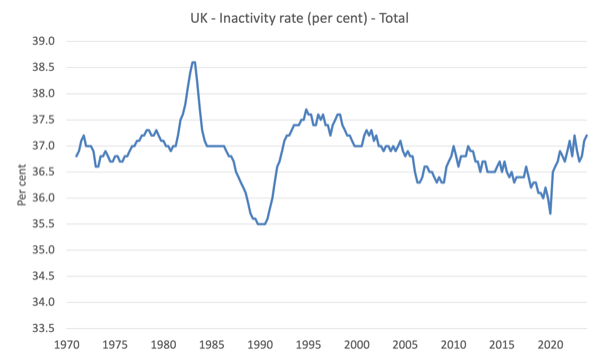
Using the latest data (released on 13 February 2024), the chart below shows the inactivity rate (percentage) for the UK aged 16 years and over from the March quarter 1971 to the December 2023 quarter (the latest data available).
We see some interesting patterns.
When Thatcher's government turned to manufacturing and coal mining in the early 1980s, many workers were forced out of the labor market and into inactivity.
They were mostly older men, the backbone of post-World War II industry.
Beginning in the mid-1990s, inactivity levels fell again, largely due to increases in female labor force participation.
From a gender perspective, male inactivity rates have increased from 16% in the March 1971 quarter to over 33% in the December 2023 quarter.
For women, the proportion was 55.3% in the March 1971 quarter and 41.1% in the December 2023 quarter.
As a result, there has been a considerable shift in participation between men and women.
Furthermore, the major events of the period in the early 1980s, the global financial crisis and the pandemic, were dominated by shifts in male participation rather than female participation.
This downward trend was halted by the coronavirus pandemic.
The UK inactivity rate has risen from 35.7% to 37.2% since the third quarter of 2020, meaning 1.191 million workers have left the active workforce since the pandemic began, mostly due to long-term illness (More than 700 workers) Thousands).
Since the start of the pandemic, 59.5% of those who have been inactive have been men.
March 2020 quarter to December 2023 quarter:
1. 16-17 years old – Inactivity increased by 0.7 percentage points.
2. 18-24—up 4.7 points.
3. 25-34 – up 0.6 points.
4. 35-49 – down 0.2 percentage points.
5. 50-64 – Up 1.0 points.
6. 65+—up 0.4 points.
Therefore, the increase in activity since the pandemic until Q12 2023 is distributed across all age groups.
About 50% of the increase came from people under 65, so it is unlikely to be related to planned retirement.
At this stage, the data do not allow me to break down the sources of the increasing number of long-term illnesses that force workers out of the labor market.
A large portion of the change is almost certainly due to complications from COVID-19 infection.
However, as years of austerity have wreaked havoc on the NHS, declining quality of care may also be an important factor.
Of course, these two factors are also intertwined.
The long-term effects will increasingly weaken the UK economy.
It will become increasingly difficult for businesses to find workers.
As the population ages, younger workers need to be more productive than their fathers, but many are being forced out of the workforce due to chronic illness.
You can bet the “sound finance” gang will attack with all their might any fiscal activism forced to provide income support to these workers who can’t work.
Their efforts will only make the situation worse.
Better COVID-related health policies could have prevented growing inactivity.
Allowing the virus to spread, according to the Barrington mob, made the problem worse.
When I was in London recently, I stood out because I was the only person still wearing a mask despite being closed (shops, etc.).
Such a simple act significantly reduces the spread of infection, and almost no one is doing it.
Against this background, it is interesting to read Will Hutton’s column in The Guardian (February 18, 2024) – The first step to our economic liberation is to abolish these serious fiscal rules – Urges the UK government to abandon the austerity mentality reinforced by attempts to follow strict fiscal rules.
In that sense, his challenge applies to both the Conservatives and Labour.
He rightly noted that given the “bad governance of the past 14 years,” the scale of the challenges the government is about to face may be unprecedented, although he was careful to note that the behavior causing the problem dates back “decades.” ago”—and this has been the case since monetarists became the dominant school of economic thought.
It’s not just a matter of dealing with degradation of infrastructure and service delivery.
The new challenges posed by the climate emergency require more investment than “repairing” past damage.
Hutton attacked the Conservative Party for its political bias, going back first to Mrs Thatcher, then to Osborne and then to Brexit.
But he should mention Mrs Thatcher's previous Labor government, led by James Callaghan and Denis Healey – who were the first to articulate “sound financial monetarism” during their time in government.
Don't forget about Blair and Brown, who tried to boast of “loose” regulation (ie: no regulation) of the financial sector, which undoubtedly made the UK's global financial crisis worse.
Don’t forget the current Labor team – Starmer and Reeves – who are as obsessed with fiscal rules as any Tory.
Even abandoning investments in necessary climate policies that will see a horrific backlash in the coming years.
Hutton understood what I was thinking when he wrote:
The country is clearly willing to give Keir Starmer and Rachel Reeves a chance to govern…
Now is not the time to close options and capitulate to the right that is trying to lock them into the same failed paradigm—and as a former editor of the New York Times put it, the cheers of the right-wing mass media are even more disproportionate to public opinion. Sun David Yelland said the figure was higher than at any time since the 1930s.
Indeed, we will see.
But if modern history tells us anything, the Labor leadership will not be able to resist kowtowing to the “urban” and thus capitulating to the “right”
in conclusion
Massive fiscal intervention is needed to change the trajectory of the UK, which is not only grappling with a global climate catastrophe but now also experiencing increasing rates of illness in its workforce, with workers of all ages being too sick to work Retire early.
As the coronavirus continues to spread and evolve into new variants, people will become multi-infected and the situation will get worse.
Surprisingly, governments have not addressed this issue and introduced policies to reduce infection rates.
That's enough for today!
(c) Copyright 2024 William Mitchell. all rights reserved.