from Congressional Budget Office:
The U.S. economy is showing signs of slowing, but it’s hard to say whether the economy is currently in recession. In retrospect, it’s likely that the economy will slip into a recession sometime this year. However, from the data available in early August, this is not clear. Some key indicators point to a decline in economic activity as the first half of the year progresses, while others point to continued growth, albeit at a slower overall pace than before.
Both real gross domestic product (GDP adjusted for inflation) and industrial production fell. In the first two quarters of 2022 in particular, real GDP will decline by an average of 1.25% (on an annualized basis). Industrial production increased from January to April, was basically flat in May, and declined in June.
Other key indicators of economic activity continued to grow in the first half of 2022, but overall at a slower pace than earlier. For example, real Gross Domestic Income (GDI) grew at an annual rate of 1.8% in the first quarter of 2022 after an average increase of 6.3% in the second half of 2021.2 (GDI data for the second quarter has not yet been released.) Real personal income decreased After removing federal, state and local government transfers to the people, the average annual growth rate will be 0.5% in the first half of 2022 and 3.1% in the second half of 2021. Real personal consumption expenditures will grow at an average annual rate of 1.4% in the first half of 2022, compared with 2.2% in the second half of 2021 (the second quarter growth rate was slightly slower than the first quarter). One reason for the deceleration in personal consumption expenditures is higher inflation, which has eroded the purchasing power of consumers. Another reason is the decline in real disposable personal income in the first half of 2022. Savings accumulated during the coronavirus pandemic, including transfers, continue to support consumption.
The labor market remains tight, with low unemployment and high job vacancies, but both indicators have weakened in recent months. Nonfarm payrolls averaged a net monthly gain of 375,000 in the second quarter of 2022, compared with a net gain of 539,000 in the first quarter and a net gain of 590,000 in the second half of 2021. Unemployment at 3.6% in June 2022 (unchanged since March, near pre-pandemic lows) and roughly 1.8 job openings per unemployed worker (one of the highest readings in the series’ nearly 22-year history) One, albeit below its March high of 2.0).
Graphical descriptions of almost all of these series are in this postal.
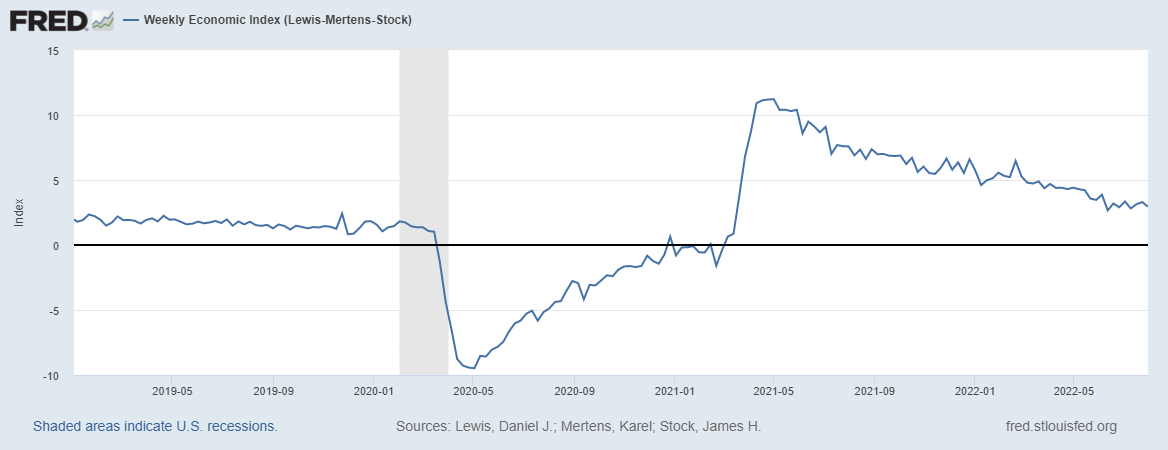
For data through July, we have the Lewis-Mertens-Stock weekly economic index:
resource: New York Fed through FREDaccessed August 4, 2022.
Tomorrow we will receive the unemployment rate estimate for July.to trigger Sam’s Law For a recession, the unemployment rate would need to jump to 5.1% (that is, the 3-month moving average would need to jump 0.5 percentage points from the lowest unemployment rate recorded last year. The Bloomberg consensus is for the unemployment rate (U6) to remain at 3.6 percentage points.
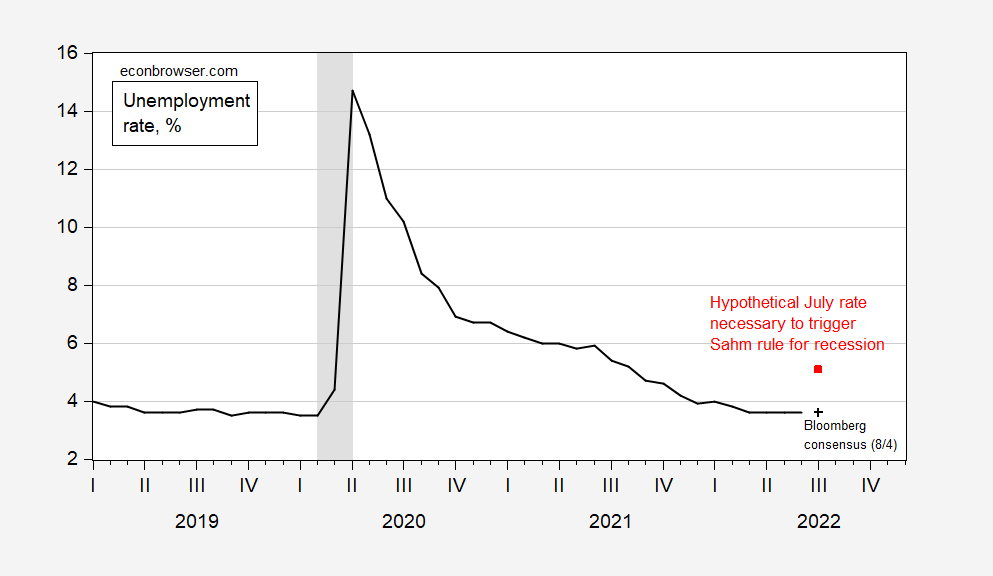
figure 1: Unemployment rate U6 (black), Bloomberg consensus 8/4 (black+), hypothetical unemployment rate required to trigger the Sahm rule (red squares). The NBER uses shades of grey to define the peak and trough dates of the recession. Source: BLS from FRED, Bloomberg, NBER, author’s calculations.