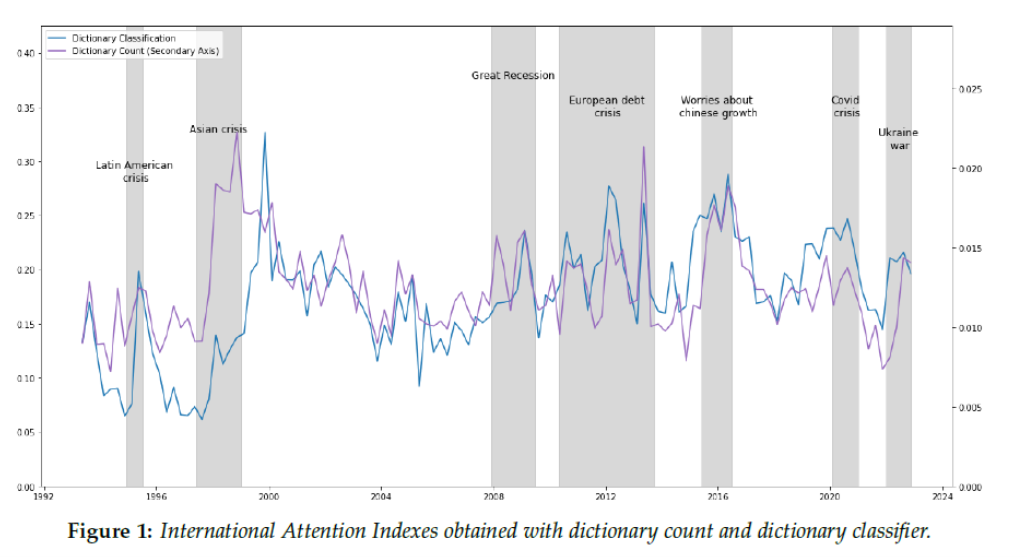
Ferrara and Drew actually pose this question more subtly in their paper (Capturing the International Effects of U.S. Monetary Policy Through NLP Approaches) presented at the ISF meeting in Charlottesville. They wanted to know whether the way in which international economic issues were mentioned in FOMC meeting minutes showed statistical significance in Taylor’s equation when converted to indices, and gave the answer “yes”.
The first is the “International Attention Index”:
Next, regressions of the fed funds rate on lags, nominal interest rates, the personal consumption expenditures gap, and the output gap are strengthened by the international concern index.
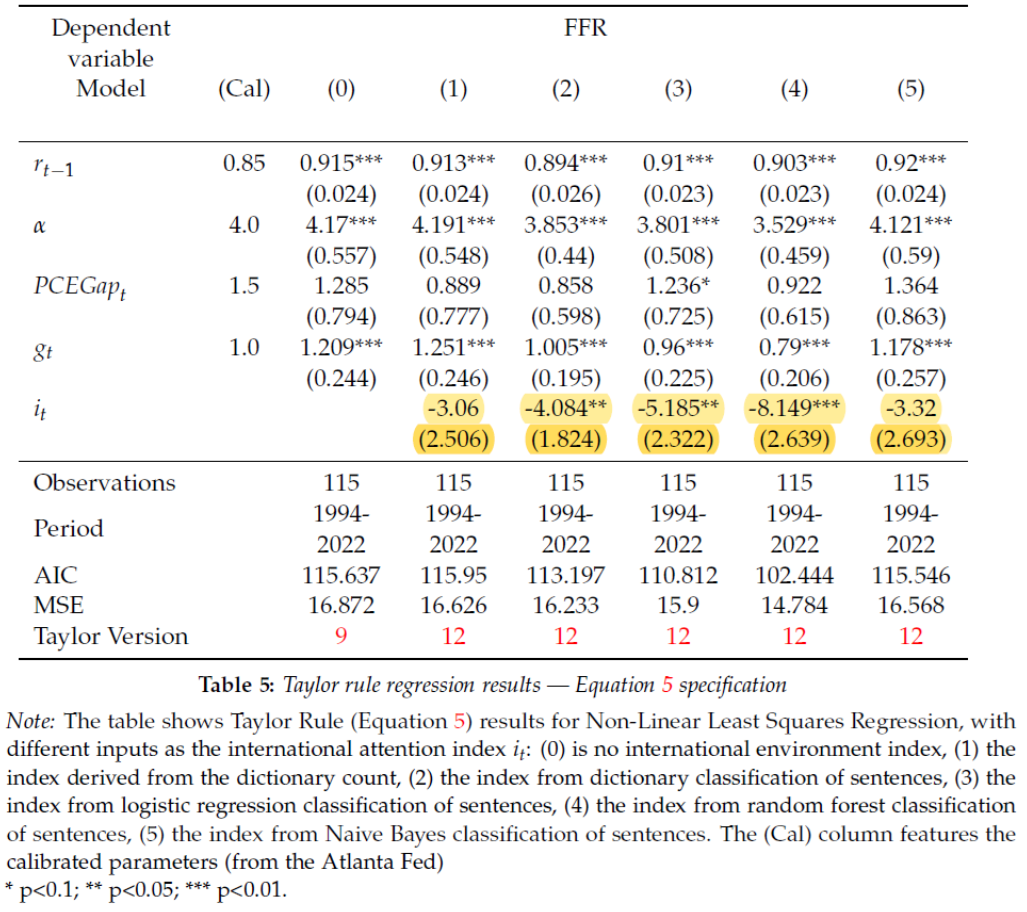
The index is normalized from 0 to 1, so a 0.10 increase in the index would result in an 80 basis point decrease in the fed funds rate relative to what would otherwise be the case. For context, the index increased by about 0.10 during Russia’s expanded invasion of Ukraine.
From the summary:
Our results show that when international topics are focused within the FOMC,
The Fed’s monetary policy has generally been more accommodative than expected under the standard Taylor rule. This result is robust to a variety of alternatives including the time-varying neutral rate or the shadow central bank rate.