Today, we are pleased to introduce to you from Rob Fairley Professor of Public Policy and Economics at the UCLA Luskin School of Public Policy.
Federal, state and local governments spend billions of dollars each year on incubators, training programs, loan programs, tax breaks and investor incentives to encourage business formation, one of the main goals of which is job creation. Yet these spendings are often made without knowing whether the programs will create lasting, well-paying jobs.
For the past seven years, I have been working with the U.S. Census Bureau with zachary croft, Javier Miranda and Nicholas Zoll Presents a new set of statistics on job creation and survival of all start-ups. The findings were recently published in MIT Press titled “The Promise and Perils of Entrepreneurship: Job Creation and Survival in American Startups.” https://mitpress.mit.edu/9780262545358/the-promise-and-peril-of-entrepreneurship/
Two aggregated statistics published by the federal government on startup job creation and survival rates are often looked at — an average of six new jobs are created per startup, and 50% of startups survive for up to five years. But those numbers only focus on new businesses with employees. Every year, millions of businesses start without employees, and a small percentage of them reach the hiring stage.
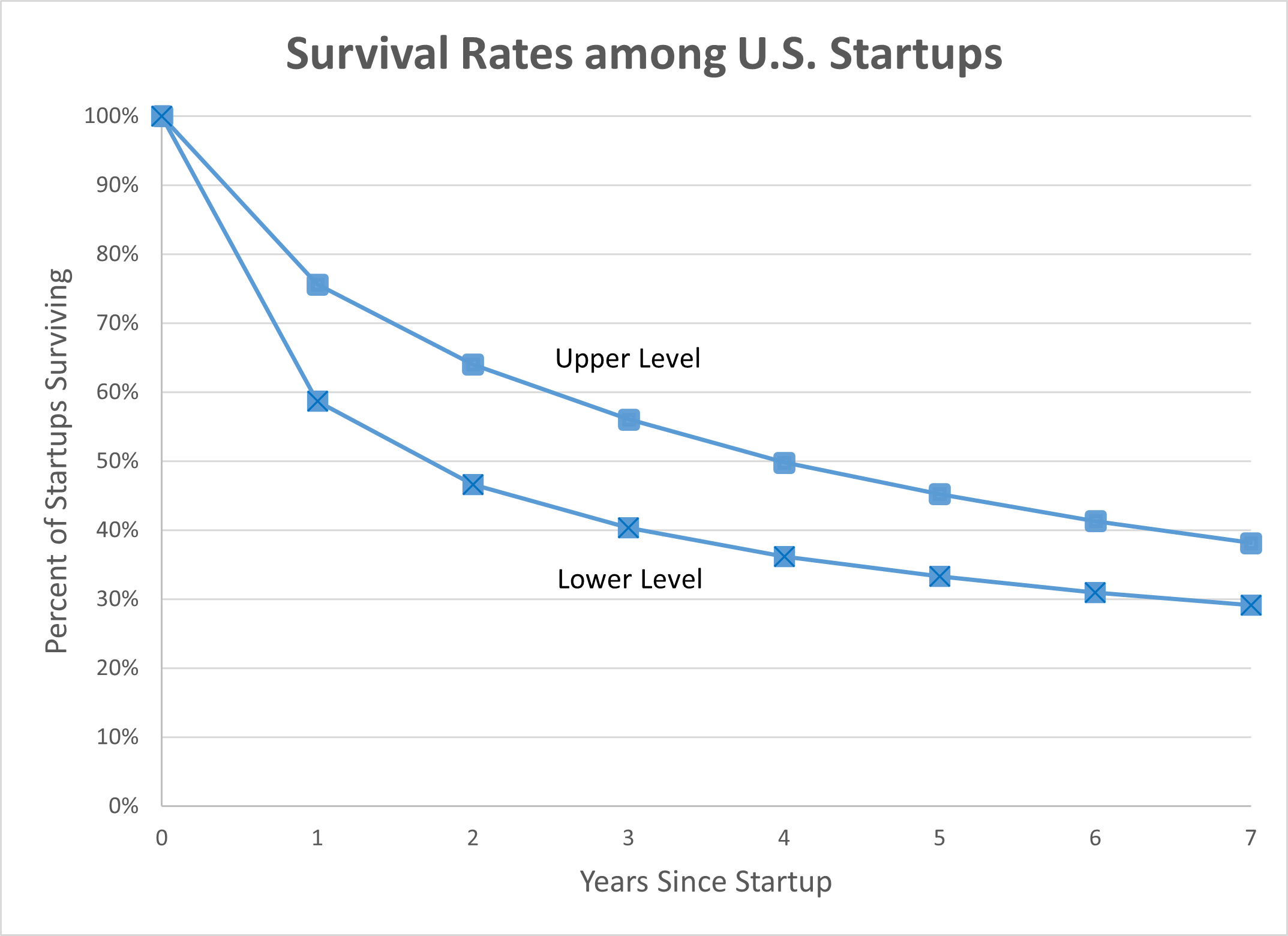
We found that the number of jobs created per startup was far lower than commonly cited federal statistics on new employer businesses. We found that start-ups in the US created between 0.7 and 2.6 jobs in their first year of existence, a figure far below the 6 jobs created per start-up. We also found that startups had lower survival rates. A massive shakeup occurs in the first few years, resulting in only 33-45% of startups surviving five years later.
figure 1.
However, start-ups are still very important to job creation in the U.S. economy. On average, 4.1 million start-ups in the United States each year create a total of 3 million jobs in their first year and employ 2.6 million workers five years later. Without these jobs created by start-ups, net job creation would be negative as older firms lose jobs on average.
We hope these new findings suggest that public policies attempting to stimulate business creation need to consider a variety of business types and entrepreneurs, and to have a realistic understanding of how many jobs new entrepreneurs can create.
The author of this article is Rob Fairley.