Regular readers will know that I have been evaluating evolving data on the long-term impact of COVID-19 on the workforce. As time has passed and infections have persisted, our immediate understanding of the severity of the pandemic has diminished, largely because governments no longer regularly release data on infection rates, hospitalizations and deaths. So the tracking of impact on a daily, weekly basis disappears as if there is no problem to deal with. But data from national statistical agencies and organizations like the U.S. Census Bureau tell a different story, and I’m surprised that public policy hasn’t responded to this information—most notably, in terms of population aging and the number of workers. In an era of shrinkage, we are overseeing massive attrition rates of workers forced into disability due to the pandemic. It represents a colossal policy failure and a major manifestation of social ignorance.
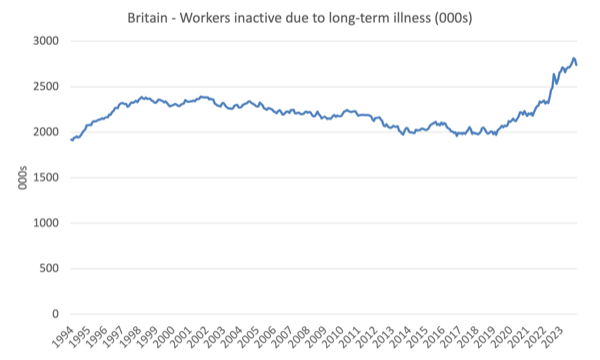
Latest ONS data (published on 12 March 2024) – LFS: Economy. Reason for inactivity: Long-term illness: UK: 16-64:000s: SA – Pretty clear.
Attached Labor Market Report – UK labor market overview: March 2024 – Noted:
The economic inactivity rate for people aged 16 to 64 in the UK is 21.8%, higher than estimated a year ago (November 2022 to January 2023) and rising in the latest quarter.
The detailed analysis shows that “Economic inactivity has generally fallen since comparable records began in 1971; however, during the coronavirus (COVID-19) pandemic, it has increased and fluctuated around this rate of growth .”
The ONS breaks down inactivity data by reason (retirement, study, illness, etc.) and the chart below shows workers aged 16-64 who became inactive due to long-term illness.
The chart below documents how this data has changed since 1994.
This number has increased by 6,29,000 since the beginning of 2020, accounting for approximately 1.8% of the existing workforce (1.4% of the total population aged 16 to 64 years).
Given the timing of this increase, it is unlikely to be driven by anything other than the impact of COVID-19 infections.
Adding the number of deaths from the coronavirus will only exacerbate the labor market impact.
The data is interesting because it also allows us to speculate on the impact of austerity and cuts on the NHS.
Many suggest that the rise in inactivity in the UK is due to these neoliberal shifts in government policy.
I'm obviously sympathetic to their concerns, but the data shown above suggest that the number of workers forced to cease activity due to long-term illness was declining over the 20-plus years before the outbreak.
That shift came with COVID, and I think that's indisputable.
There is other data (which I will report on another day) that suggests that rates are rising among workers who are still working but also have some type of chronic disease.
Perhaps rising incidence rates reflect increasing austerity and falling standards within the health system.
The impact of COVID-19 is also being seen in many other countries, meaning the UK-specific issue of inactivity will receive further emphasis.
For example, in June 2022, the U.S. Census Bureau added questions to their survey specifically— Family Intention Survey – aims to “provide data on key social and economic issues affecting American families.”
These additional questions specifically allow the survey to generate information on “COVID-19 vaccination and long-term COVID symptoms and effects.”
You can find more information about these new features of HPS at: National Center for Health Statistics (NCHS).
The agencies claim the additional data are “intended to supplement the federal statistical system's rapid response capabilities and provide relevant information on the impact of the coronavirus pandemic in the United States,” although one has to conclude given the findings and the lack of consistent policy on this. The conclusion: The lack of attention paid by the authorities to the information produced has caused great harm to the population.
NCHS provides an extensive data set – “Post-COVID-19 Situation Estimates” – with the latest published observations ending on March 4, 2024.
Data show that in June 2022, 40.3% of American adults were infected with the new coronavirus.
By February 2024, this proportion has risen to 59.6%, and is trending upward.
Back in June 2022, when these questions were added, 14% of U.S. adults had experienced long COVID-19, defined as “symptoms that last three months or longer.”
By February 2024 (the latest data), this proportion had risen to 17.4%.
HPS also asked about the share of U.S. adults “currently experiencing post-COVID conditions (long-COVID),” which includes adults who have had “COVID-19, have long-term symptoms, and are still experiencing symptoms.”
In June 2022, this proportion was 7.5%, and in February 2024, this proportion was 6.7%.
Additionally, when asked “whether there are any activity restrictions among long-term COVID-19, adults currently experiencing long-term COVID-19, and all adults…” the numbers were:
– June 2022: 5.9%.
– February 2024: 5.5%.
And, when asked about “significant activity restrictions due to long-term COVID-19, adults currently experiencing long-term COVID-19, and all adults…significant activity restrictions due to long-term COVID-19,” the numbers were:
– June 2022: 1.8%.
– February 2024: 1.7%.
The incidence of these categories is distributed across age groups, which mitigates the possibility of concluding that these problems are associated solely with older adults.
In fact, older workers have lower incidence rates.
Brookings Institution Research August 24, 2022 – New data shows long-term COVID-19 pandemic could put as many as 4 million people out of work – reports the first version of this new dataset.
Then it was discovered:
– Today, approximately 16 million working-age Americans (ages 18 to 65) are chronically infected with COVID-19.
– Among them, between 2 and 4 million people have lost their jobs due to the long-term COVID-19 pandemic.
– The annual cost of lost wages alone is approximately $170 billion (possibly as high as $230 billion).
At the time, different organizations provided various estimates of the percentage of people with long-term COVID-19 infection who were leaving the workforce or working reduced hours.
You can see these studies cited in the Brookings Institution report.
The Brookings Institution authors also predict:
If the United States does not take necessary policy actions, these impacts will worsen over time.
Many recent studies have found that work impairment is a serious problem caused by COVID-19.
The Lancet, for example, published a number of recent studies showing that those who “have an impairment in their ability to endure work…represent a significant burden” (source):
Studies have found that many employers have laid off or terminated employees who reported long-term COVID-19 symptoms that affected their current ability to work (source):
The Lancet survey (March 11, 2023) — Long Covid: 3 years – The conclusion is:
…an estimated 65 million people are battling long-term COVID-19, a debilitating post-infectious multisystem disease with common symptoms including fatigue, shortness of breath and cognitive dysfunction that impairs them for months or years Ability to perform daily activities.
This accounts for “10-20% of cases, affecting people of all ages, including children, with the majority of cases occurring in patients with mild acute illness.”
Additionally, “an estimated 1 in 10 people with long-term COVID-19 infection has stopped working, causing huge economic losses.”
So what has been the policy response?
The evidence shows:
The prospects for such care appear only to be worsening. Primary care has been affected in many countries, with waiting lists lengthening and health systems struggling. Education and awareness of long-term clinical management of COVID-19 in primary care remains inadequate, and inequalities in care persist. Many places still lack reliable, authoritative platforms to support and guide patients. Delays in care and support can prolong and exacerbate long-term COVID-19 symptoms. There is no point in bringing in social support, especially in employment, to meet patients' needs.
In Australia, it is difficult to find a coherent policy response.
Federal and state governments have effectively given up on any attempt to reduce infection rates through simple measures such as mandatory mask-wearing in public places.
I'm in airports and on planes almost every week, and despite the persistence of infection and its long-term effects, few people are wearing masks.
Over the weekend, the British Guardian reported (March 24, 2024) – The number of people unable to work due to illness has seen the longest sustained increase since the 1990s, think tank says – Summarizing the Resolution Foundation’s analysis of the latest Office for National Statistics inactivity data (which does not appear to have been made public yet).
Readers are informed:
…Economic inactivity due to long-term illness (i.e. people aged 16-64 who are neither working nor looking for work due to a health condition) has increased annually since July 2019, a trend that has continued since 1994-1998 The longest growth
Policy response?
“Crackdown on Welfare Claimants”.
Just like you!
in conclusion
While most progressives have moved away from the COVID-19 issue and have even published articles and books that amount to denial of the issue, the evidence base is growing as time passes and more data becomes available.
Yes, the short-term data provided daily is now suppressed by government agencies.
But long-term data based on survey evidence are becoming increasingly richer in time frame and detail, allowing researchers to answer many questions.
What is clear is that the legacy of COVID-19 is that more and more workers are no longer able to work and earn an income.
This is in stark contrast to the complex toll the disease takes on their health and life expectancy.
I'm surprised the policy response has been so pathetic.
Even those actuaries who constantly complain about “costs” and “budgets” should be aware of the silence on the long-term consequences of an increasing proportion of the population losing the ability to work and becoming dependent on welfare support.
Why?
That's enough for today!
(c) Copyright 2024 William Mitchell. all rights reserved.