


The key to effective business collaboration does not depend on the type of personality displayed by your team. It does not depend on what your company does or sells. Although all of these areas may contribute in some way, they are not the only responsibility for effective collaboration.
You may be surprised to find Organization is the key Factors that determine whether your business can collaborate effectively. The truth is that the more products and people you add to the equation, the more difficult it is to keep everything together. Therefore, companies that want to grow must develop a configuration system as soon as possible.
Input: Organization chart.
What is an organization chart?
Think of this as a roadmap to your company’s culture. The organization chart lays the foundation for business operation and role maintenance. It helps to define three key elements:
- Chain of command
- Control range
- centralization
These types of systems determine which tasks are delegated and where to approve the work. It determines how proposals, requests, and questions are communicated and the authority to manage them.
The organization chart will arrange the decision-making process and answer the way, people, and location of daily operations. It guides everyone to take responsibility and lays the foundation for corporate development. Not only that, it also provides a clear outline of who supports whom for your team.
Types of organization chart
Company can be Flexible and organic, Or build it in a more mechanized and departmental way. Each method has sociological advantages and disadvantages. There are several different types of organization charts in the scope, and it is important to understand the process of each organization chart before deciding which one is more suitable for you.
It is also important to understand what kind of company you want to be.if you want Create a more autonomous environment, A more linear one, then your organization chart will be very different from the organization chart of a company that focuses on who manages who and who is responsible for which department.
1. Hierarchical structure
This type of organization (also known as bureaucratic or mechanical structure) is known for having narrow areas of control that follow more traditional organizational models.
The following is an example of this organization chart:
One or two entities finally make the final decision. Specific standards and practices are used in all aspects of management decision-making.
- Clear chain of command
- Controlled accountability
- High degree of specialization
- Coordinated decision
- Centralized decision
The mechanical organization chart is based on top-down management. There will always be someone sitting as high as possible. The hierarchical structure can be organized according to various positions in the company, including:
- Features
- market
- geography
- production line
- process
The bureaucratic organization chart is very formal and highly concentrated.Although it is an effective form of management, it can Stifle organic growth And prevent employees from participating. Other disadvantages include:
- Limited collaboration between departments
- May hinder creativity and agility
- Slow down the decision-making process
- Duplication of activities and resources (reduce communication)
- Missed social opportunities
If the organizational structure is too compact, it may be difficult for the company to keep up with the rapidly changing market. In this model, the team only collaborates as needed. If your company is involved in an arbitrarily changing market, an organic organization chart may work better.
2. Organic (flat) structure
Another aspect is the organizational chart defined by organizational positioning. Authority is flexible, and an autonomous environment promotes the free flow of information. The following is an example of this organization chart:

The benefits of an organic (flat) structure include:
- More balanced decision making
- Increase opportunities for shared resources
- Reduce pressure associated with grades
- Stimulate innovation and productivity
- Consistent communication and collaboration
An organization chart with this structure is not a hierarchical pyramid, just like a hierarchical structure. On the contrary, it looks like a flat structure with limited management. All employees Only a few steps away from the leader.
An organic structure produces a decentralized decision-making process in which the final choice is made within a group or team. This may not apply to every business. Especially if you want to expand quickly. The company may need a core person to make decisions quickly. Other disadvantages of flat organization charts include:
- Confusing approval process
- Difficult to identify authority
- Unclear responsibilities
- Lack of accountability
- Difficult to resolve differences
If you choose a flat organization, the best practice is to have a clear management hierarchy or employee group. In this way, administrative decisions can be made quickly when necessary.
3. Functional organizational structure
As the name implies, the functional organization structure groups individuals according to their job functions. The structure is concentrated, and there is a clear overlap with the traditional linear or hierarchical structure, providing more communication channels.
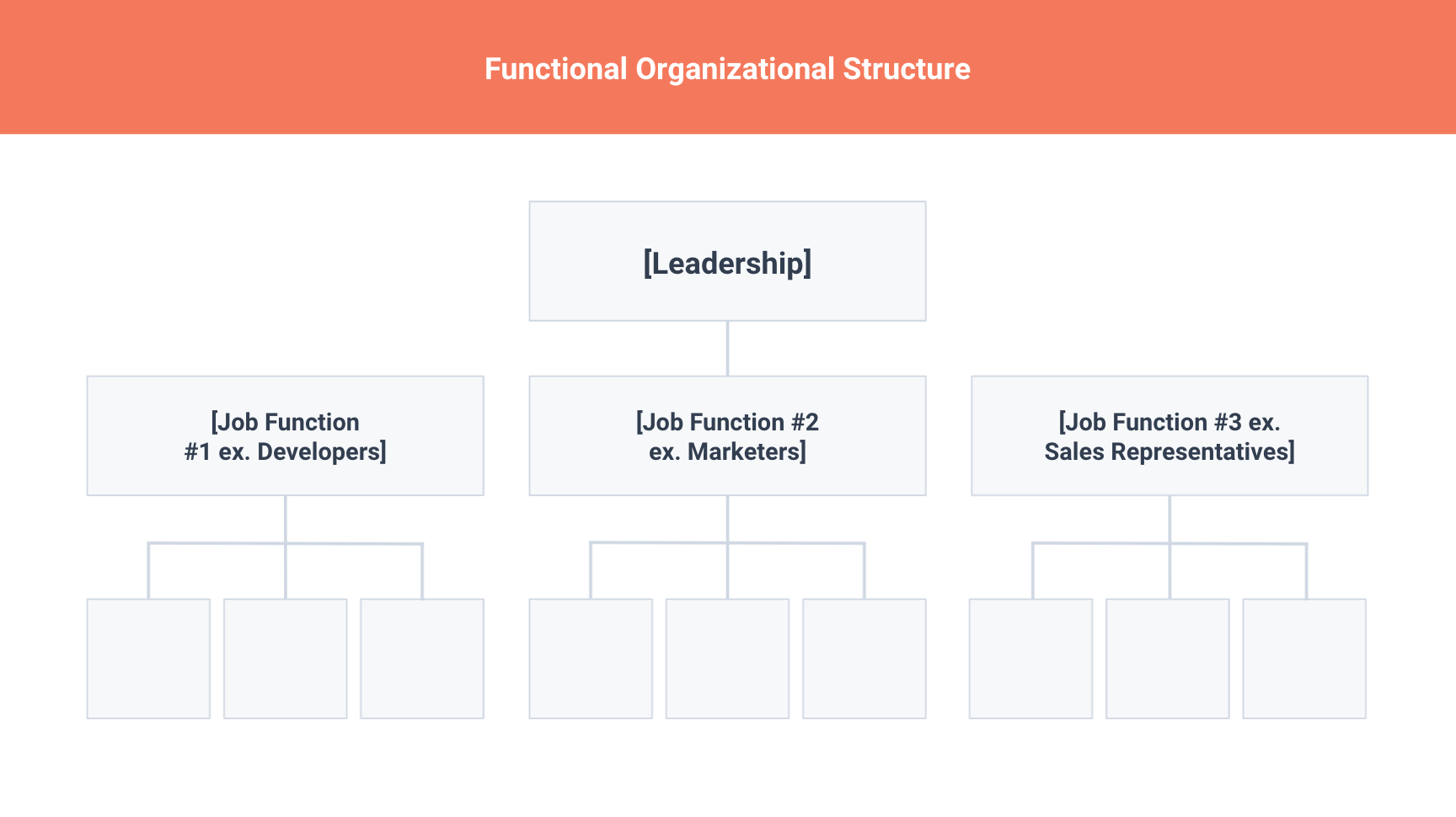
Each department has its own supervisor, who reports directly to the CEO. In addition, directors have direct powers to employees. In addition, communication channels appear to be open, so directors can send or share information to managers that they do not directly control.
The benefits of the functional structure include:
- Easy to expand, suitable for organizations of all sizes.
- Allows high degree of specialization
- Increase self-sufficiency and innovation
For example, if your organization adopts a functional chart, you would put all sales, marketers, and customer service personnel in three separate departments. Placing employees in skills-based departments allows employees to develop specific professional roles. However, because the organization chart is mechanical in nature, it may hinder the growth of employees.
In addition, the functional structure may create barriers between departments or functional groups. Other disadvantages include:
- Limit people’s knowledge to departmental boundaries
- Prohibition of communication between different departments
4. Matrix structure
Unlike most organizational structures, the matrix structure deviates from the traditional straight-line structure. This is a hybrid organization chart that combines functionality and project-based structure.
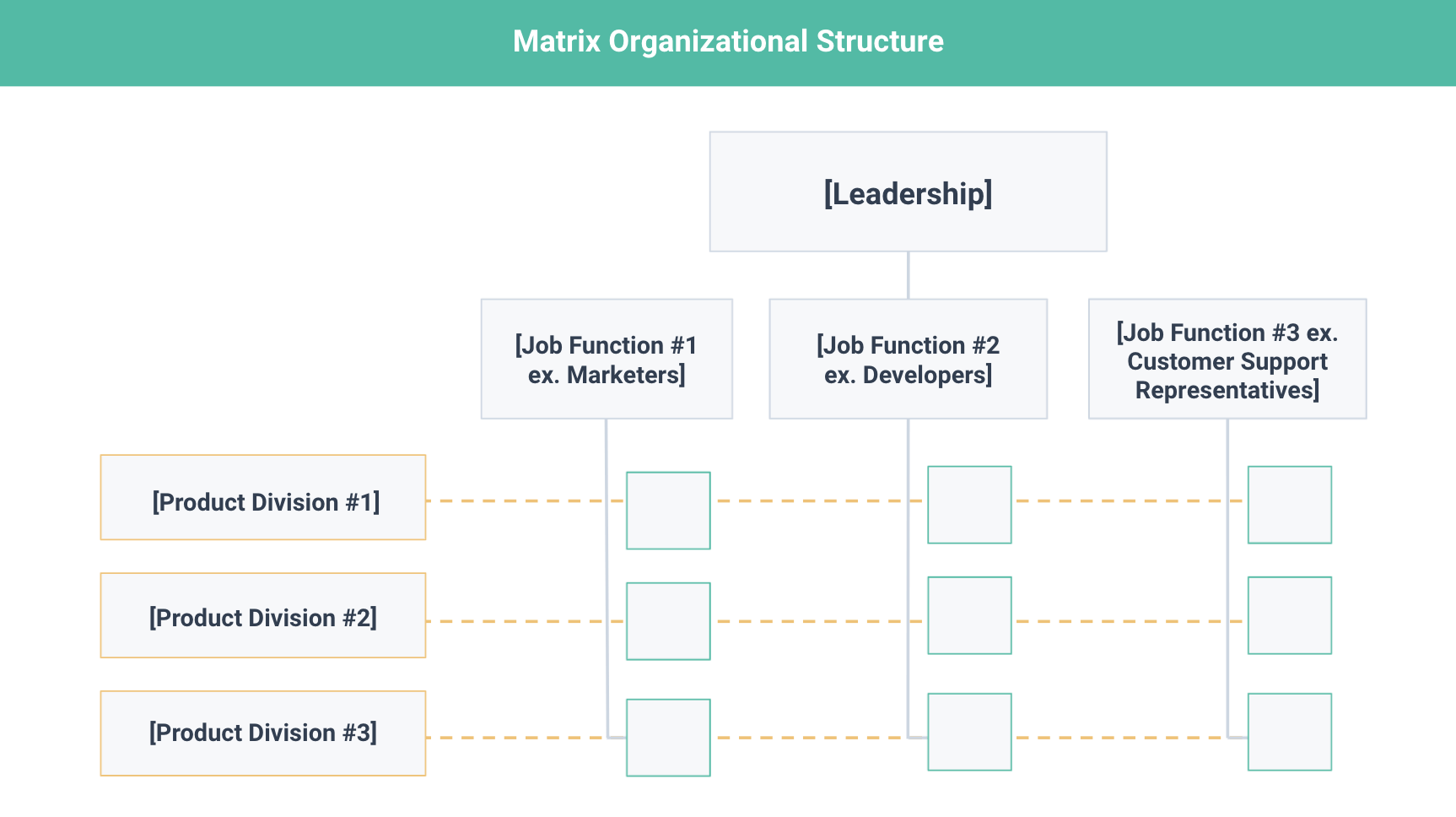
For example, leaders have direct power over representatives from traditional functional departments, such as marketers, developers, and sales personnel. Then, the representatives report to the functional managers in their respective professional fields. In other words, in the matrix structure, there are two bosses.
The benefits of Matrix’s organizational structure include:
- The team leader can freely choose the best talents for each project
- It assigns different responsibilities to each employee
- It enables employees to hone their skills outside their area of expertise
Even if the matrix organization structure is effective, its essence may be the source of multiple challenges. Some disadvantages of this structure include:
- It changes frequently
- It can lead to conflicts of interest between departmental needs and project organization.
Other organizational structure
The four structures mentioned above are some of the most common structures. However, there are other structures that companies can use and find that their processes and requirements are effective.
Other organizational structures worth mentioning include:
- Market-based departmental structure-responsibilities and job roles are based on the market served.
- Product-based departmental structure-Responsibilities and job roles are based on the products being created and sold.
- Process-based structure-designed around the activities performed by each employee and how these activities interact with each other.
- Circular structure-This structure is not a hierarchical structure, but focuses on leadership that expands from the inside out.
- Geographical department structure-this structure is most suitable for companies in different regions and geographic locations. Although each is part of a larger entity, they operate each location in a way that best suits that particular department or local requirements.
- Network structure-this structure is very unconventional. It pays little attention to hierarchy, and is flat and flexible. Managers within this structure control the company’s internal and external relationships.
Benefits of organizational structure
The organization chart can be applied to enterprises of any size in any industry. As the company grows, this type of system can help new employees understand how the process is managed. It defines the corporate culture and keeps daily operations running efficiently.
The organizational structure will visualize the workflow to predict future business.It enables companies to use leadership as Brand evolution. There is no right or wrong way to organize your business. Some institutions may require a strict and centralized foundation, while others may thrive in a flexible and decentralized environment.
Factors to consider when choosing an organization chart for a remote team
There is no doubt that the COVID-19 pandemic has severely affected the world of remote work. During the epidemic, 70% of employees are in the U.S. home work.
Remote work seems to have left a deep impression on most employees. 80% want to work from home At least 3 times a week after the pandemic. If you have any questions about whether your organization should adopt remote work, now is the time.
Remember to embrace a mixed team or Allow full remote work It may change the way your company manages its employees. Therefore, you need to combine the culture of the remote company with a suitable organizational structure. Doing so allows employees to fully understand the direction of your organization and how they contribute to achieving the established goals.
Having a formal organizational structure helps to hold remote employees accountable and Manage projects smoothly. When choosing an organizational structure that perfectly matches the remote working mode, please choose the following structure:
- Strengthen communication
- Promote cooperation
- Allow managers to monitor progress through regular check-in
- It clearly outlines who will be responsible for what.
Why it is important to understand the organizational structure
One of the main reasons salespeople in the B2B market segment spend a lot of time searching for decision makers is that they do not understand the internal structure of the underlying organization. The organization chart can help you understand exactly who is in control and make it easier to complete sales.
Organizational structure also contributes to account-based marketing strategies. For example, consider the situation where you sell a full-service marketing, sales, and customer service platform. You will ask the department head to “approve” for the sale.
In this case, an organization chart can help you identify each key customer, the position they hold, and the impact of software installation on them. In this way, your sales and marketing team can prepare a hit-and-shoot campaign and present it to decision makers.
Choose an organization chart according to business needs
The organization chart is not static. If one does not work, please change the workflow. In the real world, the solution is somewhere in between. Companies usually choose a hybrid version of layered and organic charts. Try to borrow elements from different structures.
In the final analysis, it is about daily functions, brand identity, and employee satisfaction and productivity. Regardless of the type, a well-defined organizational structure is always essential for business development.


