


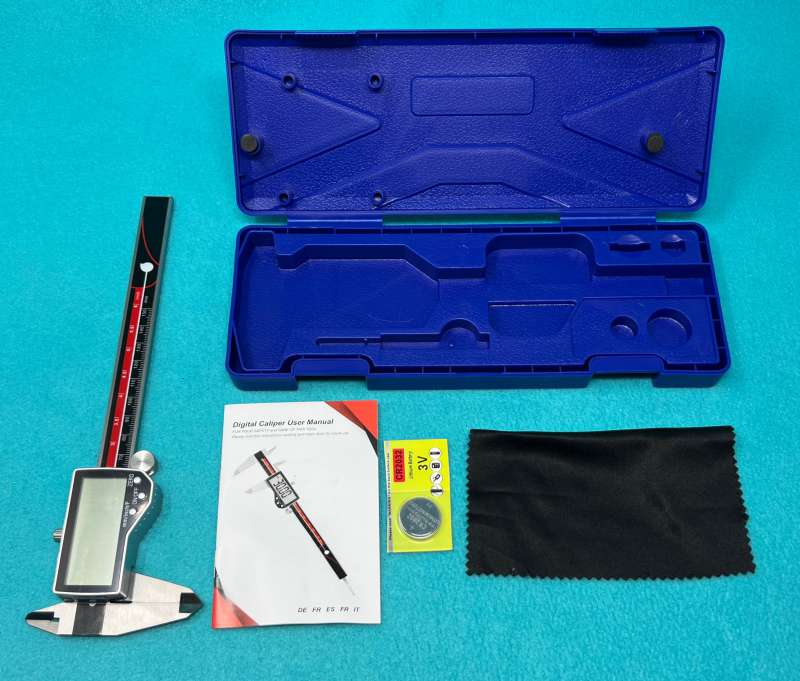
review – Highly accurate measurements help in everything from cooking and bartending to engine performance, aircraft stabilization and many other engineering tasks. For physical measurements of objects, it’s hard to beat a set of vernier calipers. I received a set of digital vernier calipers from Qfun for testing and have been measuring all the small spaces in my house for a few weeks. I’m ready to report now (about the tools, not the size of the items in my house!).
What is it?
The Qfun Digital Caliper Measuring Tool is a set of modern metal calipers with a digital readout instead of a dial or scale.
What’s in the box?
- Qfun digital caliper measuring tool
- storage box
- Batteries and paperwork
history
Vernier calipers have two jaws – one for internal measurements and one for external measurements. Initially, the slider had a set of scales that gave you highly accurate readings. Then someone invented a set of gears that would give you a reading on a rotating dial when you changed the distance between the sets of jaws. Now, in the digital age, the slider’s gearing informs the LED reading, which can be reset with a push button for differential measurements. (How much bigger is this thing than that thing?)
Vernier calipers have been helping people with their measurement tasks because they Invented in the 1650s(Pierre Vernier, born 1580 in Ornans of the Spanish Habsburg dynasty (now France), Franche-Comte invented the “scale caliper”. He created the Vernier scale, published in his publication in 1631 The Structure, Appearance and Properties of the New Quadrant of Mathematics.)
Modern calipers were manufactured and mass-produced by American Joseph R Brown in 1851.
Manufacturing tolerances have improved since then, but the reading method has remained the same until recent decades. In high school and college in the ’70s, I was taught how to read the Vernier scale. There may have been dial models available at the time, but we didn’t have anything but the originals to work with. (Remember, in 1970, a 4-function calculator (only add, subtract, multiply, and divide – no square roots!) cost $300 to one of my teachers. That’s $2,200 today, according to dollar times! )
Design and Features
The Qfun digital caliper measuring tool model I received is very sturdy and well made. There’s no “wobble” in the sliding scale, so you know it’s accurate. There are three buttons on the scale: on/off, reset and mm/inch for metric/ISO conversion. The jaws are 9.25 inches long for a total length of 3 inches. The readout area is 0.625″ thick x 2.25″ x 1.5″. While the head is clearly heavier than the scales, the overall weight is only 5.8 ounces. The heavy hard plastic case holds it in place without rattling, and there’s room for an extra battery or two, along with instructions (I doubt you’ll need them!) and a polishing cloth for the screen .
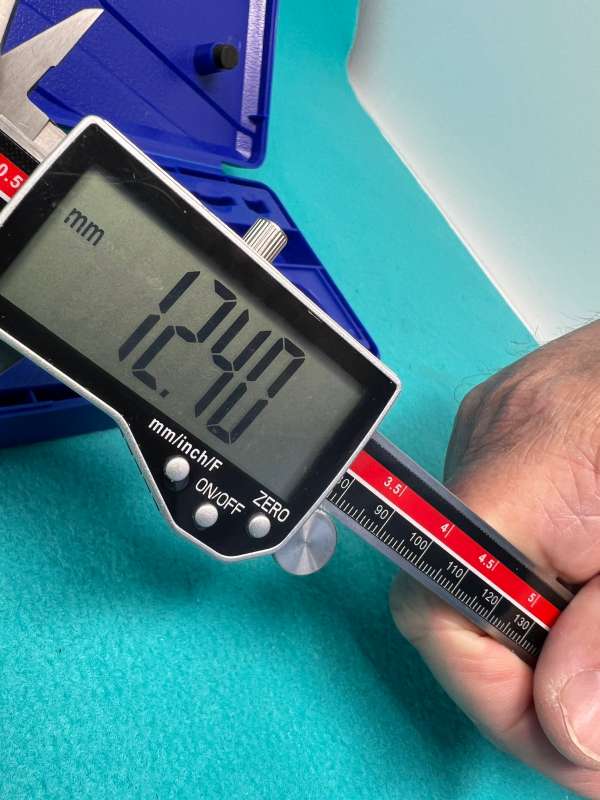
Usage is simple. Turn on the device, make sure it’s completely off, and set to zero. Pull the jaws apart (or use the thumbwheel) until the jaws just touch the area you want to measure and check the reading. In the manual’s defense, it does provide tips for measuring irregularities in order to get a correct reading, but that really has nothing to do with the device itself, just math. (There are techniques that can be used to measure certain solids correctly. Making sure the measuring device bisects the solids correctly can make a big difference, but if you need this tool, you already know it!)
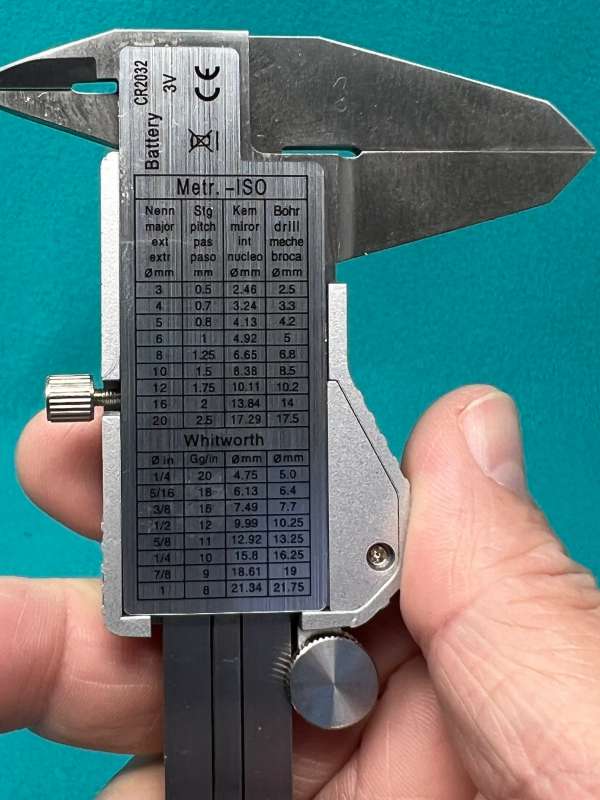
On the back there is a scale related to internal measurements and engineering gauges (I think), but that doesn’t help me, even though the units are given in five languages.
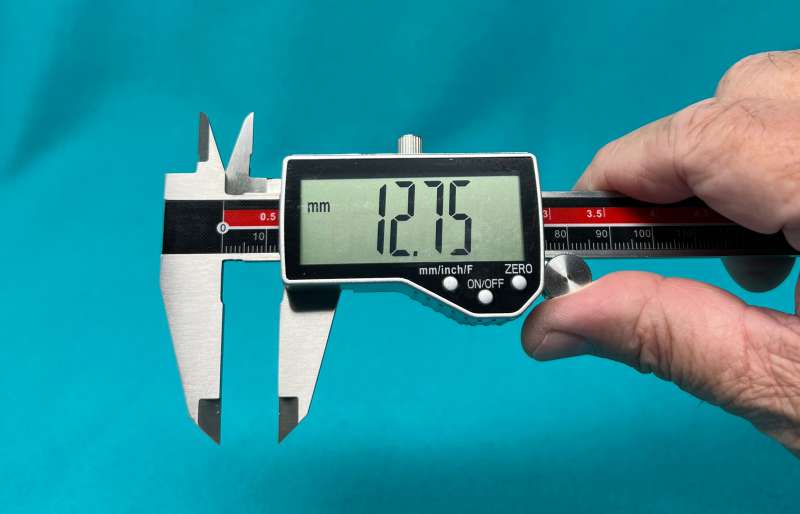
If you want to keep the jaws of the Qfun digital caliper measuring tool open by a set amount for production verification, there is a small set screw on the top opposite the button, shown here above the “2” in the readout. Although it’s a tiny set screw, it seems to hold on tightly.
Performance
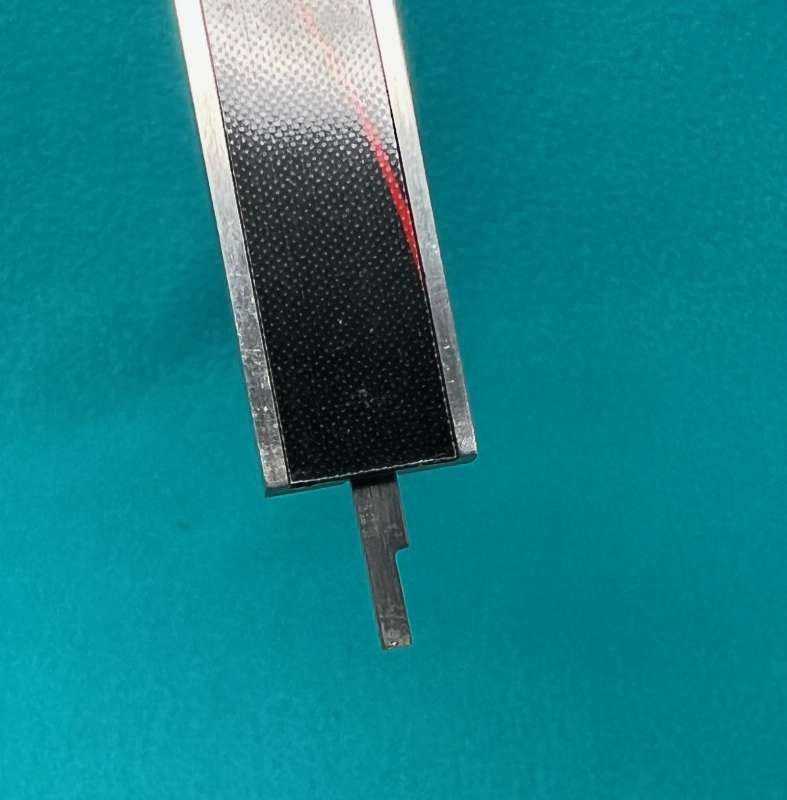
The Qfun digital caliper measurement tool can be easily turned on and off and the conversion is accurate (verified pCalc Calculator app on my iPhone). Occasionally, when I open it, a small amount is displayed on the scale, even with the door fully closed. I got into the habit of zeroing it on full shutdown every time I use it, and that solved the problem. It’s a nice touch to use the tailpiece to make step measurements within a milled piece, not just a single pin. If they really wanted to level up the game, there might just be a small horizontal pin that would slide into an internal cutout. I’m looking forward to using it to check out items I’ll be making with my 3D printer that will show up in my review queue!
what do I like
- Fast and accurate measurements
- Extremely easy to use
- Excellent build quality
what would i change
- Maybe a reading from the backlight?
final thoughts
The first time I encountered vernier calipers was in high school physics class. Above the blackboard, next to the giant slide rule, is a giant device. We also have very basic models that can be used in our experiments. It wasn’t until college that I actually got my hands on a really beautiful setup in a physics lab, and I’ve admired the simplicity of the design ever since. Adding numerical functionality to the overall idea is as logical as replacing a slide rule with a pocket calculator. Accuracy has increased, as has speed and ease of use. If you need to take small measurements, do yourself a favor and get a set of Qfun digital calipers measuring tools. It’s no longer a very good laptop for the price!
price: $32.99
where to buy: Amazon
source: This product sample is provided by fun.


