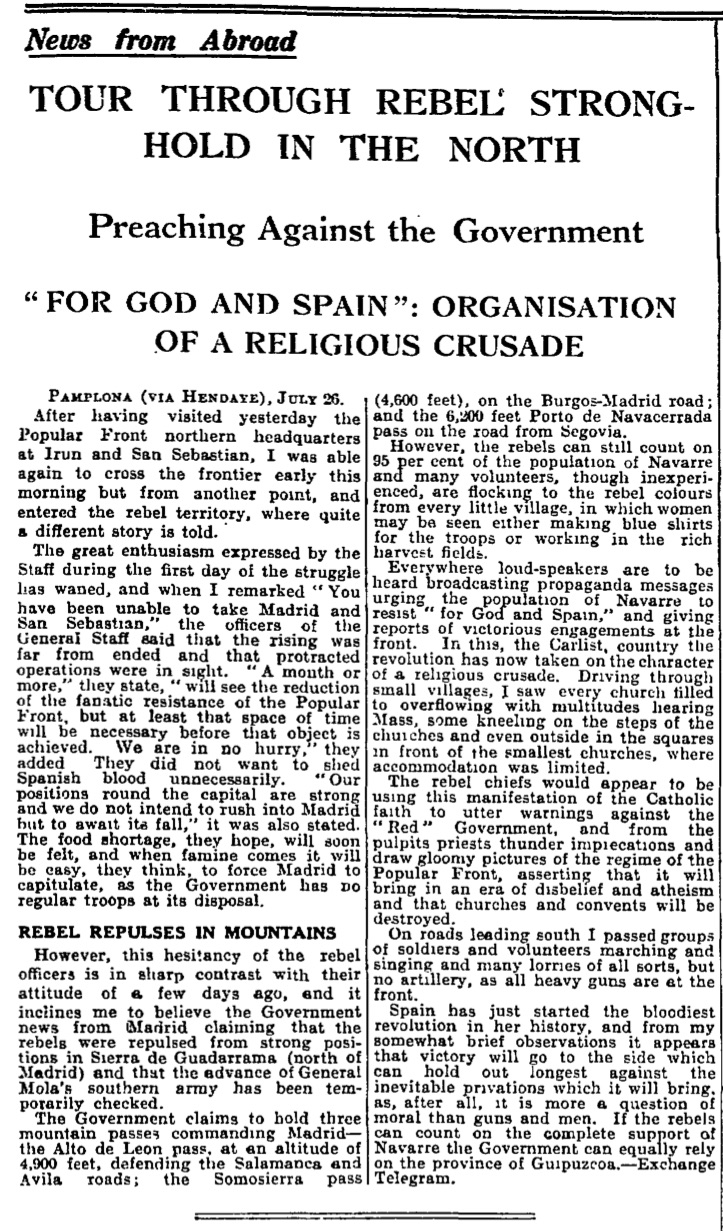
New troubles in Spain?
July 18, 1936
Reuters learned this morning that due to what is considered to be “serious political reasons”, Spain Telephone communication with the rest of the world is interrupted.Paris received a mysterious message from Paris Spain The statement said that there was an incident in Cuenca, but the number of victims is unclear. “Cuenca is the capital of the province of Cuenca, located about ninety miles southeast of Madrid.
Rebels occupy Spanish cities
The Observer, July 19, 1936
It was learned late last night that the Spanish army’s rebellion in Spanish Morocco had spread to Seville, but according to official sources from the Spanish government, the army was quickly subdued by the government. Other parts of Spain and the Canary Islands are apparently also in trouble.
Reports from neighboring countries stated that the number of troops in the Moroccan uprising was about 20,000. They are obviously the leaders, but the Spanish Foreign Legion, supported by the local army and other units, the movement is aimed at the People’s Front (socialist) government.
Fighting in the Spanish Republic: Severe Uprising
July 20, 1936
From Friday to Saturday night, a large-scale military, monarchist and fascist rebellion began in Morocco, Spain, many cities and towns in Spain, and the Canary Islands and Balearic Islands.
News from Spain is subject to strict scrutiny, but it is clear from the news approved last night that the threat to the Republic has been-and may still be-very serious. The left-wing government still rules Madrid-even though it was rebuilt twice in 15 hours-and it was announced last night from the capital’s radio station that it has the upper hand in Morocco and Spain itself.
The centers involved in Spain include Malaga, Seville, Barcelona, Bilbao and Cádiz. A French passenger plane from North Africa refueled in Barcelona, and the report stated that the city had been bombed by planes.
The Seville radio station, which is in the hands of the rebels, has been sending out rebel propaganda with varying degrees of credibility. The report broadcast yesterday stated that the rebel leader, General Franco, has landed in Cadiz from Morocco and is preparing to march. In Madrid.
The government claims that the navy remains loyal and that some ships have been sent to Morocco to help quell the rebellion, but a rebel destroyer bombed the barracks in La Linea near Gibraltar yesterday, and the loyal army refused to follow the fascist officers.
In a statement broadcast yesterday, the new cabinet Mr. Girard, Announcing that it will arm the Spanish people with the goal of suppressing the revolutionary movement. Weapons have been issued to civilians in Madrid and other centres defending the Republic. Madrid itself clearly has no serious problems.
Editorial: Uprising in Spain
July 20, 1936
On Friday, a serious rebellion broke out between the armed forces in the Spanish region of Morocco and the Canary Islands, but at first it did not have any significant impact on the continent outside of Seville.
Presumably, the purpose of this uprising was to overthrow the left-wing Republican (but not socialist) government that came to power after the March election and establish some kind of right-wing dictatorship to replace it. The Spanish people seem to be particularly unwilling to accept the results of democratic elections.
continue reading.
Rebels aided by the Italians and Germans: Berlin’s Mediterranean ambitions
From our diplomatic correspondent
July 25, 1936
Here is a pessimistic attitude towards events in Spain. There is no indication as to whether the government or the insurgents are likely to win. Everything points to a protracted and bloody civil war. The advantage of the insurgents is that they can get outside help, but the government has got nothing. The latter has applied to the French government for a license to import weapons from France, but at least so far has not obtained a license. On the other hand, the insurgents were assisted by Italians and Germans.
Weapons from Italy
For the insurgents, they believe that they have the support of the two “fascist forces”, which is a huge encouragement. But this is not just an encouragement, because many of their weapons now come from Italy. This is especially true in Morocco. Germany has the strongest influence in the Balearic Islands. Germany is very interested in the victory of the insurgents. Obviously, when they came to power, she hoped to get concessions in the Balearic Islands. These islands will play an important role in Germany’s future plans to develop maritime power in the Mediterranean.
Germany is particularly interested in the civil war, because the victory of the insurgents will open the prospect of action in the presence of Anglo-French cooperation and the presence of a pro-British, pro-French and pro-Alliance Spanish Republic.WEAT EuropeIn other words, a “fascist” Spain will be a means for Germany to “turn the French flank” and play a role in the Mediterranean.