I reposted this article on the day President Biden announced the repurposing of the former Foxconn site 2017 assessment.
from Legislative Finance BureauThe memorandum of understanding between Wisconsin and Foxconn states:
…Foxconn agreed to invest $10 billion over six years to build a factory in Wisconsin and create up to 13,000 jobs, with a reported average wage of $53,875 over six years. The state agreement would provide an economic package of up to $3 billion, including refundable tax credits and a construction sales tax exemption for Foxconn, according to the memorandum of understanding.
What is the cost calculation for benefits to taxpayers in the state? In order to conduct the analysis, a set of assumptions needs to be made; these include:
- The project will require the employment of an average of approximately 10,200 construction workers and equipment suppliers per year, with an average annual total compensation of approximately $59,600 (including benefits) over the four-year construction period (2018 to 2021). Their combined income is estimated at $2.4 billion.
- Nearly 6,000 indirect and induced jobs will be created during construction, with average total compensation of $48,900.
- The additional construction period work will increase state taxes (primarily income and sales taxes) equal to approximately 6.3% of the additional payroll. The total increase in state taxes associated with the construction period is estimated at $186.9 million.
- The number of regular employees at Foxconn factories is expected to increase from about 1,000 in the second half of 2017 to 13,000 starting in 2021. , we will invest $1 million, which will increase to approximately $700 million annually starting in 2021.
- All employees are Wisconsin taxpayers (i.e. no Illinois residents).
- Starting in 2021, state tax revenues related to additional employees and payroll are expected to increase from about $900,000 this year to $44 million annually.
- Based on a multiplier of 2.7, indirect and induced jobs associated with the project are expected to reach 22,000 starting in 2021. The average annual salary for these individuals is estimated to be approximately $51,000.
- Ongoing payroll is $1.12 billion per year, with associated state taxes of $71 million per year. The impact from 2017 to 2020 is expected to be smaller.
in conclusion:
[Wisconsin Department of Administration] The cost of refundable state tax credits under the bill is expected to exceed the potential increase in tax revenue until the last EITM payroll credit is paid in fiscal year 2032-33. By the end of the year, the cumulative net cost of the incentive program was estimated at $1.04 billion. Beginning in 2033-34, payments to the company will stop, raising state tax revenues by an estimated $115 million annually. DOA estimates that the project's break-even point will be achieved in fiscal year 2042-43.
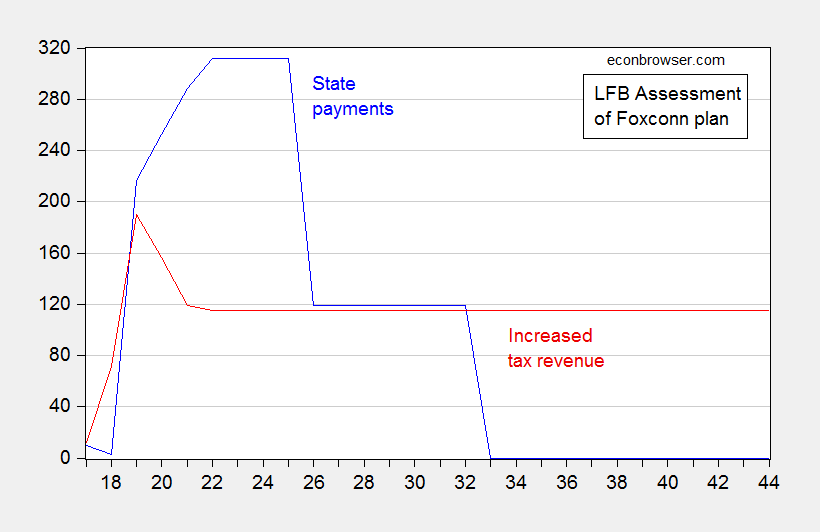
In Figures 1 and 2 below, I summarize the growth of state payments and revenues and the flow and accumulation of net income, respectively.The astute will note that state payments are made in advance for the first 15 years (after which Foxconn may leave), and even under the fairly optimistic assumption of 13,000 new jobs, breakeven will be achieved in fiscal 2017 2042-43.
figure 1: State payments (blue) and tax increases (red) mandated by Act 1 of the August 2017 special session, in millions of dollars, by fiscal year (2018 represents fiscal year 2018-19). source: Legislative Finance Bureau,Table 4.
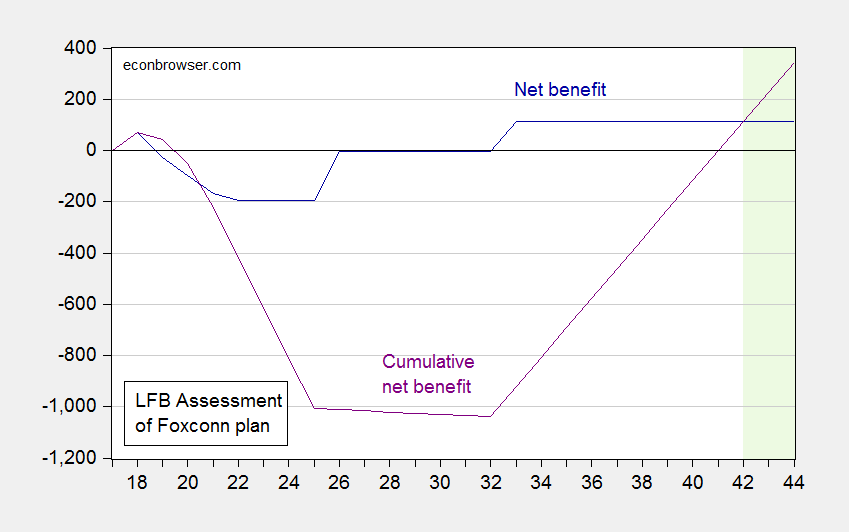
figure 2: Net benefit calculated in fiscal year (2018 means fiscal year 2018-19) is incremental tax revenue minus state payments under Act 1 of the August 2017 Special Session of the Assembly (dark blue) and cumulative (purple) in hundreds Ten thousand U.S. dollars. source: Legislative Finance Bureau,Table 4.
As mentioned earlier, there is considerable uncertainty about employment growth. LFB mildly observed:
Media reports said the proposed factory would have closer to 3,000 permanent jobs, rather than 13,000. If this were the case, using the other assumptions above, payments of the EITM payroll tax credit would decrease from just under $1.5 billion to about $345 million over the 15-year life of the EITM zone, but the capital expenditures credit would still would be estimated at $1.35 billion. The project's ongoing tax benefits are estimated to be reduced from $115 million to $27 million per year, with the break-even point well beyond 2044-45.
Whether Foxconn will live up to its promises is a serious question. Hilzik at the Los Angeles Times Highlighting the 2013 Pennsylvania deal.
Foxconn itself has a reputation for making generous promises only to fall short, and that seemed to be the case with a project the company promoted in 2013 in Harrisburg, Pennsylvania. The deal is to build a $30 million factory employing 500 workers. But the plant has yet to materialize.
and from Wisconsin State Gazette:
Amid all the cheers and hype, it's important to remember that Foxconn has earned a reputation for failing to deliver on its promises. Business publication Crain's warned that “Foxconn Technology Group…has a history of making huge promises in the United States with little in return.”
Foxconn abandoned its commitment to Harrisburg, Pennsylvania, where Chief Executive Terry Gou pledged to expand its small 50-person factory into a manufacturing facility with 500 workers. According to The Washington Post, its announcement caused “intense buzz” and was “created by a CEO known for promising projects around the world that never quite materialize.”
Foxconn has also failed to deliver on its commitments for new or expanded investments in Brazil, China, India, Indonesia and Vietnam.
“There's a pattern here,” observed Alberto Moel, a senior analyst at Bernstein Research in Hong Kong.
Bloomberg pointed out that Foxconn’s current commitments total US$27.5 billion, which is more than Hon Hai’s expenditures in the past 23 years.
The fact that this venture does not appear to be a big positive for Wisconsin appears to be consistent with the literature that state tax incentives for business relocation generally do not yield large returns.from a survey Bath(2001):
Currently, the tax literature appears in hundreds of publications but provides little guidance to policymakers trying to adjust economic development. Taxes should be important to states, but researchers can't determine how, when, or where. Businesses may need tax incentives to improve their viability in certain areas, but the researchers couldn't pinpoint which businesses or which locations.
Perhaps more relevant to this specific case:
… Declining firms tend to take advantage of programs targeting poor areas, while growing firms tend to be located in nonpoor counties.Tax incentives make distressed districts worse off or not better off, while non-distressed districts always improve
Excerpt from Analysis of Noah Williams around the same timeformerly of the University of Wisconsin-Madison.
In this article, I assess the potential economic impact of the Foxconn plant on the Wisconsin economy. I consider the factors that influence the immediate impact of the Foxconn factory and the other wider impacts it may have. If implemented as planned, the plant's immediate impact would be significant, and the broader impact could extend far beyond typical fiscal policy. In particular, the opening of large-scale high-tech manufacturing operations by multinational corporations has the potential to generate significant spillover effects. I draw on the economic literature on factory openings and foreign direct investment to analyze the size of these potential gains. Although direct employment multipliers in the literature range from 1.7 to over 3, the range most relevant to this case is 2.5-3.0. Therefore, if Foxconn creates 13,000 direct jobs, it can directly create a total of 32,000-39,000 jobs through its supply chain, employee suppliers, spillovers from existing businesses, and new investments. I have also reviewed the previously conducted economic assessment and assessed some of the concerns raised about the proposal. In an overall assessment of the Foxconn package, the uncertain but potentially large gains in employment, wages, output and income must be weighed against certain fiscal costs.